Guide · 9 min
Vinyl Wear Layer: How to Choose by Usage Class
2 September 2026
Most people start choosing vinyl flooring by looking at the décor and the colour. What actually decides how long the floor lasts, though, is not its appearance but two technical figures: wear layer thickness and usage class. Between them they determine whether, five years from now, a worn traffic path appears in front of the kitchen sink or the surface still looks as it did on day one. This guide explains both in plain language and gives you the tables you need to match a floor to your rooms.
What the vinyl wear layer actually is
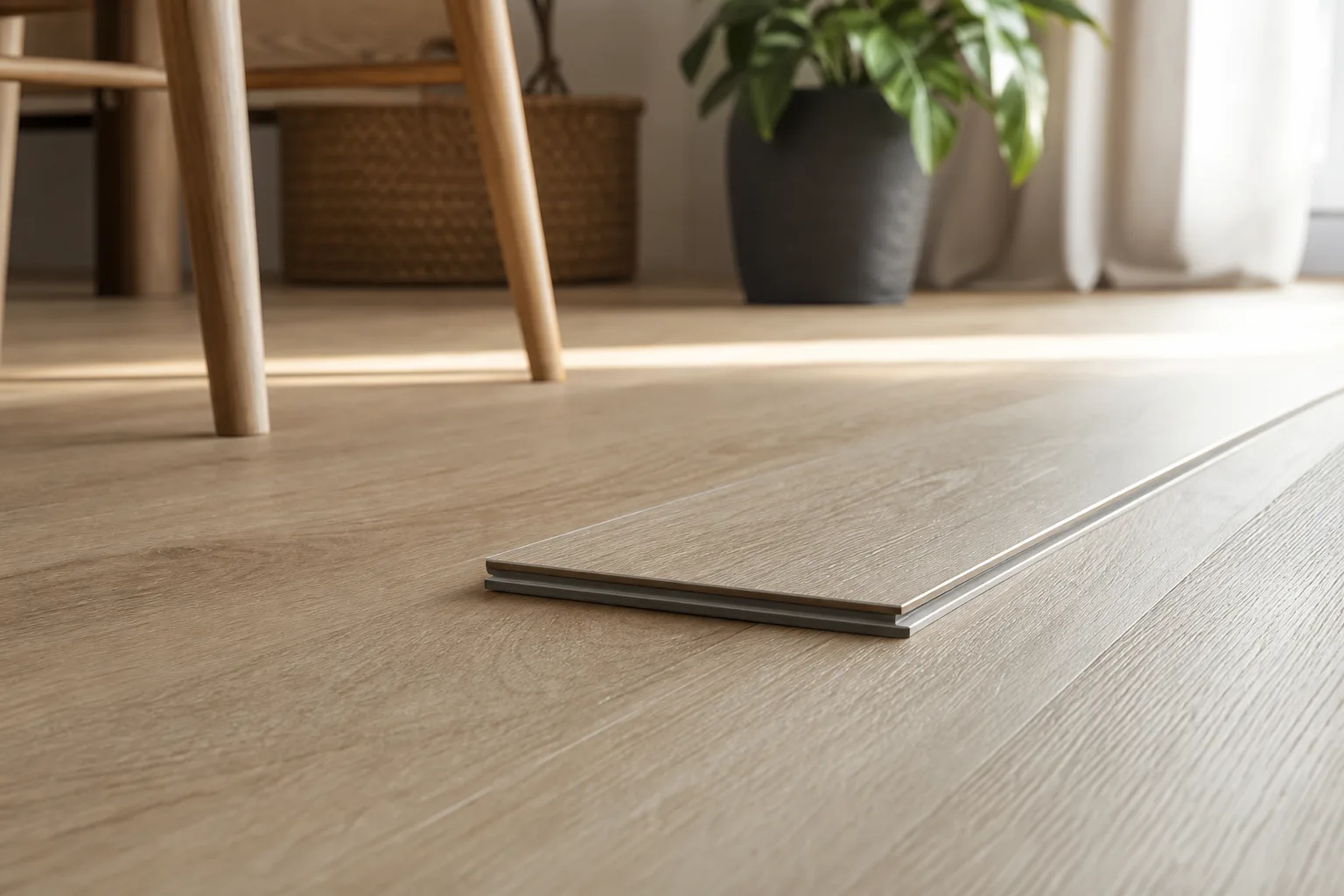
A vinyl plank is built up in layers. At the bottom sits a rigid SPC core (a stone-polymer composite), above it a decorative film printed with a wood, stone or concrete design, and right at the top a transparent wear layer (also called the wear coat). This is pure clear PVC. It covers the print and absorbs all the friction the floor ever sees: shoe soles, castor wheels, pet claws, grit walked in from outside.
Thickness is measured in millimetres and is usually 0.3 mm, 0.5 mm or 0.55 mm. The thicker it is, the longer the décor stays untouched. It is important not to confuse the wear layer with overall plank thickness — that figure (4–6 mm in the case of SPC) governs rigidity and underfoot feel, not abrasion resistance. You can easily have a substantial 5 mm plank carrying a thin 0.3 mm wear layer: the floor will feel solid, but the print will wear through sooner than on a thinner plank protected by 0.55 mm.
| Wear layer | Suited to | Typical traffic |
|---|---|---|
| 0.3 mm | Bedrooms, sitting rooms, rooms in occasional use | Low / moderate |
| 0.5 mm | Kitchen, hallway, a whole apartment, homes with children and pets | Moderate / heavy |
| 0.55 mm | High-traffic zones, light commercial (office, consulting room) | Heavy |
In practice, the dependable threshold for a home is 0.5 mm. That is enough protection for a family apartment with children, a dog or a cat, and an office chair being rolled about. Our SPC vinyl collections carry a 0.5 mm wear layer as standard, which covers even the busiest areas of a home as well as light commercial use.
Usage classes: what the numbers from 21 to 43 mean
The usage class is standardised under EN ISO 10874 — the same standard that applies to laminate. It is a two-digit number in which the first digit indicates the type of space and the second the intensity of traffic.
- 2x — domestic spaces. 21 is low traffic (bedroom), 22 moderate (sitting room), 23 heavy (hallway, kitchen).
- 3x — commercial spaces. 31 is low traffic (hotel room), 32 moderate (office), 33 heavy (shop, café).
- 4x — industrial and very heavy traffic. 41–43 covers production areas, warehouses and public spaces.
The logic is straightforward: the higher the number, the more hard-wearing the floor. A domestic floor does not have to carry a domestic rating — a commercial-class floor (31–33) will last even longer in a house, because household traffic is light by its standards. This is why good vinyl is often given a double class, such as 33/43: 33 is the commercial rating, 43 the industrial one. Our SPC floors carry exactly that marking — 33/43 — which means they are designed for heavy-traffic commercial and light industrial use, and in a home they are effectively immune to wear.
| Class | Space | Traffic | Example |
|---|---|---|---|
| 21–23 | Domestic | Low to heavy | Bedroom, sitting room, apartment |
| 31 | Commercial | Low | Hotel room, private office |
| 32 | Commercial | Moderate | Office, consulting room |
| 33 | Commercial | Heavy | Shop, café, corridor |
| 41–43 | Industrial | Low to heavy | Factory, warehouse, public areas |
Which class to choose for a home
For most apartments and houses, class 32–33 with a 0.5 mm wear layer is enough. That combination absorbs everyday traffic, children at play, pet claws and furniture being shifted about for at least 15–20 years without visible wear. If you are laying the same vinyl throughout (open-plan layouts being the most popular approach at the moment), there is no need to buy different classes for different rooms — one good class 33 floor will serve the bedroom and the hallway equally well.
A few practical pointers, room by room:
- Kitchen and hallway — the heaviest traffic and the most moisture; here 0.5 mm and class 33 are not excessive, they are the baseline.
- Bathroom and WC — SPC is 100% waterproof and works well; the class matters less than sealing the perimeter properly against the walls.
- Bedroom — 0.3 mm and class 23 would technically do, but if you are buying one floor for the whole home, stay with 0.5 mm.
- Home office or reception area — a rolling chair loads the surface hard; go for 0.55 mm, or class 33 at the very least.
Want to work out exactly how many square metres you need and what that will cost? Use our flooring quantity and price calculator — enter the room area and you will see the number of packs and the total straight away, with a 5% allowance added for offcuts.
How the wear layer affects price and warranty
The wear layer is one of the most expensive components of a plank, so it feeds directly into the price. Budget vinyl — indicatively around €15–20/m², though street prices differ from country to country — normally has a 0.2–0.3 mm layer and a class of 23 or 31. Mid-range and upwards, with a 0.5 mm layer, starts at roughly €25.95/m² incl. VAT, which is where our SPC vinyl flooring begins. The gap between 0.3 and 0.5 mm looks small on paper, but in service it translates into another 8–12 years of life.
The warranty is almost always tied to wear layer thickness and class. Our SPC vinyl carries a 25-year domestic and 10-year commercial warranty — no manufacturer would offer that term on a thin layer. It is a useful shortcut when comparing floors: if the domestic warranty is shorter than 15 years, the wear layer is most likely 0.3 mm or thinner.
If you are weighing SPC against the more flexible LVT, we compare the two in a separate article — SPC or LVT vinyl: the differences and which to choose. And if you want to understand pricing as a whole, our guide to vinyl flooring costs sets out what actually makes up the final price per m².
The common mistake: thickness instead of quality
Sellers like to lead with overall plank thickness (a full 6 mm, and so on) because the number is large and sounds impressive. But total thickness only affects rigidity and acoustic comfort, not surface durability. When comparing floors, always check the wear layer (mm) and the usage class first, and only then the overall thickness. A well-balanced domestic floor looks like this: a 4–5 mm SPC core, a 0.5 mm wear layer, class 33/43, and an integrated acoustic backing.
The best way to judge a floor is to handle it. Order 3 free samples to your door: you will see the texture and the depth of the print, and get a feel for how the plank looks under your own lighting. Would you prefer a personal recommendation based on your rooms and traffic? Arrange a free video consultation — we will go through the plan together and settle on the right class. There is more on the material itself in our full guide to vinyl flooring.
Frequently asked questions
Which wear layer is right for a home?+
The dependable threshold for a home is a 0.5 mm wear layer. It stands up to heavy household traffic, children at play, pet claws and furniture being moved. 0.3 mm is only enough for bedrooms or rooms in occasional use, while 0.55 mm is worth choosing for a home office with a rolling chair or for light commercial use. Our SPC vinyl has a 0.5 mm layer.
What does class 33 vinyl mean?+
Under EN ISO 10874, class 33 means a commercial space with heavy traffic — a shop, a café, a corridor. In a home, household traffic is light by that standard, so a class 33 floor is effectively immune to wear. It is often given a double class, for example 33/43, where 43 is the industrial rating. Our SPC vinyl is class 33/43.
Are the wear layer and the overall thickness the same thing?+
No. Overall plank thickness (4–6 mm in the case of SPC) governs rigidity and underfoot feel, while the wear layer (0.3–0.55 mm) governs abrasion resistance. A thick plank can carry a thin wear layer: it will feel solid, but the print will wear through sooner. Always check the wear layer and usage class first, and the overall thickness afterwards.
How much does vinyl with a 0.5 mm wear layer cost?+
Our SPC vinyl with a 0.5 mm wear layer and class 33 starts at €25.95/m² incl. VAT. Cheaper floors, indicatively €15–20/m² depending on the market, usually have only a 0.2–0.3 mm layer and class 23 or 31. We ship on pallets across the EU, with the delivery cost and lead time shown at checkout or confirmed on request, and you can work out the exact area you need with our flooring calculator.
Do different rooms need different classes?+
No, not if you choose a good class 33 floor with a 0.5 mm wear layer — it will cover the hallway and the bedroom alike. In open-plan homes it is actually recommended to run one continuous floor without thresholds, so separate classes are unnecessary. Mixing classes only makes sense when you are economising and laying a thinner 0.3 mm floor in the bedrooms.