Advice · 9 min
Parquet in a bathroom: can it really work?
2 September 2026
Why parquet can be an excellent bathroom floor
Natural character
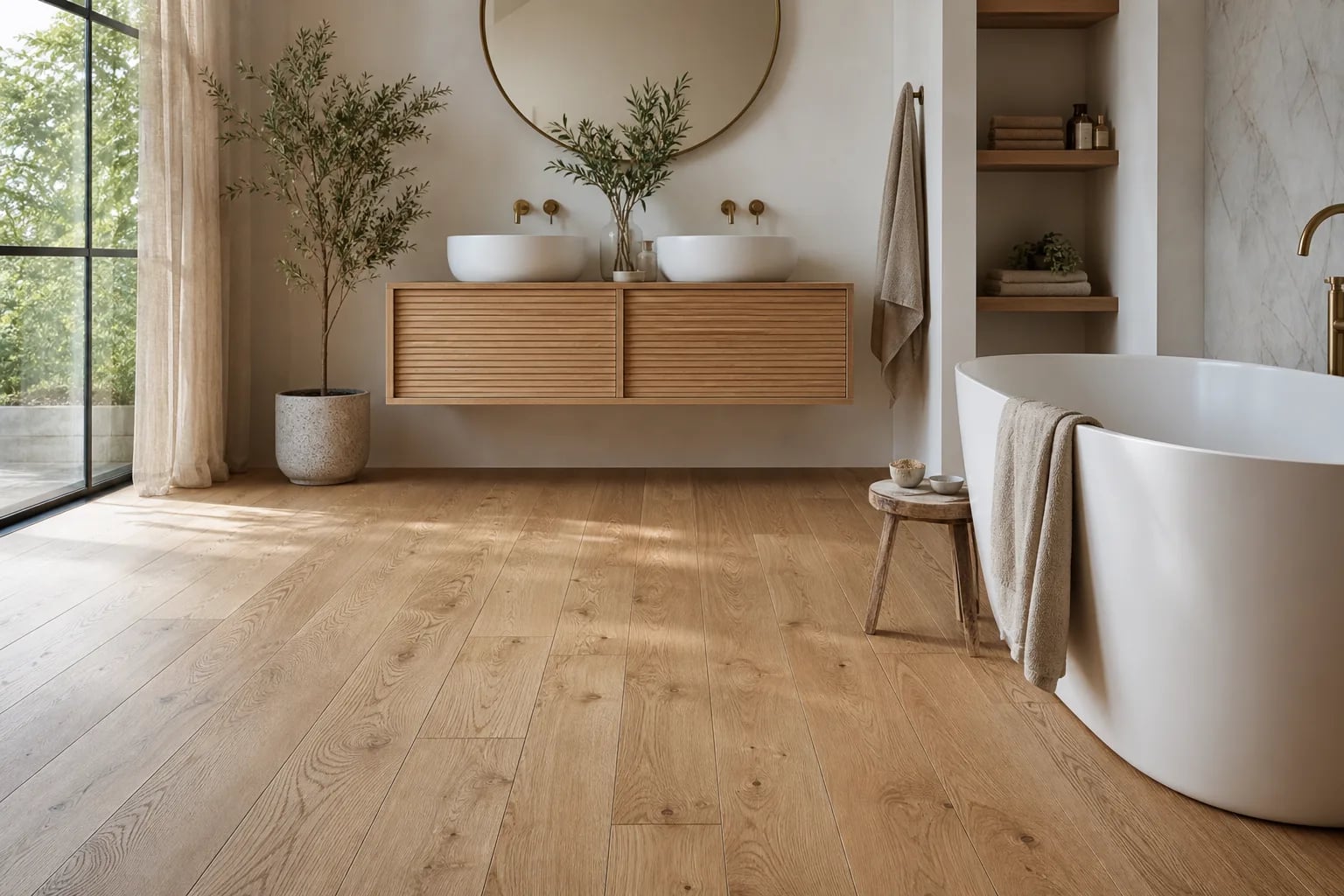
Warm tones and a grain that is never twice the same give a bathroom something domestic and calm, a long way from the sterile look of standard tiling. Plenty of designers now specify wood for exactly that contrast with conventional wet-room materials. There is more on how oak behaves and ages in our guide to oak parquet.
A wide design range
Wood gives you a choice of colours, surface textures and laying patterns, so the floor can be shaped to the room rather than the other way round. Light and matt, dark brown oiled, rustic and brushed — there is a version for every style.
Warmth
Wood is a natural insulator and stores heat efficiently, which makes it an energy-efficient surface over underfloor heating. Bathrooms are where underfloor heating is most common of all, so the pairing is a logical one: good heat transfer, plus a floor that feels warm underfoot.
Durability
A well-built board and the right surface treatment protect the wood against scratches, wear and moisture. An engineered floor with a suitable finish will serve 15–20 years in a bathroom, against 30+ years in living rooms.
Hygiene
The natural acids in wood (tannins) have an antibacterial effect and help keep the surface hygienic. Looked after properly, a bathroom with parquet is no less hygienic than a tiled one.
Added value
A well-maintained wood floor holds its looks and reads as luxury to a future buyer. In the premium property market, bathrooms with parquet are valued above standard tiled ones.
The four factors that decide it
1. Surface finish — oiled or lacquered?
Both lacquer and oil form a protective layer that keeps moisture out of the wood, so both are usable in a wet room. They behave differently, though.
Oiled parquet in a bathroom
Advantages:
- A natural, warm look with the grain clearly visible
- Open, “breathing” pores that regulate moisture evenly
- Less slippery underfoot — a real safety point in a bathroom
- Damage can be repaired locally, without replacing a whole board
Drawbacks:
- Needs re-oiling on a schedule (every 6 months to 1 year in a bathroom)
- Higher risk of staining, because the pores stay open
- A softer surface than lacquer
Lacquered parquet in a bathroom
Advantages:
- A water-resistant, hard-wearing protective film
- Easy to clean and far less prone to staining
- High abrasion resistance
Drawbacks:
- Can be slippery when wet, unless specially treated
- A slightly less natural look
- Damage is harder to repair
- Moisture that gets behind the lacquer film causes serious damage
There is a detailed comparison in our oiled or lacquered parquet guide. For bathrooms, most professionals point to lacquer: simpler care, better moisture resistance.
2. Board construction — engineered or solid?
Engineered parquet (recommended)
Advantages:
- Straightforward installation with a click system
- Less expensive than solid parquet
- The multilayer core moves far less when humidity changes
Drawbacks:
- A thinner wear layer — normally only 1–2 sandings
- If water reaches the subfloor beneath the boards, repairs get involved
Solid parquet
Advantages:
- Can be sanded back many times over
- Better moisture resistance thanks to the full timber section
- Higher resale value
Drawbacks:
- Needs specialist knowledge to install
- Higher material costs and higher professional fitting rates, which vary widely by country
- Not widely stocked across Europe
For a bathroom, lacquered engineered oak parquet is the optimal choice. Our entire collection is engineered.
3. Wood species — hard or soft?
In a bathroom it genuinely matters that the species is a hardwood. Dense, hard timbers cope better with humidity and are less inclined to swell or shrink.
Ideal for a bathroom:
- Oak (our core collection) — versatile, hard-wearing, long-lived
- Walnut — dark, luxurious, resistant to moisture
- Teak — naturally oily, water-resistant
- Merbau — exotic, hard, rot-resistant
Best avoided in a bathroom: pine, spruce and maple, all softer and more sensitive to moisture. More detail in our oak parquet guide.
4. Installation — DIY or a professional?
In a bathroom, full glue-down installation is non-negotiable. Bonding the boards across the whole surface, with the joints sealed tight, is what actually keeps water out.
The work demands precision: a level subfloor, careful setting of every board, and an unbroken seal along the joints. It matters more still over water-based underfloor heating, where even heat distribution depends on full contact with the screed.
Our recommendation: professional installation is strongly advised. For bonding we recommend Berger Seidle M1X adhesive — a one-component PUR carrying the EC1 Plus emissions classification.
Care best practice for a bathroom floor
The basic rule
Regular cleaning with products made for wood is the foundation. Clean damp rather than wet, and wipe dry immediately afterwards — “never too wet” is the principle to work to.
Dry the floor quickly
After a shower or a bath, the floor should be wiped down straight away. Keep a dry towel within reach.
Protective mats
Put mats in front of the areas used most: the shower, the basin, the bath. They cut splashing and direct contact with the wood.
Regular checks
Look over the boards periodically for signs of moisture — colour changes, a finish that is lifting, shrinkage gaps opening. Problems caught early are far easier to solve.
Humidity control
The ideal relative humidity in a bathroom is 40% to 60%. A hygrometer makes it easy to keep track. Use extraction or a dehumidifier as required; roughly 15 minutes of ventilation after a shower is usually enough.
WOCA care products
Our WOCA maintenance oil and WOCA wood floor soap are formulated for damp rooms: a natural composition that stops ambient moisture settling on the surface of the wood.
What this looks like in practice
A small guest bathroom
Light, occasional use. Parquet is an excellent choice here: the moisture load is minimal and the visual gain is large. Our recommendation — lacquered oak, click system, good ventilation.
A family bathroom with bath and shower
Heavy daily use. Parquet is possible, but only under a strict protocol: lacquered oak, fully glued down, mats in place, wiped dry after use, and an annual care check.
A children's or high-splash bathroom
Plenty of splashing, very little caution. Here we do not recommend parquet. Choose EndlessLove porcelain tiles or SPC vinyl flooring instead. There is a full comparison in our parquet or tiles guide.
Alternatives, if parquet is not the right fit
- Ceramic and porcelain tiles: the classic bathroom surface, completely waterproof; our EndlessLove collection is Italian rectified porcelain.
- SPC vinyl: a lower-cost wood look, 100% water-resistant and simple to clean. More in our SPC or LVT vinyl guide.
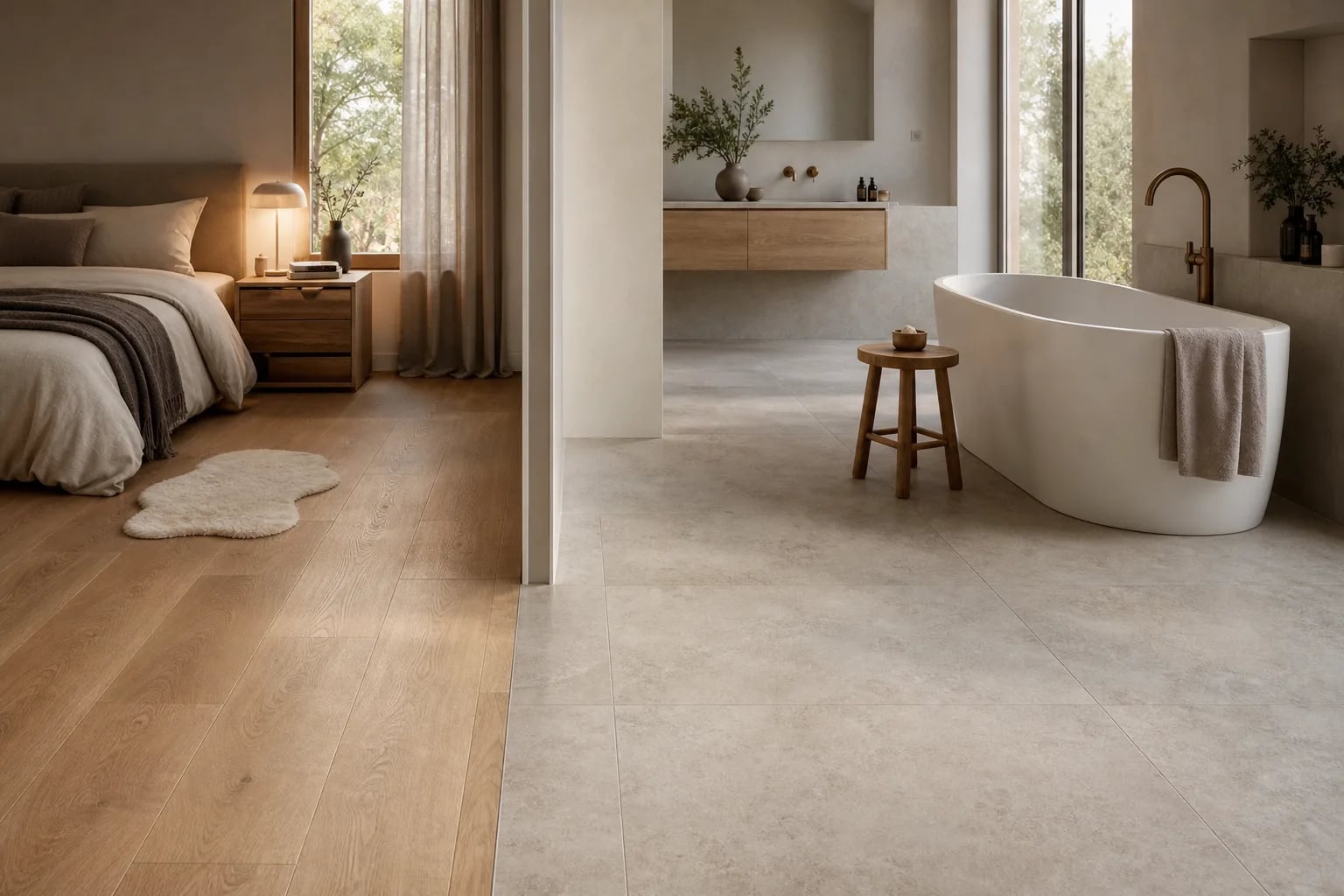
- A hybrid layout: tiles in the shower zone, parquet in the dry transition area. The rule is simple — tiles wherever water lands, parquet only where it does not.
FAQ: parquet in a bathroom
Will parquet rot in a bathroom?
Specified properly — lacquered, fully glued down, joints sealed — natural oak parquet will not rot, even in a bathroom. The tannins in the wood act as a natural fungicide. The risk arises only where water gets underneath the boards or the joint seal has been damaged.
Which oak parquet is best for a bathroom?
A matt-lacquered engineered oak board with a Drop Down Click system. Our picks: Oak Bergen (matt lacquer), Oak Oxford (dark, lacquered) and Oak Milano (light, lacquered).
Does bathroom parquet need a waterproof membrane underneath?
Yes, exactly as tiling does. The subfloor has to be tanked, either with a liquid-applied membrane or a sheet system, and the boards are then bonded onto that waterproofed surface.
How do I protect the joints from water?
Choose a board with a tight click profile, or use a dedicated joint sealant. Fill the perimeter gaps between the boards and the walls with an elastic sealing compound.
How often does a bathroom floor need refreshing?
Lacquered floors want recoating every 5–7 years. Oiled floors need re-oiling annually. A full sand and refinish comes round every 15–20 years.
Ready to start?
Order up to 3 free samples and see how lacquered oak reads in your own light and your own room; delivery time and any cost are shown at checkout or on request. You can also book a free consultation through our contact page — we will go through your bathroom layout and heating system together and settle on the right board and installation method for the project.