Laying patterns
Herringbone parquet flooring: patterns, prices and fitting (2026 guide)
1 September 2026
Herringbone parquet is the most decorative way to lay a wooden floor — a pattern that runs from the state rooms of Versailles to today's city apartments, and it has rarely been in higher demand. This 2026 guide brings it together in one place: how herringbone and chevron differ, what herringbone engineered oak actually costs (from 52,95 €/m² incl. VAT), when vinyl herringbone from 28,95 €/m² is the smarter buy, what fitting adds to the budget, and which rooms show the pattern at its best.
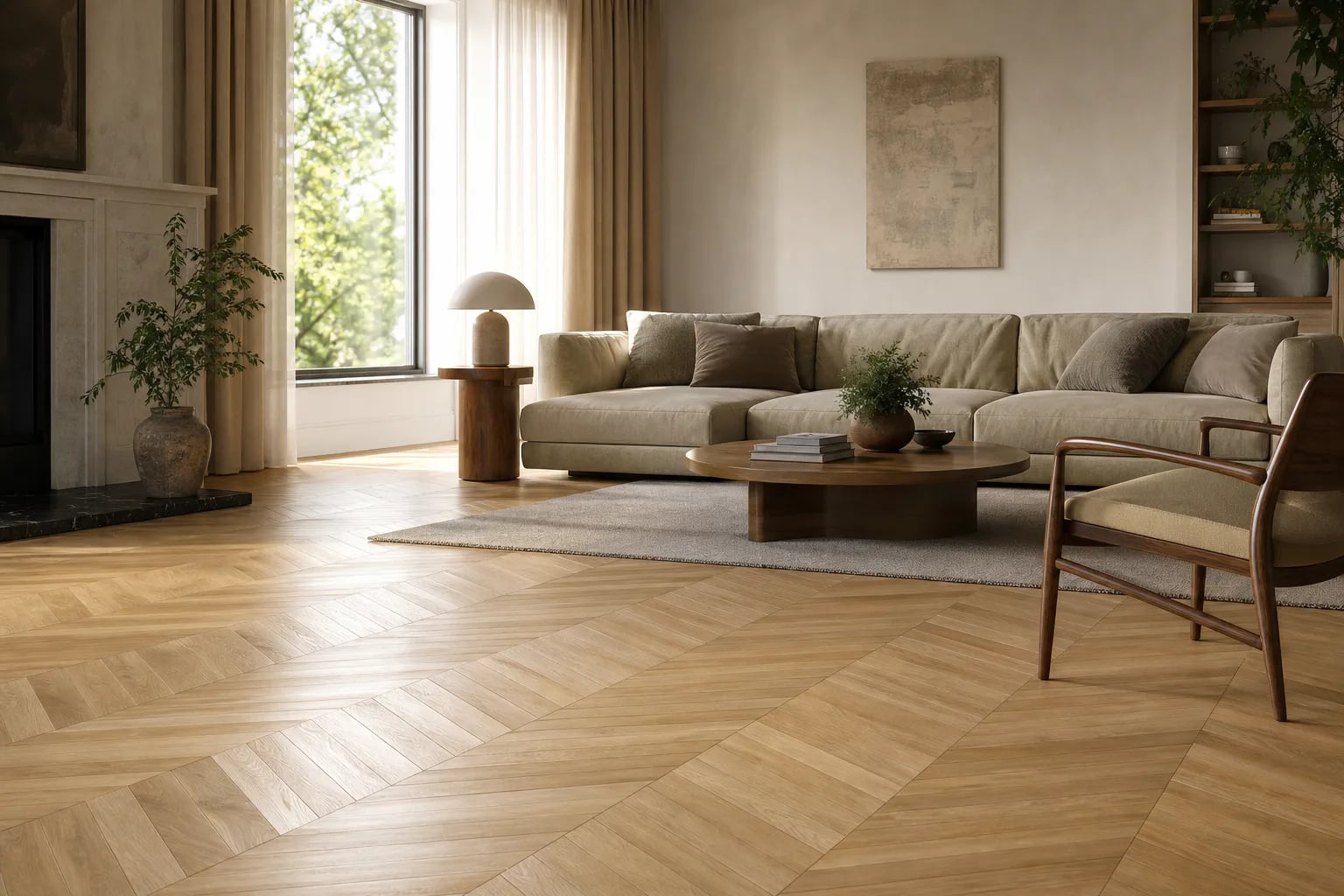
No other property of a floor changes the character of a room as much as the laying pattern. The same oak laid as straight planks reads calm and Scandinavian; set out in herringbone it becomes the main event, noticed the moment you step through the door. This guide works through the pattern types, real prices, an honest comparison with vinyl herringbone, and the fitting details that make this floor a bigger planning job than an ordinary one.
What is herringbone parquet?
Herringbone is a laying method in which rectangular boards are set at an angle to one another to form a repeating “V”, reminiscent of the skeleton of a herring — which is where the name comes from. The pattern was perfected in France, and the parquet of Versailles is still treated as the benchmark for the style. Today herringbone is enjoying a genuine revival, chosen for period city flats and new-build houses alike.
Why the return? First, the sense of value. A herringbone floor signals immediately that the interior was designed rather than assembled, and it often becomes an argument at resale: the pattern is still relatively rare and laying it takes real craft, so buyers read it as an investment rather than a finish. Second, design direction — warm natural materials and geometric patterns are dominant again, in classical and minimalist projects alike. Third, supply: a decade ago herringbone formats were a niche order, whereas today you can choose across several price levels and even across materials.
It helps to separate two things from the outset: the pattern and the material. Herringbone is not exclusive to wood — the same geometry is available in vinyl planks, which we come to below. In our engineered oak collection the herringbone formats are three-layer boards: 14 mm thick with a 3 mm oak wear layer that can be sanded back two or three times over the life of the floor. How that construction works, and why it is more stable than solid parquet, is covered in our guide to engineered board construction.
Herringbone or chevron: what is the difference?
Across Europe both patterns are casually called herringbone, although the laying technique and the finished look differ considerably.
Herringbone — the classic
Rectangular boards meet at 90°: the end of one board butts into the side of the next, producing the stepped fish-bone figure the pattern is named after. It is the traditional, quieter of the two, and it sits equally well in a period interior and a modern one. Our Oak Verona and Oak Torino are 600 × 120 × 14 mm boards made specifically for this layout: brushed and oiled surface, with left-hand and right-hand boards supplied together.
Chevron — the French herringbone
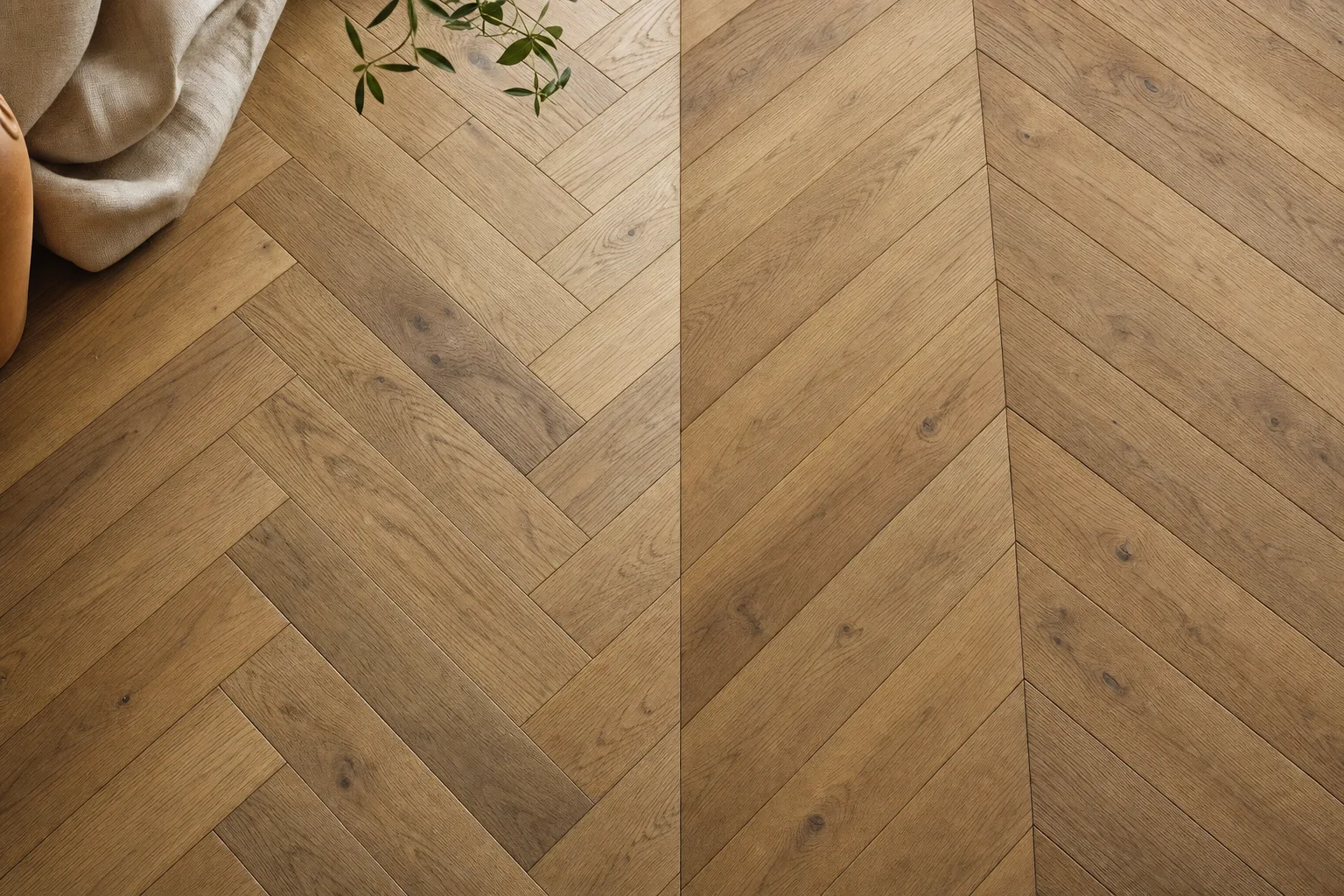
Chevron boards are mitred at 45°, so that joined together they form a perfectly straight arrow. The result is more graphic, more modern, and it visually lengthens a room — but it is considerably harder to lay, because every angle has to be exact and the offcut rate is higher. If this is the version you are weighing up, our chevron guide covers prices and setting-out in detail.
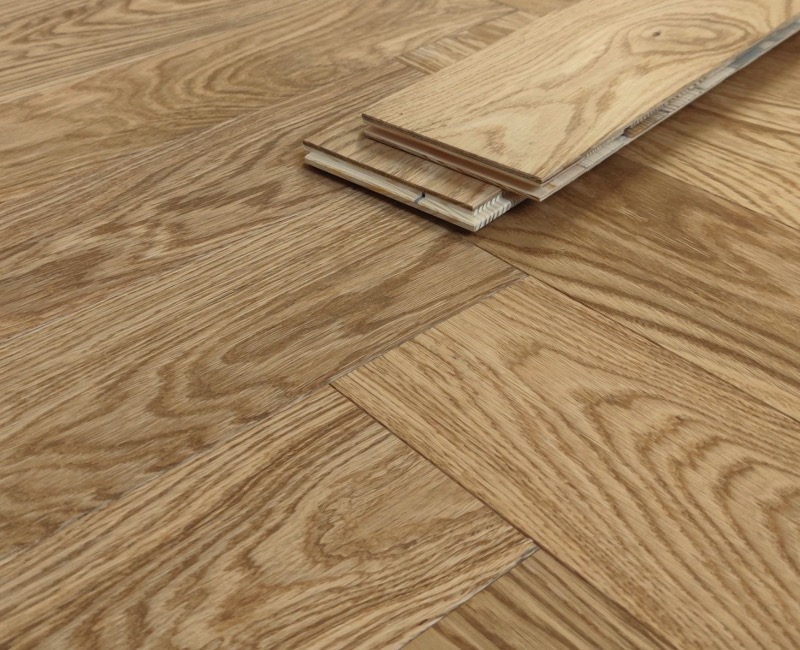
The simplest way to tell them apart: herringbone forms “L”-shaped joins with 90° corners, chevron forms clean “V” arrows with a single straight seam running through them. Herringbone can also be laid single, double or triple — from restrained to very dynamic — and oak tones from warm sand to deep brown give the pattern a shifting play of colour as the daylight moves round the room.
Herringbone parquet prices: from 52,95 €/m²
A herringbone format always costs more than standard planks. The reasons are straightforward: the smaller board means more machining at the mill, left-hand and right-hand boards have to be matched into sets, and edge tolerances are tighter, because in a pattern every single joint is on show.
Our range currently holds 12 herringbone engineered oak models from 52,95 €/m² incl. VAT. For comparison, the parquet collection as a whole starts at 37,95 €/m², so herringbone means an entry point around 40 % higher. Every model, with prices and photographs, is in the herringbone parquet category — from pale Scandinavian tones to deep browns. The most popular choices are Verona, with its lively Natura figure, and Torino, with the calmer Natur grading.
On finishes, it is worth knowing that an oiled surface emphasises the natural grain and lets you repair wear marks locally rather than resanding the whole floor; we set out the advantages and drawbacks in our oiled versus lacquered comparison. For the wider price picture — what makes up the cost of a parquet floor and what is worth paying for — see our parquet price guide.
When budgeting, do not stop at the price per m². The final figure has three parts: the boards plus a 12–15 % waste allowance, adhesive and subfloor preparation materials, and the fitting itself. In practice a 25 m² living room in herringbone needs noticeably more than a simple price × area sum — which is why fitting has a section of its own below.
We ship on pallets across the EU; delivery cost and lead time are shown at checkout or quoted on request. Before committing to a full order, request up to three free samples — photographs only take you so far with a real timber surface and tone.
Engineered oak or vinyl herringbone?
The pattern is no longer the preserve of wood. Our range includes 2 vinyl herringbone models from 28,95 €/m² — vinyl planks laid into the same herringbone figure. You will find them in the vinyl herringbone category, and the alternative is covered in full in our vinyl herringbone guide.
An honest comparison:
| Criterion | Herringbone engineered oak | Herringbone vinyl |
|---|---|---|
| Price | from 52,95 €/m² | from 28,95 €/m² |
| Feel | Real timber — warm, alive, authentic | A convincing reproduction — harder, flatter underfoot |
| Longevity | 3 mm oak wear layer, sandable two or three times — decades of use | 0,5–0,55 mm wear layer — cannot be sanded, replaced as a whole |
| Installation | Full-surface glue-down only, a professional fitter is essential | Simpler, faster, more forgiving work |
| Moisture | Sensitive to prolonged damp | 100 % waterproof |
When does vinyl make sense? When the budget is tight, when the floor is going into a kitchen, hallway or another moisture-prone zone, and when practicality outranks everything else. Vinyl is untroubled by a spilled glass, wet boots or a pet's water bowl, and from standing height the pattern reads very much like wood. When do the oak boards win? When you want the feel of real timber, longevity with the option of refinishing, and the resale value that comes with it — a reproduction, however good, stays a reproduction, and you notice it barefoot as much as in the listing. In living rooms and bedrooms real wood almost always wins, while in a bathroom we do not recommend it at all.
One more practical note: herringbone engineered oak is suitable over underfloor heating when it is bonded to the subfloor across the full area, while for vinyl over underfloor heating you should follow the manufacturer's instructions. Underfloor heating therefore does not decide the question on its own; the budget, the use of the room and how much an authentic timber surface matters to you do.
Fitting herringbone and what it costs
Here is the key point for anyone planning a budget: herringbone always costs more to fit than a straight plank layout. Fitting rates differ substantially from country to country, so treat any figure as indicative and get local quotes: professional parquet fitting is commonly quoted somewhere around 8–15 €/m², and for a herringbone pattern it is realistic to plan for the top of that band, or above it in higher-cost markets — the work is slower and demands exact geometry and an experienced fitter. These are market rates, not our prices. Our fitting cost breakdown goes through the individual items, and the step-by-step fitting guide covers the process itself.
Herringbone is not a DIY project. It calls for:
- A properly prepared subfloor — flat and dry (see our subfloor preparation guide)
- A professional PUR adhesive — we recommend Berger Seidle M1X
- An accurately set-out pattern axis — an error in the first row becomes an error across the whole floor
- Experience with matched left-hand and right-hand boards
The process runs like this: first the subfloor is checked for flatness and moisture, then the pattern axis is set out in the room — usually from the main wall or the direction of the light. The first few rows are laid with particular care, because they lock in the geometry of everything that follows. The boards are then bonded row by row, with angles and joint lines checked constantly, and an expansion gap is left along the walls to be covered later by skirting. For a good fitter, a herringbone floor in an average living room is several days' work, so be realistic about the programme.
The second budget line is the waste allowance. A straight layout usually gets away with less; for herringbone we recommend 12–15 %, because boards are cut at an angle along walls, reveals and heating manifolds, so offcuts are unavoidably higher. Our quantity calculation guide shows how to work the figure out properly, and the quickest route is our flooring calculator: enter the room dimensions and you get the quantity including waste along with the total.
If you have underfloor heating, herringbone is suitable — but the boards must be bonded to the subfloor across the full area. All the details are in our guide to engineered wood over underfloor heating.
Herringbone or a classic plank layout?
Before you get as far as choosing rooms, it is worth asking honestly whether herringbone is your pattern at all. A classic wide plank layout has real strengths: long boards of 1,70–2,20 m create a spacious, calm surface, they go down faster (fewer boards per m² means fewer hours), they cost less in both material and labour, and wear marks on a wide board are easier to touch up locally. It is the natural choice for a Scandinavian, minimalist or rustic interior.
Herringbone's strengths lie elsewhere: the geometry works as a piece of decoration, it plays with the light through the day, it is at home in period and modern rooms alike, and — being less common and harder to lay — it lifts the value of the property. The price for that is a larger material and labour budget and a longer fitting programme. A simple test: if you want the floor to be a quiet background for furniture and art, lay planks; if the floor is meant to be the main feature, lay herringbone.
Which rooms suit herringbone parquet best?
Herringbone is a pattern that needs a stage. A few practical rules from our projects:
- Living and dining rooms — the best stage of all. From about 15–20 m² the pattern has room to read properly, and the light changes it through the day.
- Period flats with separate rooms — particularly rewarding: in each room the pattern works as a design feature in its own right.
- Long hallways — herringbone visually widens a narrow space, especially when the pattern axis runs along it.
- Small rooms up to about 12 m² — approach with care: a fine pattern in a small space can feel too busy. A calm straight layout often works better here.
- Open-plan spaces — possible, but the pattern axis has to be thought through across all the zones; herringbone in the central area with a straight-laid border around it is often the most successful solution.
If, having compared them, you lean towards the calmer Scandinavian look, our collection has wide straight-laid boards for exactly that: the pale Bergen and Milano, the subtle Vienna, and the more characterful Innsbruck and Oxford. A straight layout goes down faster, costs less in labour and is easier to refresh — and for households with animals we have a separate guide to parquet and pets.
Kitchens deserve their own note. An open-plan kitchen and living room in herringbone looks superb, but a wooden floor takes more moisture and grease around the sink and hob. There are two routes: herringbone engineered oak with an oiled surface and disciplined maintenance, or vinyl herringbone in the working zone, where water is no threat. Which floors suit a kitchen, and how to combine them, is covered in our kitchen flooring guide.
Still undecided between pattern, material and tone? Answer a few questions in our floor finder — it narrows the choice down to a handful of specific models.
Frequently asked questions
How much does herringbone parquet cost?
Herringbone engineered oak in our collection starts at 52,95 €/m² incl. VAT (12 models). Add fitting on top of the material — rates vary by country, but professional parquet fitting is commonly quoted around 8–15 €/m², with herringbone realistically at the top of that band — and allow 12–15 % extra material for cutting.
What is the difference between herringbone and chevron?
Herringbone boards are rectangular and meet at 90°, producing a stepped fish-bone figure. Chevron boards are mitred at 45°, so the pattern forms straight “V” arrows. Chevron looks more modern, but it is harder and more expensive to lay.
Is there a cheaper alternative to herringbone parquet?
Yes — vinyl herringbone from 28,95 €/m² (2 models). Vinyl is 100 % waterproof, so it suits even a kitchen or hallway, but it does not have the feel of real timber underfoot and it cannot be sanded.
How much extra material should I allow for herringbone?
Allow 12–15 % for a herringbone pattern — more than for a straight layout, because boards are cut at an angle along walls and openings. The easiest way to arrive at the exact quantity is the flooring calculator, or your fitter working from the room plan.
Is herringbone parquet suitable for underfloor heating?
Yes — our herringbone engineered oak works over underfloor heating, but it must be bonded to the subfloor across the full area. Bonding gives good heat transfer, and the three-layer construction gives stability as temperatures change.
Ready to see herringbone in person?
Order a free Verona or Torino sample and judge the brushed, oiled oak surface for yourself within a few working days. If you would rather settle everything in one go, book a video consultation: we will go through your room plans together, choose the pattern, work out the quantity including waste, and put a total budget together with the fitting.