Guide · 8 min
Chevron parquet: everything you need to know
1 September 2026
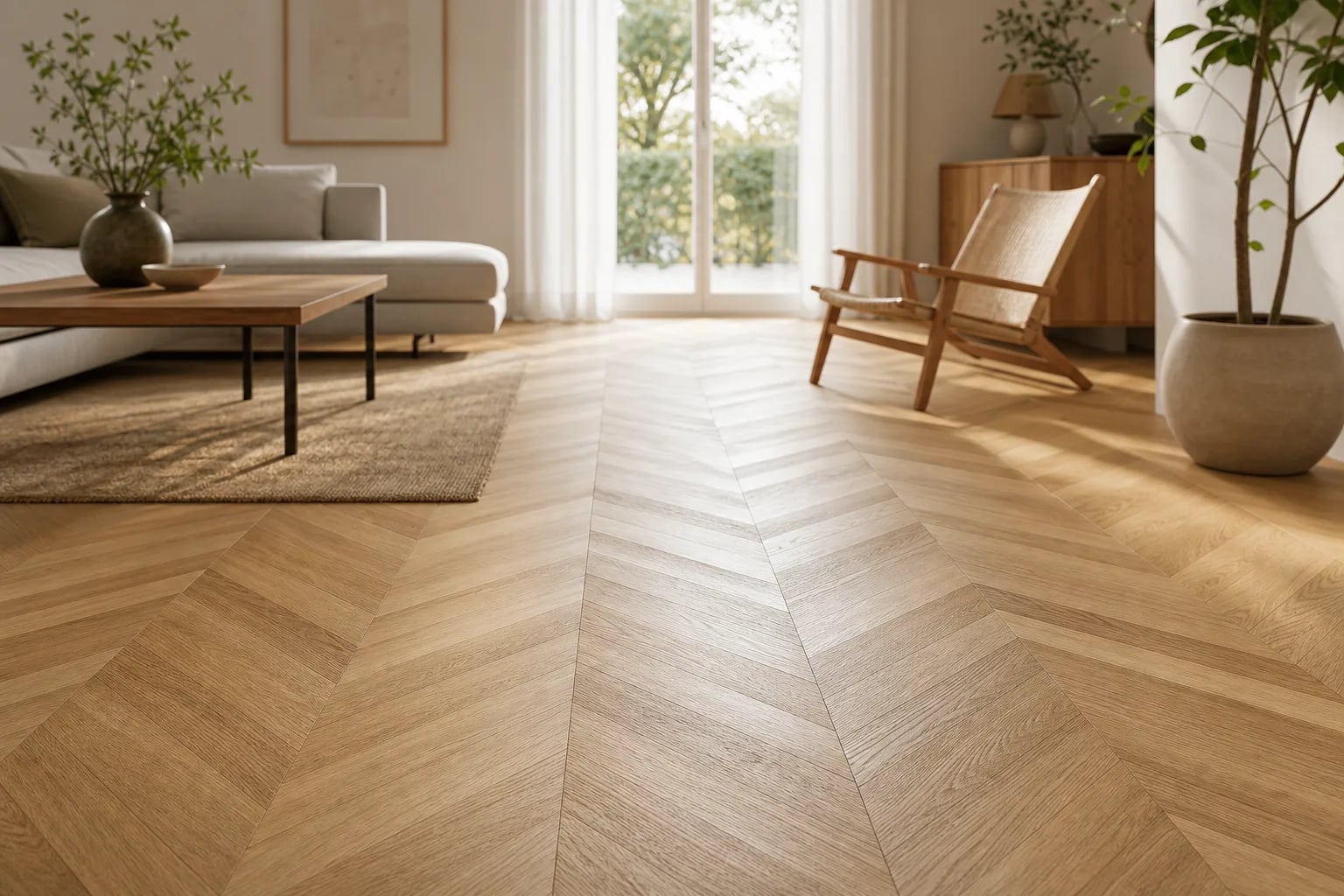
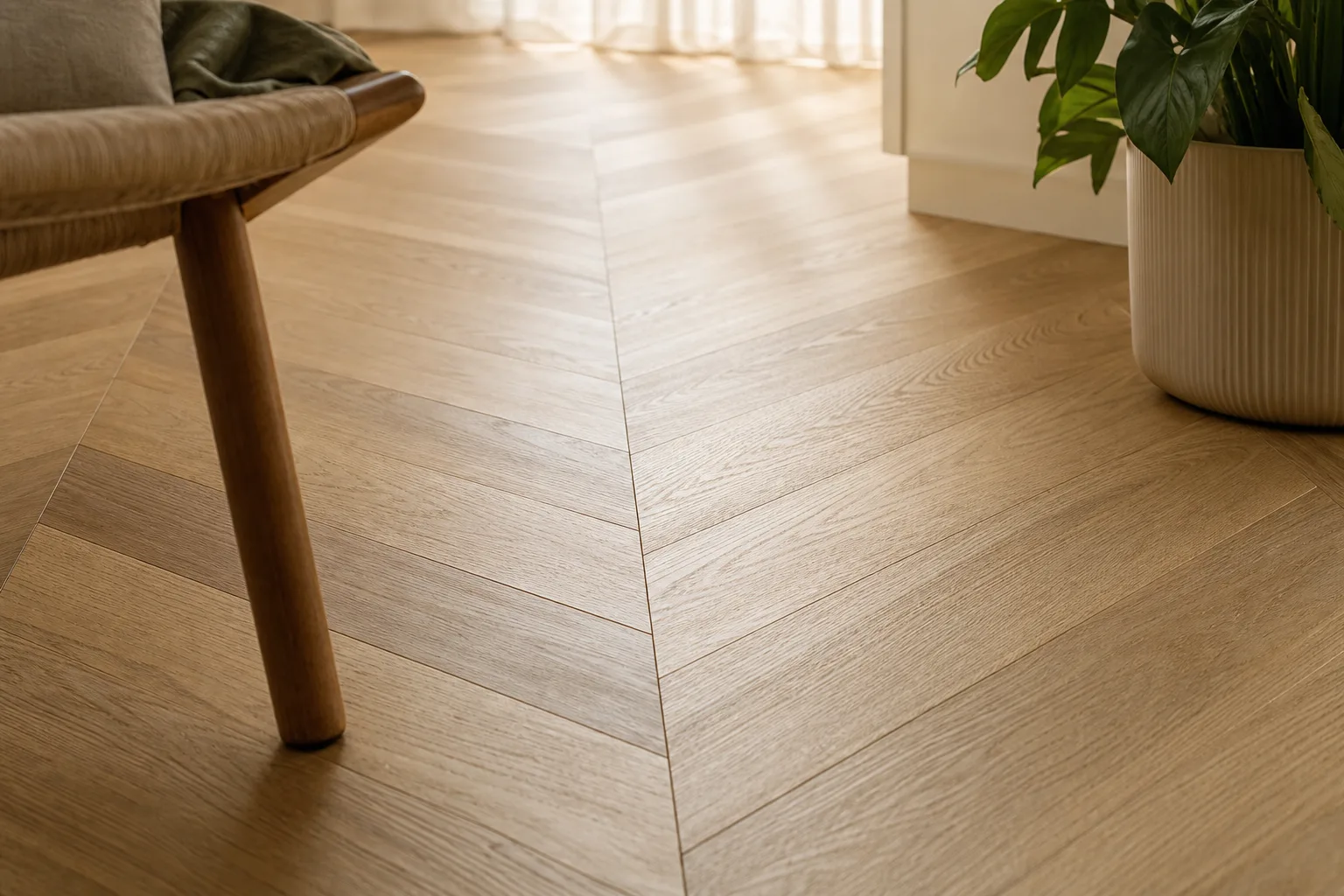
In short: chevron parquet has every board cut at a 45° angle, so the boards meet in perfectly straight V-shaped lines. The effect is contemporary and premium, and it is most often used in living rooms and studies. Herringbone, by contrast, uses square-ended boards meeting at 90°; chevron reads cleaner and more geometric. Our Verona and Torino are the chevron options in our range, from 62.95 €/m².
The chevron pattern is centuries old, yet it is currently one of the most sought-after parquet layouts in contemporary interiors. It traces back to the palace floors of Versailles, and today it turns up in premium cafés, designer living rooms and boutique hotels across Europe. So what makes it different, and is it the right choice for your own home?
What is chevron parquet?
Chevron is a laying pattern in which each board is cut at a 45° (sometimes 60°) angle at both ends. Joined to its neighbours, the boards form a perfectly straight V-shaped line — the same shape as the rank insignia on a military sleeve, which is where the name comes from (chevron is the French word for that mark).
Visually, chevron produces straight, clean, geometric lines that draw the eye the length of the room. It is often described as French herringbone, but the difference from classic herringbone is fundamental.
Chevron vs herringbone — the key differences
The two patterns are routinely confused, yet they look very different:
| Feature | Chevron | Herringbone |
|---|---|---|
| Board end | Cut at 45° | Cut at 90° (square) |
| Joint line | Straight V shape | Stepped L shape |
| Visual character | Modern, geometric, clean | Traditional, organic, classic |
| Fitting difficulty | Higher (exact angles) | Moderate |
| Cost vs straight plank | +30–35 % | +25–30 % |
| Waste allowance | 12–15 % | 10–13 % |
Put simply: chevron is the premium version — more geometric, more contemporary. Herringbone is the traditional, organic option. Which one you choose comes down to the style of the interior.
A short history — from Versailles to Bauhaus
The chevron pattern spread through sixteenth-century France, and the earliest well-known examples are the floors of the Palace of Versailles (which is why the layout is sometimes called parquet de Versailles). Conceived as a mark of luxury, it was originally laid only in aristocratic residences.
In the early twentieth century the Bauhaus and art deco movements brought chevron back into favour — its clean geometry suited modernist thinking. Today it is fashionable again, partly thanks to Pinterest and Instagram, where its visual impact is unusually strong.
Which interiors suit chevron?
Chevron is a feature pattern — it draws attention and becomes the leading element of the room. It works well in:
- Living rooms — open-plan spaces where the floor is the first thing you see
- Studies and home offices — a professional, premium backdrop for video calls
- Restaurants and cafés — it creates a design-led atmosphere
- Entrance halls — a strong first impression for guests
In small rooms — bedrooms, corridors — chevron can feel too busy, and a calmer straight-plank layout is usually the better choice.
Our chevron parquet
Terris Timber carries two chevron options, both three-layer engineered oak:
- Oak Verona — natural tone, oiled surface, classic chevron pattern
- Oak Torino — a slightly darker shade with pronounced grain
Both have a 5G click system (although for pattern stability we recommend a full glue-down installation), 14 mm thickness and a 3 mm oak wear layer. Both are suitable for underfloor heating up to 27 °C. Order three free samples and you will see the real grain and tone before you commit.
Fitting — why it needs an experienced installer
Chevron is the most demanding of the parquet patterns to lay. It requires:
- Exact angle geometry — every board has to sit at a true 45°. Even a 0.5° error compounds into visible drift over 5–10 m
- A centre line — the fitter starts from the middle of the room and works outwards so the pattern stays symmetrical
- Wet-saw cutting — a hand saw is not enough; the cut edges have to be perfectly clean
- Full glue-down — chevron should be bonded to the subfloor rather than floated, for better stability and a quieter floor underfoot
Fitting rates differ considerably from country to country, so treat any figure as indicative rather than as our price. As a guide, chevron is commonly quoted at around 40–55 €/m² against 15–25 €/m² for a straight-plank layout — expect the level in your own market to vary. What matters more than the rate is finding a fitter with genuine chevron experience; ask us through the contact page if you would like help on what to check before you book one.
Subfloor preparation
A chevron pattern needs an exceptionally flat subfloor — considerably more accurate than a straight-plank floor. The requirements:
- Flatness: max 2 mm deviation over 2 m (not 3 mm as for a standard layout)
- Moisture: no more than 2.0 % in a concrete screed
- Underfloor heating commissioned and run for 14 days before fitting
If the subfloor is out of tolerance, use a self-levelling compound — indicatively 8–18 €/m² applied, though material and labour rates vary by country. More on this in our subfloor preparation guide.
Chevron flooring: wood or vinyl?
Chevron flooring is a broader term than chevron parquet: the same pattern is made both as engineered wood boards and as vinyl. The pattern is identical, but the material changes the price and the rooms it suits.
- Oak chevron and herringbone boards — real wood, sandable and renewable, suited to living rooms, bedrooms and dining rooms. From 52.95 €/m² (herringbone parquet boards).
- Vinyl chevron flooring — an SPC core, 100 % waterproof, so it also works in a kitchen or hallway. From 28.95 €/m² (herringbone SPC vinyl); more detail in our herringbone vinyl flooring guide.
If you want the pattern in a living room and you want real wood, choose parquet. If the floor has to run through a kitchen or hallway and moisture resistance matters, chevron vinyl gives you the same look for less.
Costs — what to budget
Chevron parquet costs more than a straight-plank floor, because of the extra factory machining (the angled cuts) and the work involved in laying it. For an average 30 m² room:
- Our chevron parquet: 62.95–67.95 €/m² × 33 m² (15 % waste allowance) = 2,080–2,240 €
- Glue-down fitting: 40–55 €/m² × 30 m² = 1,200–1,650 € (indicative; local fitting rates vary)
- Adhesive (Berger Seidle M1X): 1–2 tubs = 130–260 €
- Pallet delivery: we ship across the EU, and the cost and lead time are shown at checkout or quoted on request
- Total, before delivery: roughly 3,410–4,150 €
For comparison, a straight-plank layout in the same room would come to roughly 2,800–3,800 €. The chevron premium of about 15 % is often justified by the visual effect and by what it does for the value of the property.
Maintenance
Looking after a chevron floor is no different from any other engineered parquet — the layer build-up and the finish are the same. Ours are oiled, so:
- Daily — dry vacuuming with a soft brush head
- Once or twice a month — damp cleaning with WOCA wood soap
- Every 6–12 months — refresh the surface with WOCA Maintenance Oil
Full detail in our parquet maintenance guide.
Renewing the floor by sanding
A chevron floor can be sanded exactly like a standard one — the 3 mm oak wear layer allows one full sanding over the life of the floor. After 15–25 years, once the surface begins to show wear, a professional can bring it back; sanding with re-oiling is indicatively 22–32 €/m², with the rate depending on the country and the contractor.
The verdict
Chevron parquet is a premium choice for anyone who wants the floor to be the main event in a room. Contemporary, geometric and long-lived, it earns its place in a large living room, a study or an open-plan space. Laying it is demanding and calls for an experienced fitter, so plan the budget accordingly. Order free samples, or get in touch through our contact page for a no-obligation consultation with one of our specialists.
Frequently asked questions
How does chevron differ from herringbone?+
Chevron boards are cut at 45° and form perfectly straight V-shaped lines. Herringbone boards have square ends and create a stepped, L-shaped pattern. Chevron reads as modern and geometric, herringbone as traditional and organic. Laying chevron costs roughly 5–10 % more than herringbone.
How much does chevron parquet cost?+
Our chevron options (Verona, Torino) start at 62.95 €/m². Adding fitting (indicatively 40–55 €/m², and varying by country) and accessories, a 30 m² room works out at roughly 3,410–4,150 € before delivery.
Can I lay chevron parquet myself?+
We would not recommend it. Chevron needs very exact angle geometry (every board at a true 45°), a calculated centre line and a wet saw. Even a 0.5° error compounds into visible drift across the room. Always use an experienced fitter.
Is chevron parquet suitable for underfloor heating?+
Yes — our chevron parquet is three-layer engineered oak and is suitable for underfloor heating up to a surface temperature of 27 °C. Bond it fully to the subfloor rather than floating it: heat transfer is better and the pattern moves less.
How much waste allowance should I plan for chevron parquet?+
12–15 % — more than for a straight-plank layout (7–10 %), because the 45° cuts generate more offcuts. You can work the allowance out in our calculator.