Technical guide · 8 min
Subfloor preparation for parquet: step by step
2 September 2026

A parquet floor is only as good as what sits under it. A poor subfloor shows up later as open joints, creaking, hollow spots and, almost always, a void manufacturer's warranty. This guide is not written for fitters — they already know all of it. It is written for the people paying for the floor, so you can ask the right questions and check the work.
Three critical parameters
Every manufacturer (Haro, Kährs, Parador and the rest) asks for the same things:
| Parameter | Requirement |
|---|---|
| Moisture (cement screed) | ≤ 1.8 % by CM method |
| Moisture (anhydrite / calcium sulphate screed) | ≤ 0.3 % by CM method |
| Moisture with underfloor heating (cement) | ≤ 1.5 % CM |
| Flatness | max 3 mm / 2 m |
| Strength | pull-off ≥ 1.0 N/mm² |
If your subfloor misses these figures, the parquet can still be laid — but you lose the manufacturer's warranty. Every manufacturer states this plainly in its own terms.
Measuring moisture — how it is done properly
Two approaches are in common use:
- CM method (calcium carbide) — the laboratory standard across Europe. A small sample of the screed is ground down and mixed with calcium carbide in a sealed pressure vessel; the pressure that builds up gives the moisture content. It is the only method manufacturers recognise.
- Electronic moisture meters — quick, but unreliable on cement. Treat the reading as a rough indication, nothing more.
Weakest of all is the polythene sheet test: 1 m² of PE film taped down, condensation checked after 24 hours. It tells you moisture is present, never how much.
Flatness
Good fitters check with a 2 metre straightedge. Nowhere along it should the gap to the floor exceed 3 mm. If the subfloor falls outside that:
- Self-levelling compound — the proper fix. Poured 3–10 mm thick, curing in 24–72 hours.
- Mechanical grinding — high spots taken off with a floor grinder. Worth it only for small deviations.
Underlay — more than a sheet of foam
An underlay does several jobs at once:
- Absorbs micro-unevenness (up to 2–3 mm).
- Damps impact sound — essential in apartment buildings.
- Acts as a moisture barrier — PE film over cement holds back rising vapour.
- Passes heat through — important over underfloor heating.
Common types
- Polyester / polystyrene foam (2–3 mm) — inexpensive and perfectly adequate in ordinary flats.
- Rubber — the best acoustics. Our rubber underlay is 2 mm as standard, with impact sound reduction up to 21 dB.
- Recycled composite mats (Tuplex and similar) — good over underfloor heating, low thermal resistance.
- Combined types with PE film — required over a cement screed.
Do not skip an acoustic underlay in an apartment block. Impact noise turns your parquet into your neighbours' problem, and complaints usually follow.
Expansion gaps — everywhere, every time
Wood expands and contracts as humidity changes. Parquet pressed tight against a wall has nowhere to go, so it lifts.
- Around the perimeter: 10 mm as standard, or 15 mm over underfloor heating and with wide XL formats.
- Around columns, pipes and thresholds: 8–10 mm.
- In larger areas (runs over 8 m): an additional gap through the middle, covered with a threshold profile.
All of it disappears under the skirting, so there is nothing to gain by compromising here.
Acclimatisation
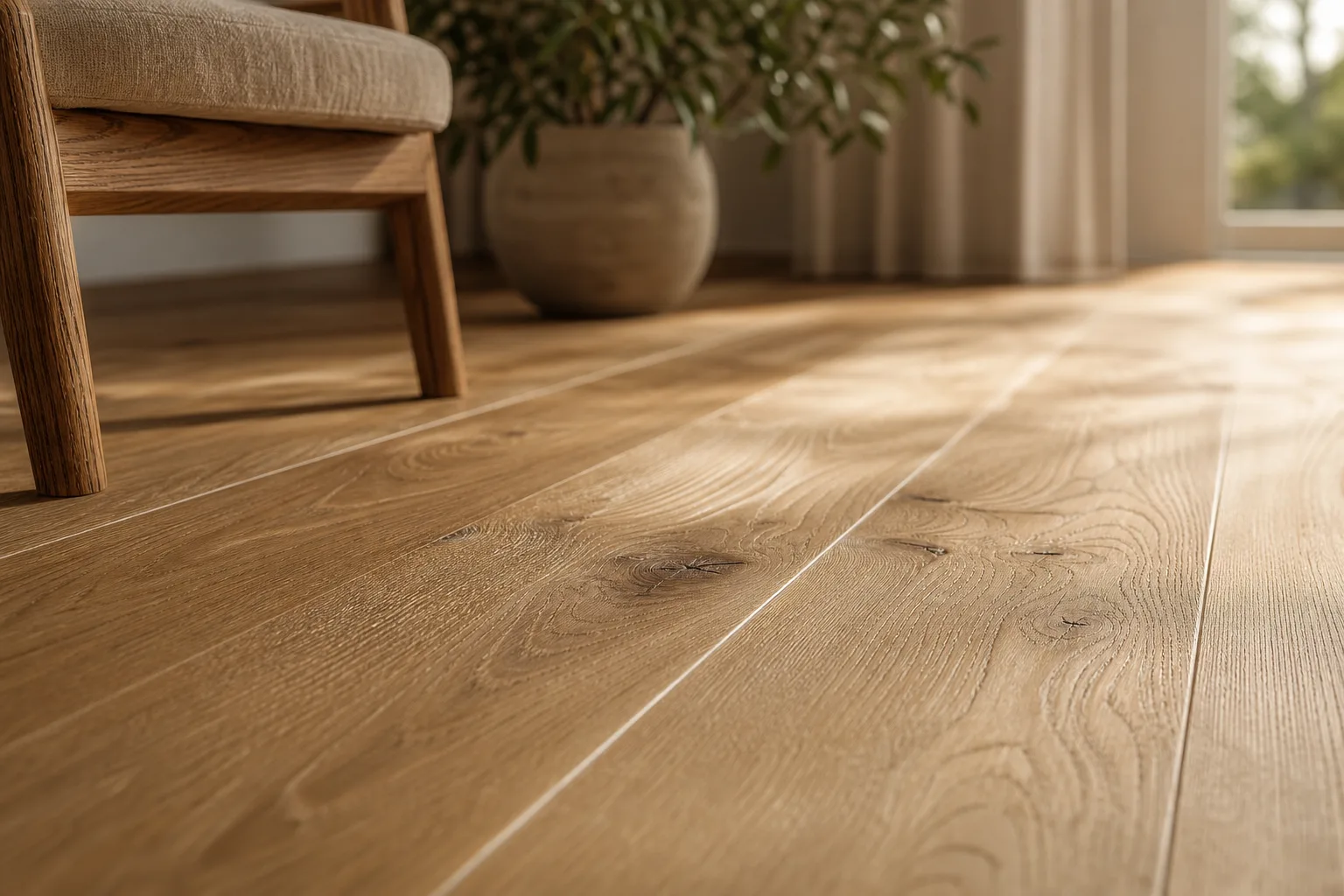
Before fitting, the boards have to settle into the climate of the room they will live in:
- 48 hours in the room, still in their unopened packs, stacked flat or on edge, never directly on a cold floor.
- Room at 20–22 °C, relative humidity 45–60 %.
- Underfloor heating already running at its normal working temperature by this stage.
Skip this step and open joints or cupping appear two or three weeks later. That is not the fitter's mistake; it is physics.
Installation methods
Floating (click)
- The floor sits loose over the subfloor and is not bonded to it.
- Faster, cheaper, and no specialist fitter required.
- Slightly louder underfoot.
- Suitable for continuous areas up to roughly 80 m². Anything larger needs intermediate gaps.
- All the click variants (Drop Down, 2G, 5G, Uniclic) are covered in our guide to click systems.
Glue-down
- Every board is bonded to the subfloor with an elastic SMP adhesive (Berger Seidle M1X or equivalent).
- The most stable option — and effectively mandatory over underfloor heating.
- Quiet and solid underfoot, much like a solid wood floor.
- Needs a skilled fitter, plus 24–48 hours of curing before the floor is walked on.
Questions worth asking your fitter
- Will you measure subfloor moisture with the CM method? (An answer of "with an electronic meter" is a bad sign.)
- What expansion gap will you leave at the perimeter and around columns?
- How many hours will the parquet acclimatise before fitting?
- Which adhesive will you use, if the floor is glued? Silane-based (SMP) is the right answer.
- Will you run a heating cycle before laying, if there is underfloor heating?
What you should have ready
- A clean subfloor — no dust, plaster or gypsum residue.
- All waterproofing and services in the walls finished.
- Door frames fitted, but thresholds still off.
- Skirting — usually installed by the parquet fitter.
In short
A fitter will do a good or a bad job in a couple of days, but preparing the subfloor is a two to three week process. Do not rush it. If the screed is still too wet, waiting is the cheaper option — laying too early costs you the floor and the warranty together. Ready to lay? See our step-by-step fitting guide. If you would like a second opinion, book a free 30-minute consultation and we will go through the condition of your subfloor with you, or order free samples first.