Comparison
Which flooring is best for a kitchen? Parquet, vinyl or tiles (2026)
1 September 2026
The kitchen floor takes more punishment than any other in the home: water, grease, dropped crockery and constant traffic. We compare engineered oak parquet, SPC vinyl and porcelain tiles without the marketing gloss, and say which one suits your situation.
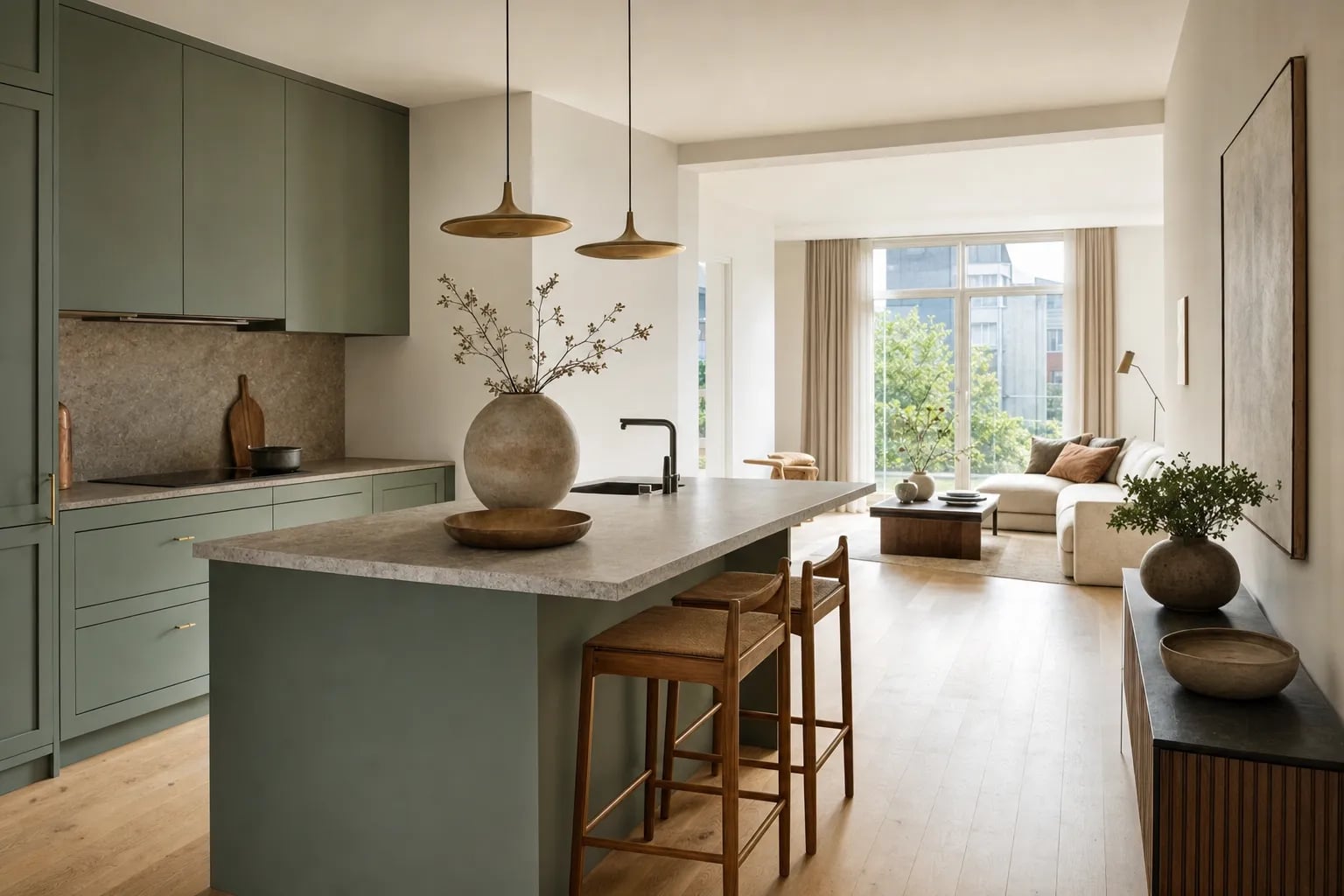
The kitchen asks more of a floor than any other room in the house. Water and cooking oil find their way onto it, pans and plates land on it from worktop height, and the traffic between fridge, sink and hob never really stops. It is also, more and more often, part of an open-plan space, so the floor has to survive daily life and then carry on into the living room without a visual break. This guide compares the three coverings most people shortlist — engineered oak parquet, SPC vinyl and porcelain tiles — on durability, comfort, looks and cost, and ends with a straight verdict for each situation.
What a kitchen floor actually has to cope with
Before comparing materials, it is worth agreeing on the criteria. A kitchen floor meets four challenges every day:
- Water and stains. Spilled water, coffee, oil or wine should leave no trace — and it matters how long you have to wipe them up before the floor suffers.
- Dropped objects. A pan or a ceramic plate falling from the worktop is a non-event on some floors, and an indentation or a cracked tile on others.
- Comfort underfoot. You stand at the hob and the sink for hours at a time, so how hard and how warm the surface feels has a direct effect on how the room is to work in.
- Visual continuity. In an open plan the floor is what joins the kitchen to the living room; thresholds, transition trims and a change of material break the space up.
There is a fifth criterion that is easy to forget: underfloor heating. If it is part of the plan, the thermal conductivity and the dimensional stability of the covering matter every bit as much as its appearance.
If you are still mapping out the whole house, start with our main guide to choosing a floor — here we go straight to the kitchen.
Engineered oak parquet in a kitchen: natural warmth, with conditions
Three-layer European engineered oak parquet (from €37.95/m²) is the warmest and the most prestigious floor a kitchen can have. Wood is warm to the touch, it is the nicest of the three to stand on barefoot, and the natural grain gives a room a character that no imitation quite reaches. In an open plan that is parquet's strongest card: the same floor runs uninterrupted from the kitchen island to the sofa, and the space reads as larger and calmer.
A dropped plate is more likely to survive on wood than on tiles, because the surface absorbs part of the impact. A heavy pan can leave a dent, admittedly, but here parquet has an advantage nothing else offers: a worn or damaged surface can be sanded and refinished, so the floor lasts decades rather than years.
Its weak point is moisture. Wood responds naturally to water, so spills need wiping up straight away, and a mat in front of the sink and the dishwasher is a sensible habit. A lacquered surface resists staining better; an oiled one is easier to repair in a single spot. Parquet works over water-based underfloor heating, and in that case we recommend gluing the boards down to the subfloor. We cover every nuance, from the finish to the care routine, in our guide to wood floors in the kitchen. The upkeep itself is simpler than it sounds: dry cleaning and wood-specific products are enough, and you will find the WOCA care range, adhesives and skirting among our accessories (from €22.95).
SPC vinyl in a kitchen: the practical favourite
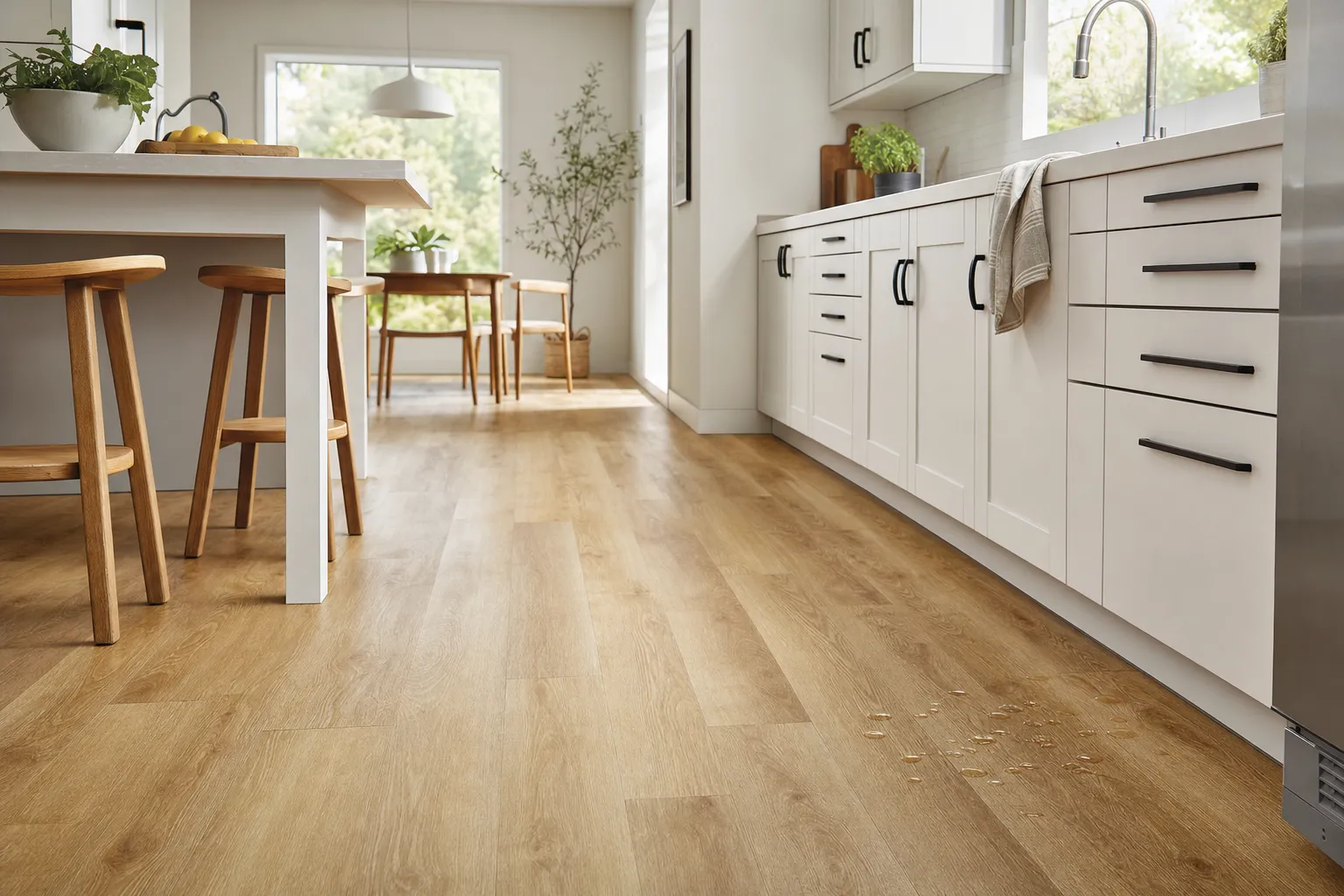
If a kitchen floor had to be summed up in one word, for SPC vinyl that word would be “uncomplicated”. The rigid stone-polymer core makes it 100 % waterproof: spilled soup, a knocked-over vase or a leaking fridge will not damage the floor, even if you do not notice straight away. Our vinyl flooring range runs to 44 models from €16.95/m² — click SPC planks (rigid, with integrated underlay, laid floating without adhesive) and glue-down LVT of 2–2.5 mm.
SPC is forgiving of dropped crockery too. The surface is harder than wood but far more resilient than tiles, so plates break less often and the floor itself resists scratching. Modern oak and stone decors with embossed texture are difficult to tell from the real material at a glance, which means SPC lets you keep the look of wood across an open plan without the care that real wood asks for.
The trade-offs? SPC is harder and cooler underfoot than parquet — underfloor heating or the integrated underlay solves that, and SPC is suitable for heating up to roughly 27 °C surface temperature — and a damaged plank cannot be sanded, it has to be replaced. Even so, the balance of price and practicality in a kitchen is hard to beat. There are more scenarios and fitting tips in our guide to vinyl flooring in the kitchen.
Porcelain tiles in a kitchen: maximum durability
Porcelain tiles are the toughest kitchen floor there is: water, grease, a hot pan and grit brought in on shoes all leave them unmoved. The range holds 52 models from €35.95/m², most of them 60×120 cm rectified tiles in marble, onyx, stone and concrete looks. The large format means fewer joints, so the floor looks continuous and is easier to clean.
The main compromise is hardness. A ceramic plate that hits the floor is almost certainly finished, and a heavy cast-iron pan can crack the tile itself — a single tile is then replaced, which is why it pays to keep spares from the same batch. Standing on a hard surface for long stretches is also harder on the legs and the back.
With underfloor heating, though, tiles become the most comfortable of the three: porcelain conducts heat better than either alternative, so the floor warms up quickly and gives that heat off efficiently. By the sink and the hob, choose a surface with adequate slip resistance — matt is more practical here than polished, as we explain in our guide to anti-slip tiles. For the full picture, see our guide to floor tiles for kitchens and bathrooms.
Comparison table: parquet, vinyl or tiles in a kitchen
| Criterion | Engineered oak parquet | SPC vinyl | Porcelain tiles |
|---|---|---|---|
| Price (from, incl. VAT) | €37.95/m² | €16.95/m² | €35.95/m² |
| Spilled water | Wipe up immediately | 100 % waterproof | 100 % waterproof |
| Dropped plate | Often survives; the board may dent | Breaks less often; the floor resists damage | The plate breaks; the tile may crack |
| Comfort underfoot | Warmest and softest | Medium — harder, cooler | Hard; cold without heating |
| Underfloor heating | Suitable (gluing recommended) | Suitable (up to ~27 °C) | Best suited — excellent conductivity |
| Repair after damage | Sanded and refinished | The plank is replaced | The tile is replaced |
| Continuity with the living room | Excellent | Excellent | Needs a transition, or tiles throughout |
If you are weighing up only two of them, we have detailed head-to-head comparisons: parquet or vinyl, parquet or tiles and tiles or vinyl.
The verdict by situation: which floor for your kitchen
The theory is clear enough, but the decision comes down to your specific case. This matrix sums up the situations we see most often in European houses and apartments:
| Situation | What to choose | Why |
|---|---|---|
| Open-plan kitchen and living room | Engineered oak parquet or SPC vinyl | One floor with no thresholds makes the space look bigger; the wood grain ties the two zones together |
| Busy family kitchen (children, pets) | SPC vinyl or porcelain tiles | 100 % waterproof, scratch-resistant, minimal upkeep |
| Premium project | Engineered oak parquet plus a care routine | Real timber that can be sanded and refinished; marble-look tiles are the striking alternative |
| Kitchen with underfloor heating | Porcelain tiles or SPC vinyl | Tiles conduct heat best and SPC stays stable; parquet works well when it is glued down |
| Tight budget or a rental flat | SPC vinyl | From €16.95/m², quick adhesive-free fitting, easy upkeep |
One point about continuity: if you want tiles in the kitchen area and wood in the living room, plan the transition along the line of the island or the run of units, not across the middle of the room. And if you are torn between two coverings, the most useful thing you can do is compare them in your own light — for parquet and vinyl we send free samples to your home. A popular compromise on larger projects is wood-look SPC throughout: in the kitchen it shrugs off water, and in the living room it is visually indistinguishable from a wooden floor.
Fitting and budget: what not to forget
When you build the budget, add fitting to the cost of the material. Fitting is priced locally and varies considerably from one EU country to the next, so treat the following as indicative market ranges rather than as our prices: click SPC around €7–12/m², floating parquet around €10–15/m², glued-down parquet around €15–25/m², and porcelain tiles around €25–40/m², with large-format 60×120 cm tiles at the top of that range or above it. There is more on timber fitting rates in our guide to parquet fitting costs. Before you commission the work, ask two or three fitters for quotes with subfloor preparation itemised separately — that is usually the line that moves the final figure most.
Practical points when ordering: the minimum flooring order is 20 m², we ship on pallets across the EU with the delivery cost and lead time shown at checkout or quoted on request, and manufacturer warranties run up to 15 years. Measure with an allowance for cutting as well — for wood and vinyl patterns, plan on roughly 5–10 % extra.
Frequently asked questions
What is the best flooring for a kitchen that opens onto the living room?
Usually engineered oak parquet or SPC vinyl — one floor runs through the whole space with no thresholds or transition trims, so the room looks larger. In that kind of layout tiles are either laid throughout or combined with a deliberate transition at the edge of the zone.
Is parquet suitable for a kitchen, or is it too risky?
It is suitable, provided you wipe up spills straight away and keep a mat at the sink. Three-layer engineered oak is stable, and a damaged surface can be sanded and refinished — something neither vinyl nor tiles allow.
Does SPC vinyl cope with spilled water?
Yes. There is no wood fibre in an SPC core, so the floor is 100 % waterproof and will not swell. Water can still work its way through the joints down to the subfloor, so do not leave puddles standing for long.
Are tiles too cold and too hard for a kitchen?
Without underfloor heating porcelain tiles are cool, but with it they become the most comfortable floor of the three — their thermal conductivity is the best of any floor covering. The hardness remains: a kitchen mat helps if you stand for long periods, and a dropped plate will usually break.
How much does a kitchen floor cost?
In our range SPC vinyl starts at €16.95/m², porcelain tiles at €35.95/m² and engineered oak parquet at €37.95/m², incl. VAT. Add fitting on top: indicative market rates run from roughly €7 to €40/m² depending on the material, and they vary considerably from one country to the next.