Guide · 9 min
Tiles or vinyl: which floor covering should you choose?
1 September 2026
Renovating a bathroom, a kitchen or a hallway and torn between the two floors that shrug off water? It is one of the questions we are asked most often by customers across Europe. The good news is that there is no wrong answer here: both ceramic and porcelain tiles and SPC vinyl flooring are made for damp rooms. The difference lies in how they feel underfoot, how they go down, and what the finished job costs. This comparison works through it point by point, so that ten minutes from now you know which floor belongs in your home.
The quick verdict — where each one wins
If you have no time for the full read, here is the essence. Choose vinyl for living rooms, bedrooms, hallways and anywhere you want a warm, quiet, forgiving floor you can lay yourself. Choose tiles for the bathroom, around the shower, in the kitchen work zone, and anywhere water lands on the floor regularly or underfloor heating is going in — ceramic is unbeatable there. Here is why.
Water resistance: a draw
This is the first reason people shortlist these two floors, and both earn full marks. Ceramic and porcelain tiles absorb no water at all (porcelain has a water absorption rate of < 0,5 %), which is why they can go straight into genuinely wet zones — a shower floor, the area around a drain; our guide to porcelain tiles goes into the detail. As we cover in our bathroom flooring guides, SPC vinyl handles moisture just as well: the board has a mineral core that does not take on water. The one caveat is the joints. They are tight, but where water stands for long periods — a walk-in shower without a floor drain, say — properly grouted tiles remain the safer answer.
Warmth and comfort underfoot: vinyl wins
This is where the two part company. Ceramic is a cold surface: without underfloor heating, walking barefoot on tiles in winter is no pleasure, because the tile simply draws warmth out of your feet. Vinyl feels the opposite — warmer and softer. An SPC board has a little give, and many collections come with an acoustic backing already bonded on, so footsteps carry less. Drop something on the floor? On vinyl it will probably survive; on tiles it may not. If you have small children, or you like going barefoot, that difference is very noticeable.
Underfloor heating: tiles win
Here is the neat paradox: vinyl feels warmer on its own, yet tiles are the more efficient partner for underfloor heating. Ceramic conducts and holds heat well, so warmth reaches the room quickly and evenly — it is the best covering for a wet or electric system. Vinyl is also suitable over underfloor heating, but it insulates slightly and has a capped surface temperature (typically up to 27–28 °C), so the system responds more slowly. If the floor is the main heat source for the room, tiles are the rational choice. Our guide to flooring for underfloor heating sets out the principles.
Installation: vinyl wins
SPC vinyl with a click joint is laid floating — the boards lock into one another and rest on the subfloor with no adhesive. A careful DIY fitter can do a medium-sized room over a weekend, with no specialist tools and no waiting for anything to cure. Tiles are the opposite: they are set in adhesive, cut on a tile saw, spaced consistently and grouted. That is a trade skill, and it is worth handing to a tiler. So a tiled floor almost always carries a fitting line in the budget as well. Labour rates differ a great deal from one European country to the next, so treat any figure you read as indicative and get a local quote before you commit. If you would like help specifying the build-up, the adhesive or the underlay, get in touch.
Durability and lifespan: tiles win
Ceramic is among the hardest floor coverings there is. It shrugs off grit and furniture feet, resists heat and household chemicals, and a well-laid tiled floor will look the same decades from now. Vinyl is durable for everyday life — the wear layer protects the decor against scratching — but something genuinely sharp, or heavy furniture dragged repeatedly, can leave a mark. In practice both floors are measured in decades in a home; tiles simply hold a larger reserve of resilience. Our SPC vinyl carries a 25-year residential warranty, our tiles 10 years.
Head to head: the full comparison table
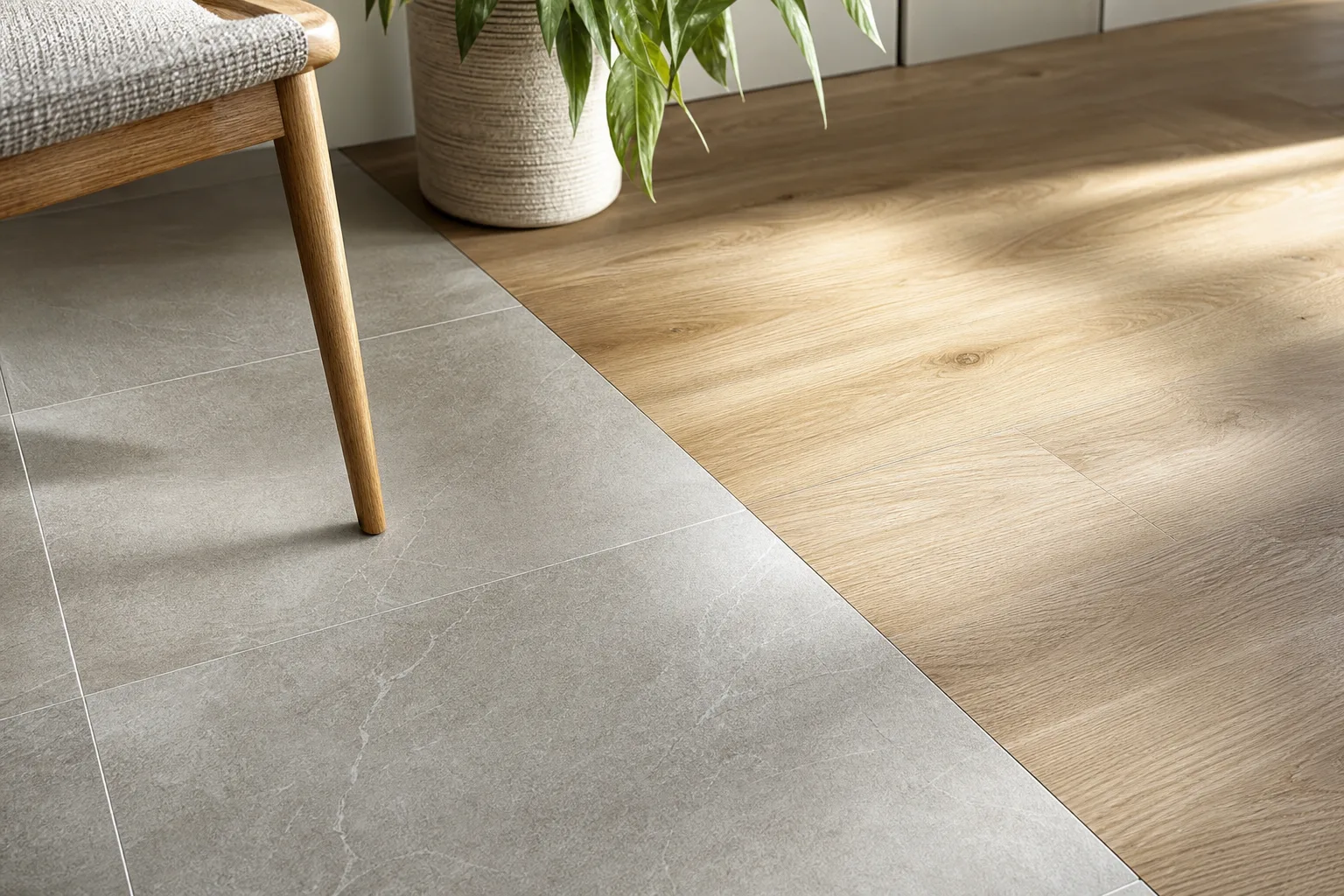
| Criterion | Tiles | Vinyl (SPC) |
|---|---|---|
| Water resistance | Excellent (shower zone included) | Excellent (mineral core) |
| Warmth underfoot | Cold without heating | Warm and inviting |
| Comfort / sound | Hard, louder | Softer, quieter |
| Underfloor heating | Best — fast heat transfer | Suitable, but slower |
| Installation | Needs a tiler | Click — DIY-friendly |
| Durability | Hardest, scratch-resistant | Very good for daily life |
| Maintenance | Easy to mop, grout needs attention | Simply a damp mop |
| Price (from) | 35,95 €/m² | 25,95 €/m² |
| Warranty | 10 years | 25 years residential + 10 years commercial |
| Where it wins | Bathroom, shower, kitchen work zone, underfloor heating | Living rooms, bedrooms, hallways |
Cost: vinyl wins, but budget for the whole job
On the headline material price vinyl is clearly the cheaper of the two — SPC vinyl flooring starts at 25,95 €/m² and tiles at 35,95 €/m², both incl. VAT. In a real budget the gap widens, because tiling almost always adds a tiler's labour, adhesive and grout, while most people click vinyl together themselves. Set against that, large-format porcelain looks genuinely luxurious and adds value to a property. To work out how much of either you need, use our flooring calculator: it turns your room area into a number of packs, cutting allowance included.
Maintenance: both are straightforward
Day to day the routine is much the same and easy on both: a damp mop, no special products. Vinyl is marginally simpler because there are no grout lines to look after; tile grout is worth refreshing over the years, and a darker grout hides everyday traffic better. Neither floor needs re-lacquering or re-oiling the way parquet does.
How to choose room by room
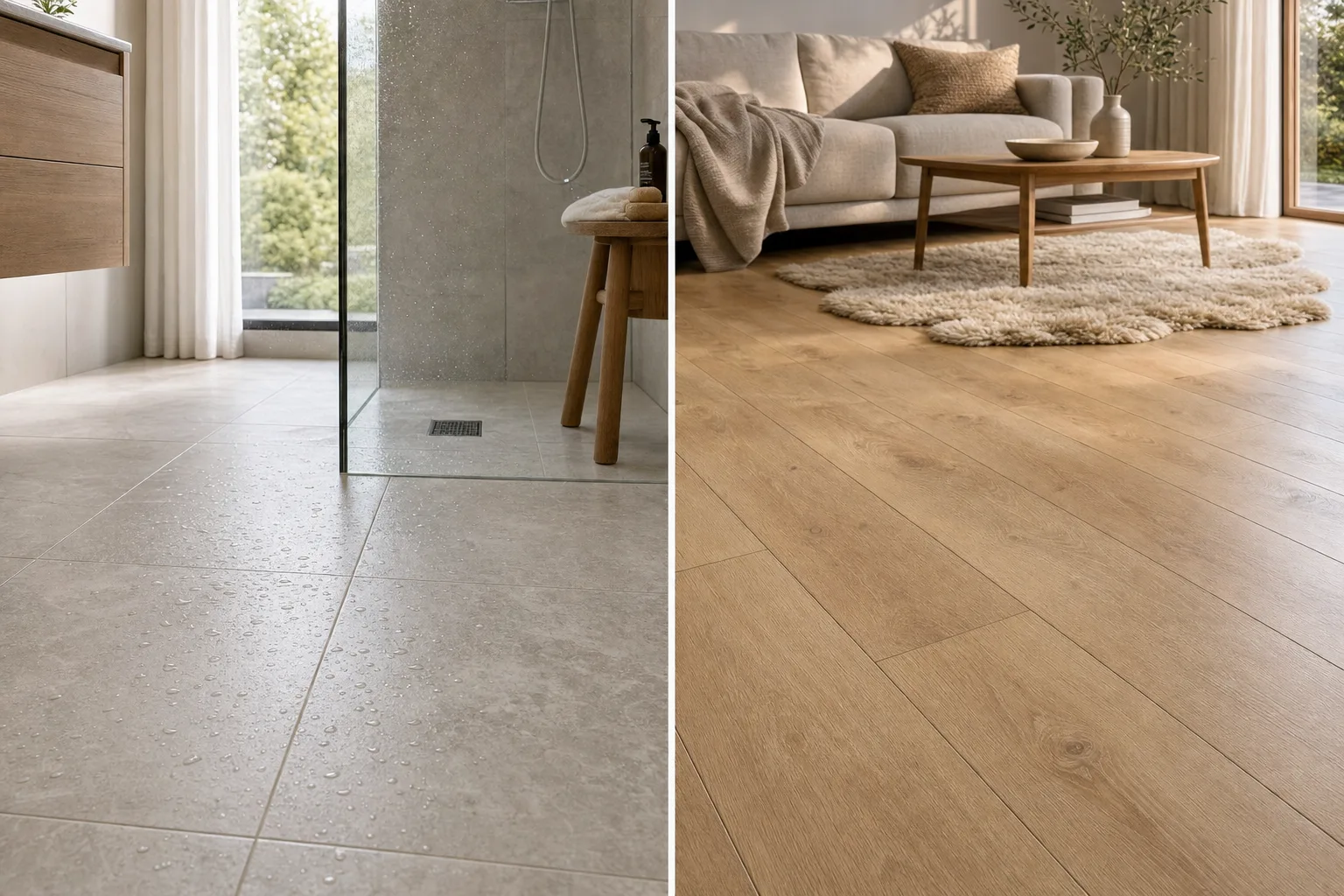
In practice the decision rarely turns on which floor is objectively better, but on where you are laying it:
- Bathroom and shower — tiles. Maximum water resistance, plus the underfloor heating that is often already there to offset the cold surface.
- Kitchen — either works. Tiles are tougher against heat and grease in the work zone; vinyl feels warmer if the kitchen opens onto the living room.
- Living room, bedroom, hallway — vinyl. Warm, quiet, quick to lay, and the wood decors read convincingly.
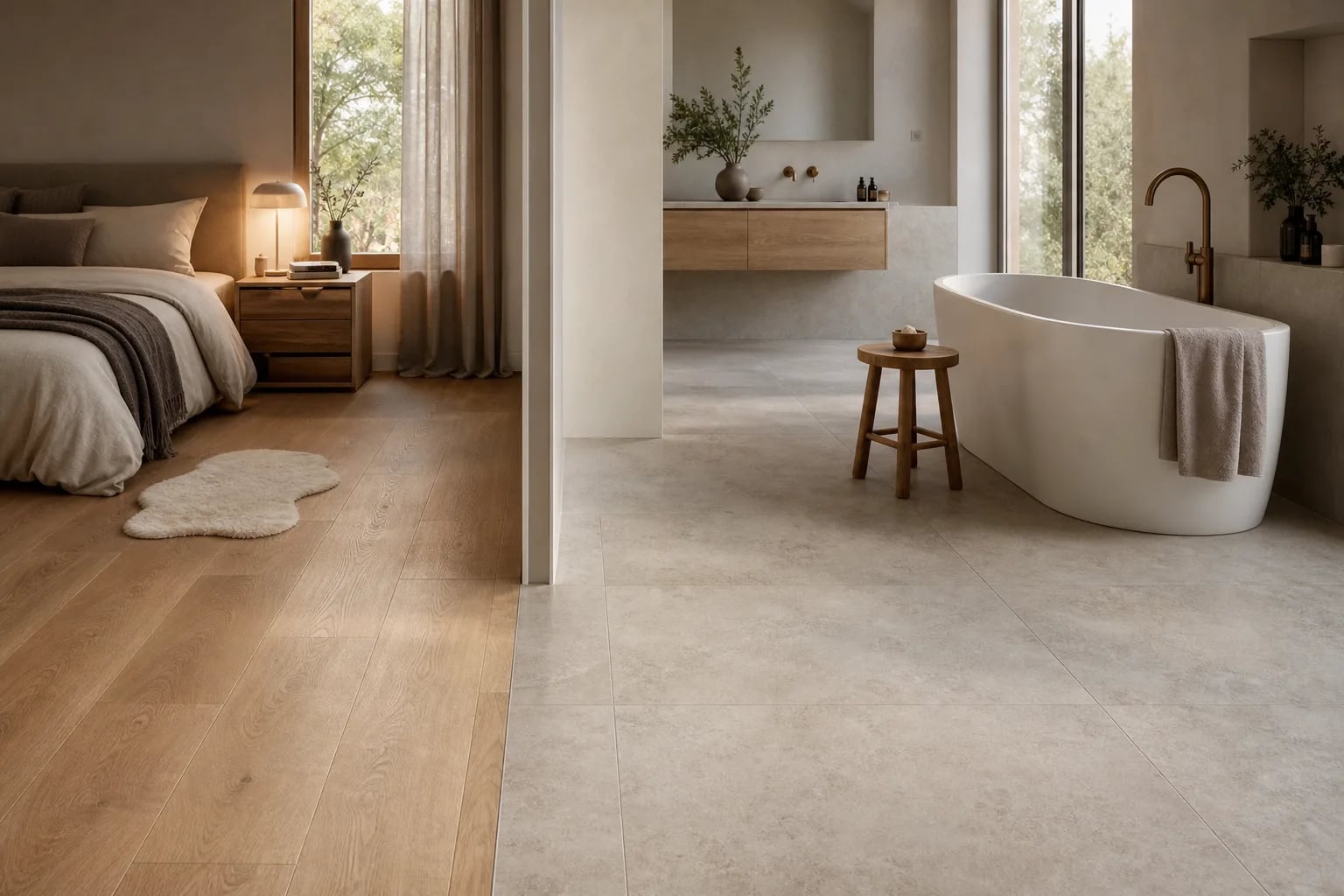
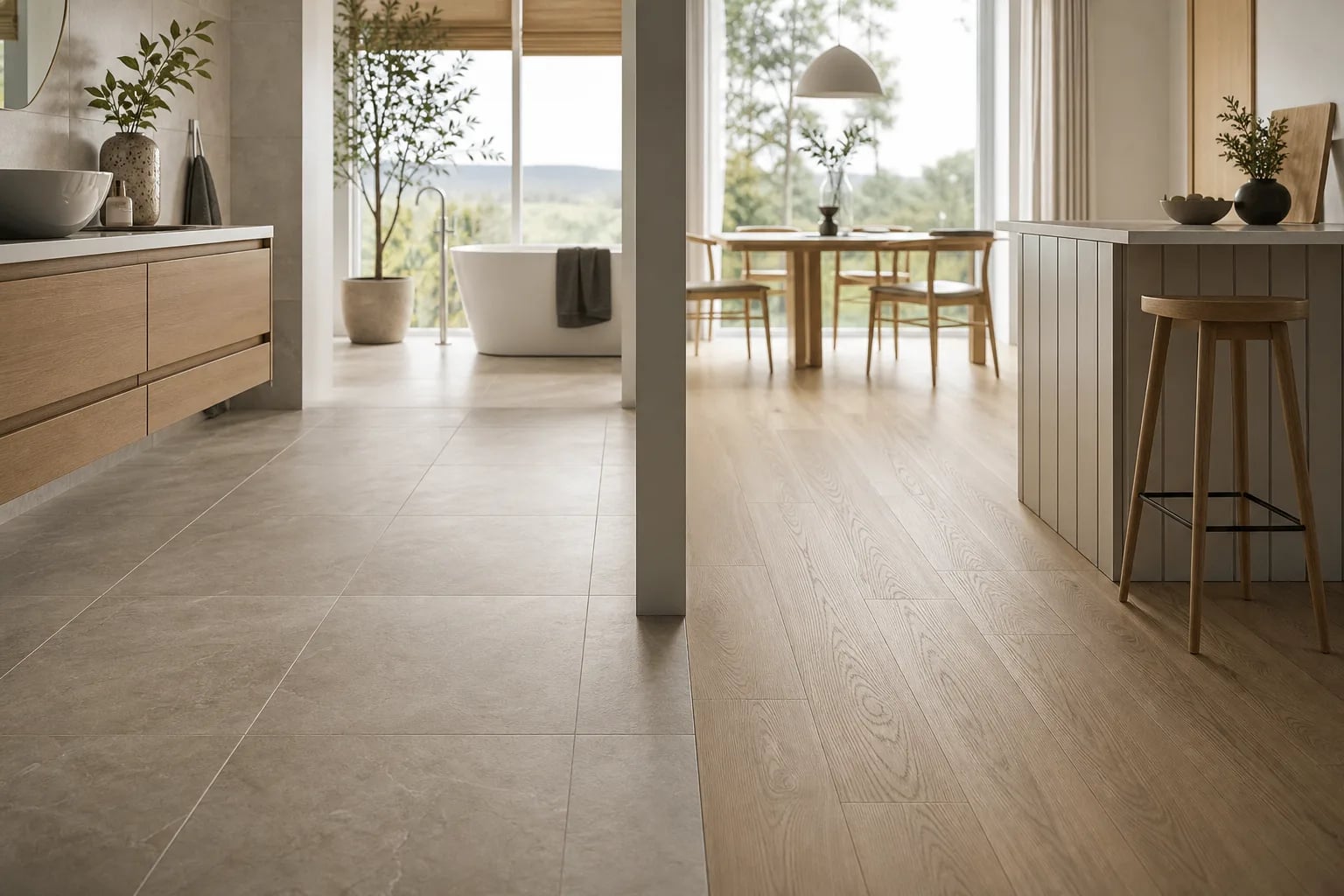
- Open plan without thresholds — vinyl lets you run one floor through several zones with no cold transitions.
If a third option is on your list, weigh it against wood in our comparisons of parquet versus tiles and parquet versus vinyl — that gives you the whole picture. For a deeper look at each covering, read the tile buying guide and the complete guide to vinyl flooring.
See it and touch it before you decide
A photograph on a screen cannot convey texture, which is why we send up to three free vinyl samples to your door. You can feel the surface, see how it reads in your own light, and hold it against the furniture you already own. We do not post tile samples; we go through tile shades with you on a call instead. If you would rather talk it through live, book a video consultation via our contact page and we will look at your room together and settle on the right specification. Our goods come straight from factories in Germany, Austria and Italy, with pallet delivery across the EU — cost and time are shown at checkout or on request.
Frequently asked questions
Which is better in a bathroom — tiles or vinyl?+
For the shower zone itself tiles are the most dependable choice: they absorb no water and work right up to the drain. For the rest of the bathroom, SPC vinyl with a mineral core is an excellent option too — warmer underfoot and simpler to fit. Many people tile the shower area and use vinyl everywhere else.
Does vinyl suit underfloor heating as well as tiles do?+
Vinyl is suitable over underfloor heating, but tiles pass heat on faster and more evenly, because ceramic is naturally conductive. Vinyl insulates slightly and has a capped surface temperature (typically up to 27–28 °C). If the floor is the room's main heat source, tiles are the more rational choice.
Which is cheaper — tiles or vinyl?+
Vinyl is cheaper: SPC flooring starts at 25,95 €/m² and tiles at 35,95 €/m², incl. VAT. In a real budget the gap is wider still, because tiles are normally set by a tiler while click vinyl can be laid by the owner. Fitting rates vary widely by country, so ask locally for that part of the estimate.
Can I lay vinyl myself, or do I need a fitter?+
SPC vinyl with a click joint is laid floating and without adhesive, so a careful DIY fitter can do it alone — an average room over a weekend. Tiles are better left to a tiler because of the adhesive, the cutting and the grouting. Fitting rates differ from country to country, so get a local quote for that work.
Can I get samples before I buy?+
For vinyl flooring, yes: we send up to 3 free samples to your address so you can feel the texture and see the colour in your own light. We do not post tile samples; we go through tile shades with you during a free video consultation.