Guide · 9 min
Porcelain tiles: why they outperform standard ceramic
2 September 2026
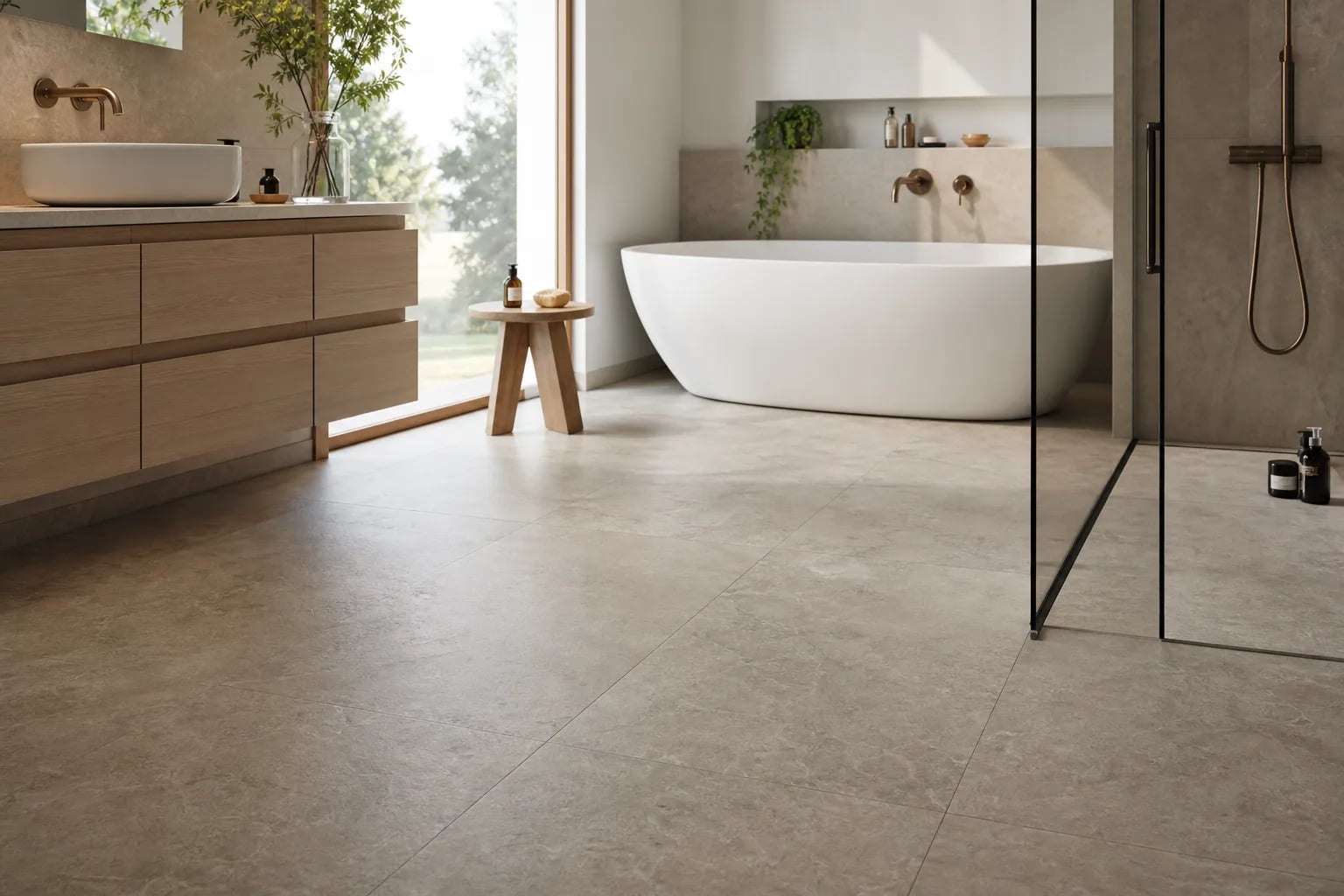
When you are choosing a floor or wall surface for a wet room, the shortlist usually comes down to three materials: standard ceramic, natural stone (marble, granite) and porcelain. The trade name for it in several European markets suggests a quarried stone, but porcelain is in fact a very dense type of ceramic, known technically as porcelain stoneware. This guide explains how it differs, where it performs best and what to look at before you buy.
What porcelain stoneware is
Porcelain tiles are made from finely milled clay, feldspar, quartz and kaolin. The mix is pressed under high pressure and then fired at a very high temperature — typically 1200–1300 °C. At that heat the raw materials partly fuse, a process called vitrification, so the finished tile is almost free of pores and glass-like right through its body.
That fusing is why porcelain has a water absorption rate below 0,5 % (group BIa under the EN 14411 standard). Standard ceramic, by comparison, often absorbs 6–10 %. Low moisture uptake means the tile will not swell, delaminate or crumble in frost — which is why it can be laid outdoors on a balcony or terrace as well as inside.
You will see the same material sold as "porcelain tiles", "gres porcelanato" or simply "gres". These are different names for one product, inherited from the Italian and Spanish factories that developed it.
Porcelain vs ceramic vs natural stone
The easiest way to place porcelain in the market is to compare it. Below are the main differences between the three most common hard surfaces.
| Property | Porcelain (gres) | Standard ceramic | Natural stone |
|---|---|---|---|
| Water absorption | <0,5 % | 6–10 % | 0,5–8 % (varies) |
| Hardness (Mohs) | 7–8 | 5–6 | 3–7 (marble ~3) |
| Stain resistance | Very high | Moderate | Low (needs sealing) |
| Frost resistance | Yes | No (indoors only) | Depends on the stone |
| Maintenance | Minimal | Straightforward | Periodic sealing |
| Colour consistency | Through the body or on the surface | Surface only (glaze) | Through the body (natural) |
The short version: porcelain combines the look of natural stone with better technical behaviour and none of the drawbacks — no sealing, no reaction to acids such as lemon or wine, and a predictable price. If you are still weighing porcelain against other surfaces, the broader comparison of tiles or vinyl for wet rooms is a useful companion piece.
The main advantages of porcelain
- Moisture resistance — with almost no water absorption the tile will not harbour mould or swell. Ideal for bathrooms, showers and the kitchen work zone.
- Mechanical strength — 7–8 on the Mohs scale means grit, furniture feet and pet claws will not scratch the surface. It is exactly why commercial spaces specify it.
- Stain and chemical resistance — a non-porous surface does not absorb coffee, wine or oil, and it tolerates stronger cleaning products.
- Suitable for underfloor heating — porcelain conducts heat well and does not move with temperature swings, which makes it one of the best surfaces over a heated screed.
- Design freedom — modern digital printing reproduces marble, concrete, wood and onyx so precisely that the difference is hard to see from across a room.
Rectification and formats
Most good porcelain is rectified: after firing, the edges are mechanically ground to an exact 90° angle and a uniform size. That allows a very narrow grout joint of just 1,5–2 mm and an almost continuous surface. Large formats such as 60×120 cm are effectively never used unrectified, because only precise edges keep a big panel flat. There is more on this in the article on rectified tiles and why they cost more.
Popular porcelain formats run from the classic 60×60 cm up to substantial XL slabs. In our porcelain tile collection you will mostly meet 60×120 cm marble-effect tiles, which visually widen a room and reduce the number of joints.
Where porcelain tiles work
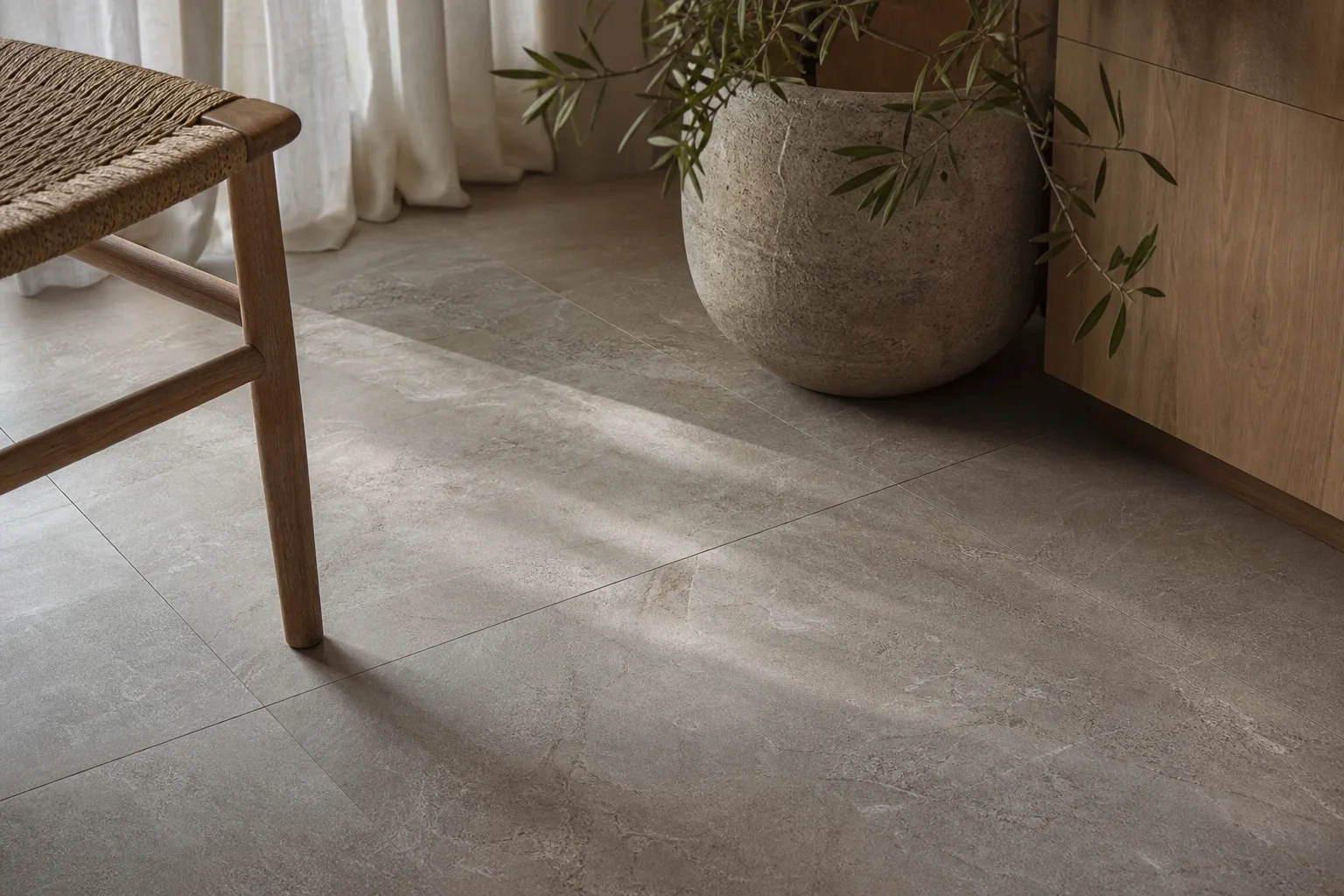
In short, almost anywhere that needs a long-lived surface resistant to moisture and wear:
- Bathroom and shower — floors, walls and the shower area. A matt or structured surface raises the friction coefficient, so the floor is less slippery.
- Kitchen — resistant to grease, heat and dropped pans. If you are choosing a kitchen surface, the guide to kitchen and bathroom tiles is worth reading alongside this.
- Hallway and entrance — the most walked-on areas, where resistance to grit and dirt off shoes matters most.
- Living room with underfloor heating — porcelain passes heat upward quickly and evenly.
- Terrace, balcony, garden paths — thanks to frost resistance, thick 20 mm outdoor tiles cope with the freeze–thaw cycles of a northern European winter.
Finishes: polished, matt, structured
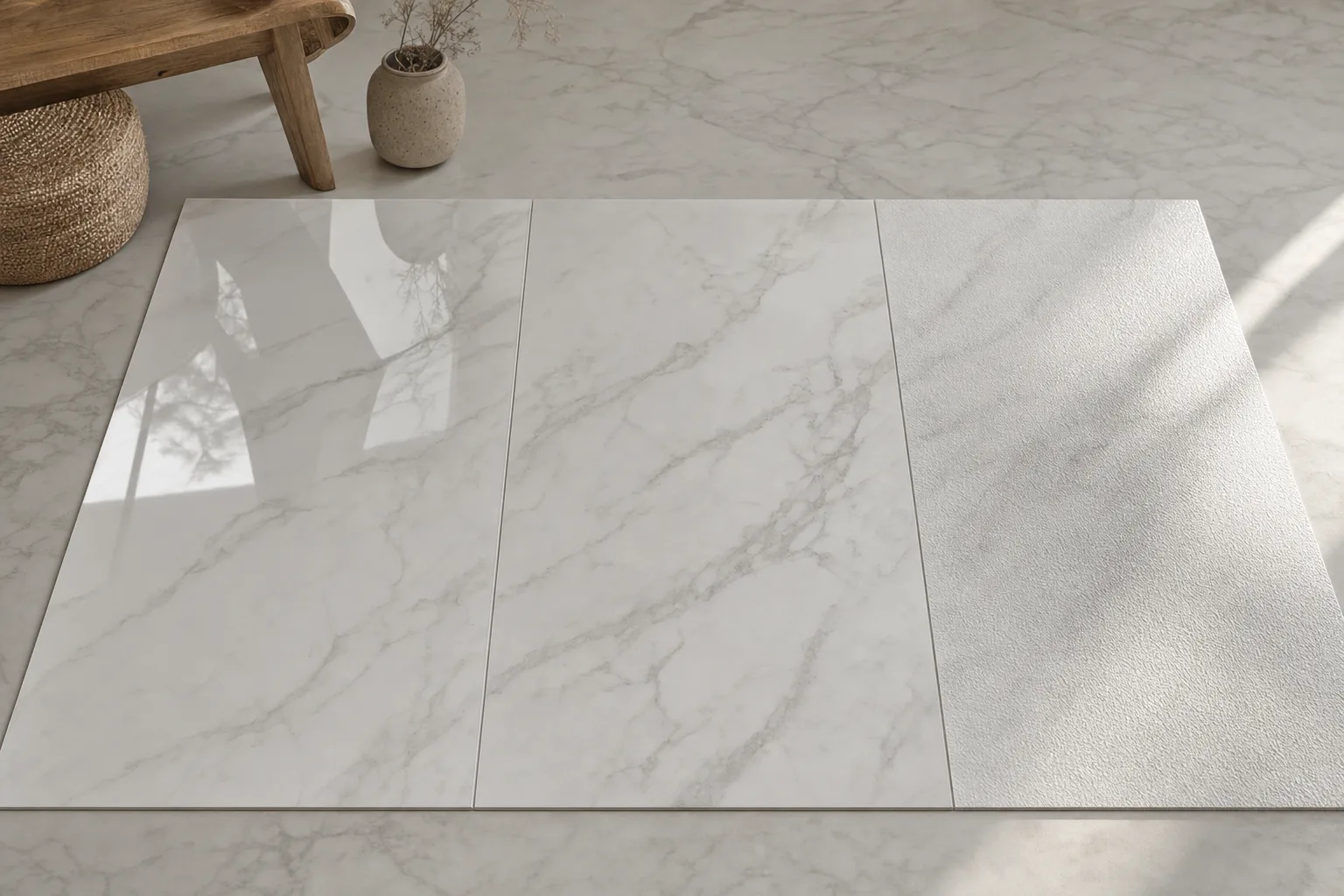
One and the same pattern can read completely differently depending on the surface finish:
- Polished — glossy, luxurious, reflects light beautifully. Suits walls and lower-traffic rooms; on a floor it can be slippery.
- Matt (natural) — the most versatile choice for floors, and water marks and fingerprints show far less.
- Structured / anti-slip — a textured surface for shower floors and outdoor areas, with a higher R rating under the slip-resistance standard.
The polished EndlessLove Perlato tile, with its soft marble pattern, suits a formal living room or entrance hall, while anyone after warmer, creamier tones should look at the onyx-effect EndlessLove Onyx Ivory.
Porcelain floor tiles: what to choose for a floor
Almost any tile will do on a wall, but porcelain floor tiles carry two extra requirements: slip rating and wear resistance. For dry rooms — living room, hallway, bedroom — R9 is enough. For a kitchen and for bathroom porcelain tiles choose R10, and for a terrace or the zone around a pool R11 or higher.
The finish decides more here than the format: matt and structured surfaces stay safe when wet, while a polished one turns slippery, so we do not recommend it for floors in wet rooms. More on this in non-slip tiles and matt or polished tiles.
Rectification matters on floors too — the grout joint narrows to roughly 2 mm and the surface reads as one plane. You will find the full floor-suitable range in the tile category from 35,95 €/m², and you can work out the quantity you need, including waste, with the tile calculator.
Price and what it covers
Porcelain tiles at Terris Timber start at 35,95 €/m². The price depends on the format (large XL slabs cost more), the surface finish and the collection. It is worth judging more than the per-m² figure: good porcelain lasts for decades, and we back our tiles with a 10-year guarantee.
We supply the tiles direct from Italian factories, with pallet delivery across the EU — the cost and lead time are shown at checkout or quoted on request. Before ordering the full quantity, we recommend the tile quantity calculator, so you can work out the exact area plus an allowance for cuts.
How to choose a shade you will not regret
Marble and onyx patterns look different in a small on-screen image than they do in a room — lighting, depth and texture do not survive the photograph. It is worth asking before you commit. We do not send tile samples to your home; free samples (up to 3) apply only to engineered parquet and vinyl flooring. For tiles we recommend studying the photographs and descriptions closely, and writing to us about the shade in your own light — we will advise for your specific room. If you would rather talk the whole specification through with a specialist, you can book a video consultation; there is more about it on the contact page.
Frequently asked questions
How does porcelain differ from standard ceramic?+
Porcelain (gres porcelanato) is fired at a higher temperature (above 1200 °C), so it is denser, harder and absorbs almost no water (less than 0,5 %, against 6–10 % for standard ceramic). That makes it more resistant to stains, wear and frost, whereas standard ceramic is suitable indoors only.
Are porcelain tiles suitable for underfloor heating?+
Yes, porcelain is one of the best surfaces over underfloor heating. It conducts heat very well and does not deform with temperature changes, so it passes warmth evenly into the room and will not crack from the heat.
Does porcelain need sealing the way marble does?+
No. Unlike natural marble or stone, porcelain has almost zero porosity, so it does not absorb liquids and needs no periodic sealing. Ordinary care with a damp cloth and a mild cleaner is enough.
How much do porcelain tiles cost?+
Terris Timber porcelain tiles start at 35,95 €/m². The final price depends on the format, the surface finish and the collection. The tiles carry a 10-year guarantee, and we ship on pallets across the EU — delivery cost and lead time are shown at checkout or quoted on request.
Do you send tile samples to customers' homes?+
We do not send tile samples to your home — free samples apply only to engineered parquet and vinyl flooring. Instead we offer a free video consultation: we show the tiles close up, discuss how the shade will read in your lighting and help you decide.