Guide · 9 min
Anti-slip tiles: how to choose by slip rating
1 September 2026
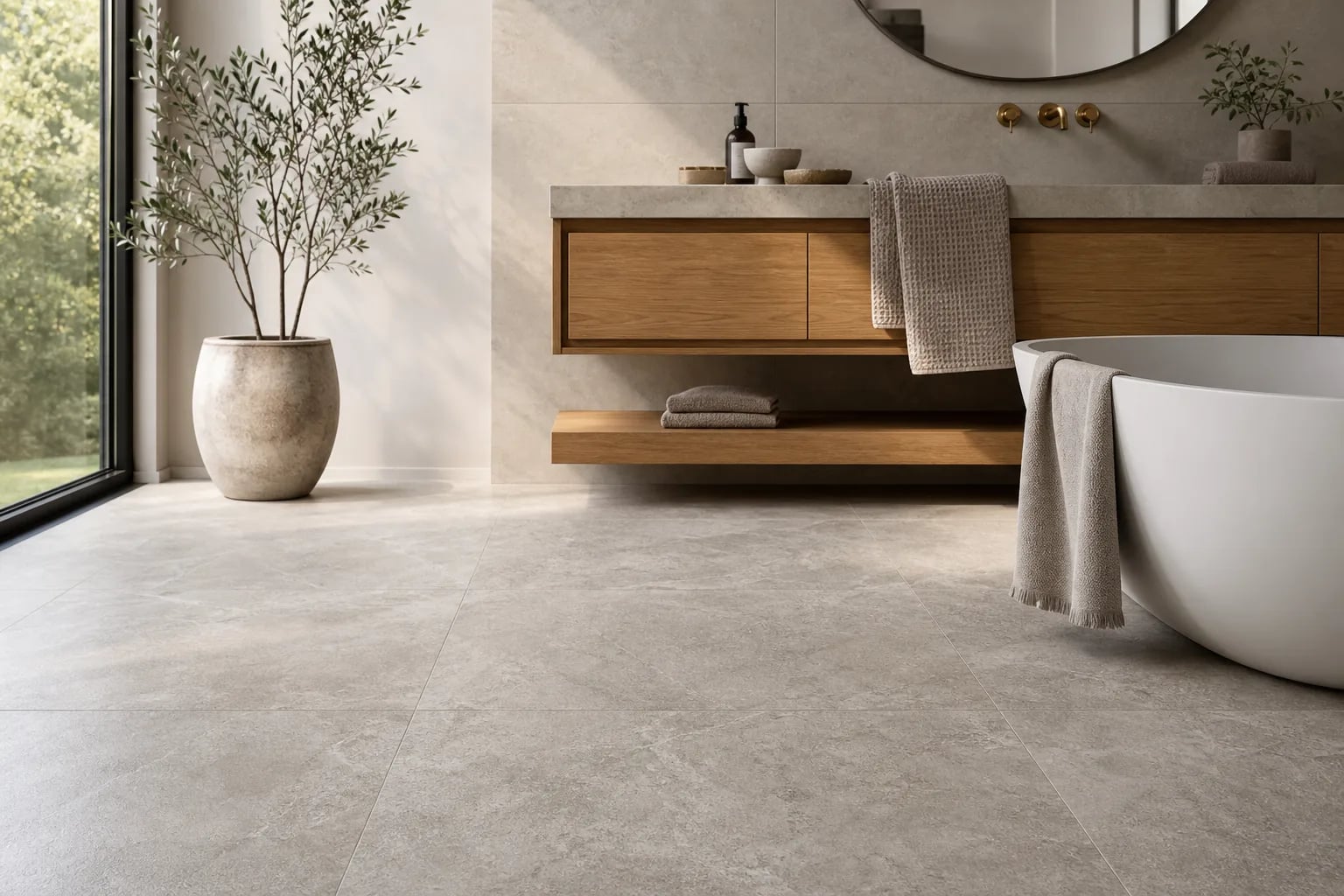
Tiles are the most durable and moisture-resistant floor covering you can lay, but they are not all equally safe underfoot. The same porcelain body can be polished to a mirror finish that turns to ice when wet, or left matt and textured — and that single difference decides whether your bathroom is safe for children and older relatives. Across Europe, slip behaviour is described by standardised ratings. Once you can read them, you choose tiles on evidence rather than on instinct.
What a slip rating actually measures
Slip resistance for shod feet is measured to the German standard DIN 51130. A tester in work boots walks across a tile coated with oil while the surface is gradually tilted, until they begin to slide. The steeper the angle the tile holds, the higher the R rating it earns. The scale runs from R9 (lowest grip) to R13 (maximum, industrial).
It matters that the test uses footwear and a lubricant, because that mirrors real life — spilled oil in a kitchen, wet snow carried in on boots. On a dry bedroom floor there is almost no slip risk, so the R rating is irrelevant there. Wherever water, grease or grit appear regularly, it becomes the single most important safety figure. Our team always asks first which room the tile is for and who lives in the house, and only then recommends a specific tile.
The R rating table: which class suits which room
Below is a practical summary of which class to choose for each room. It is the standard European benchmark, and the one we work to ourselves.
| R rating | Level of grip | Suitable for |
|---|---|---|
| R9 | Adequate (dry areas) | Living room, bedroom, corridor, dry living spaces |
| R10 | Increased | Bathroom, kitchen, hallway, WC — damp indoor areas |
| R11 | High | Terrace, balcony, entrance from outdoors, walk-in shower without a tray |
| R12 | Very high | Pool surrounds, garage, workshops, commercial kitchen areas |
| R13 | Maximum | Industry, abattoirs, food production — not needed at home |
The rule of thumb for a homeowner is simple: R10 covers most domestic needs. A higher class means a more pronounced surface texture, and that makes cleaning harder — so there is no reason to chase R12 where R10 would do. For more on tile types and formats, see our guide to choosing floor tiles.
Barefoot classification: A, B and C for wet areas
The R rating is measured with shoes on, but in a bathroom or shower we walk barefoot. That has a standard of its own — DIN 51097 — which sorts tiles into classes A, B and C by grip under a wet, bare foot:
- Class A — bathroom floors, changing areas, domestic shower approaches.
- Class B — shower areas, communal pool walkways, jetties.
- Class C — sloped pool entries, steps under water.
For a domestic bathroom, class A together with R10 is entirely sufficient. If you are building a walk-in shower where water runs straight across the floor, class B is worth specifying, or at least R11 in that particular spot. The same logic applies to vinyl solutions, which we cover in a separate article on vinyl flooring in bathrooms.
Matt or polished: how the surface changes safety
This is the most under-rated factor, and the decisive one. A mirror-polished tile looks luxurious but turns dangerously slippery once wet — even with a porcelain body underneath. Polishing fills the micro-pores in the surface and cuts friction, which is why polished tiles almost always carry only an R9 rating and do not belong in bathrooms or hallways.
Matt (natural) and structured surfaces keep a microscopic roughness that grips the sole even with water present. Between matt and polished sits a middle option: the semi-polished (lappato) tile, which gives a soft sheen without giving up all the grip. If you want shine in a bathroom, choose lappato rather than a full polish. Two tiles that balance looks with grip are the light EndlessLove Polar and the darker EndlessLove Empire — both available in a matt version for damp areas.
Safety for families and older people
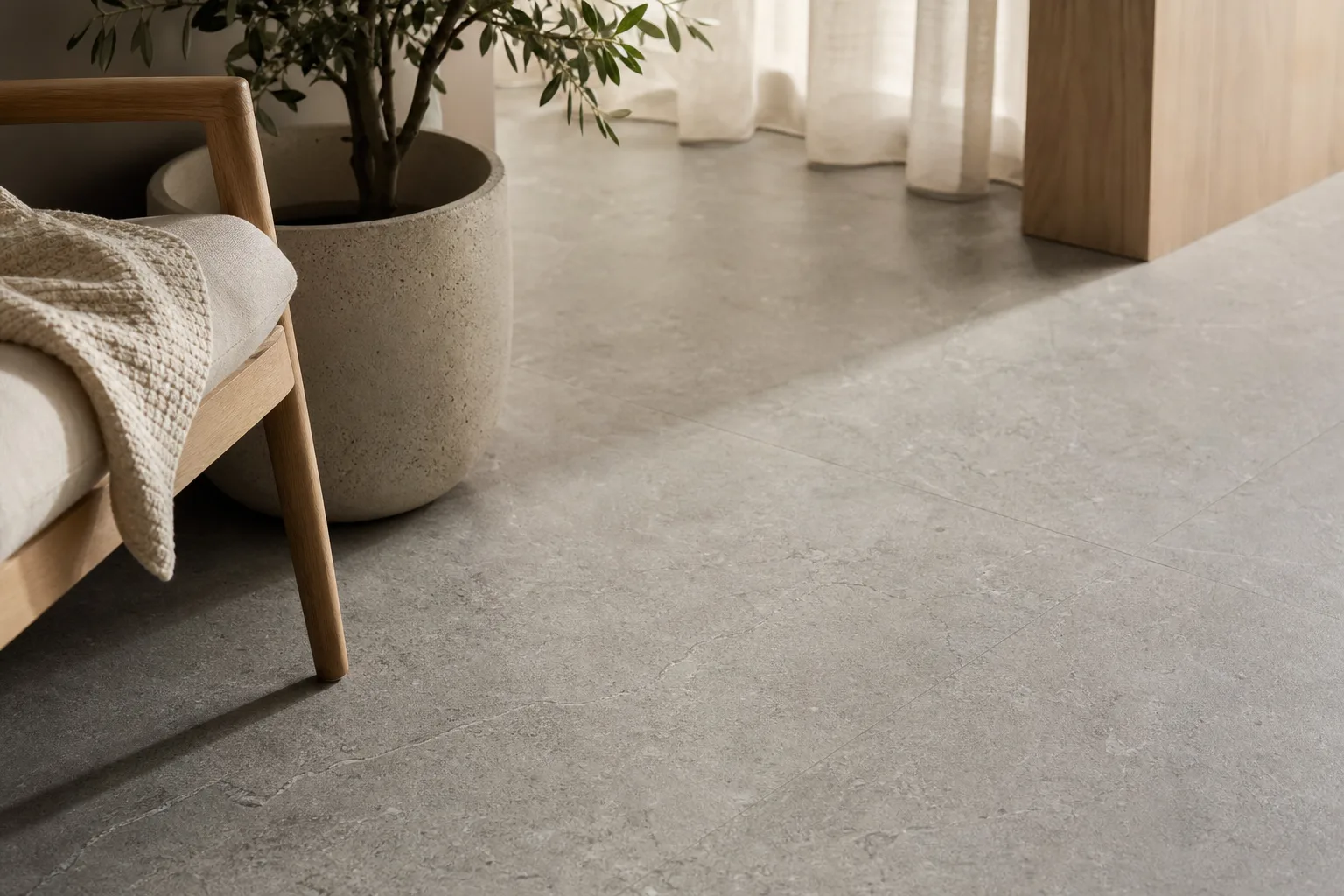
If there are young children or older people in the house, the slip rating stops being a technical detail and becomes a genuine health question. Statistically, the bathroom and the hallway are exactly where falls happen. A few practical points:
- In a bathroom choose at least R10 with class A; where an older person lives in the house, R11 in the same price bracket buys peace of mind with no compromise.
- Smaller format = more joints = more grip. Mosaic or 30×30 cm tiles on a shower floor are safer than one large slab, because the joints themselves work as tread lines.
- Avoid polished tiles on stairs and at entrances, where shoes bring in moisture and grit.
If you also want warmth underfoot, it is worth knowing that anti-slip porcelain tiles work extremely well with underfloor heating — we cover this in detail in our article on tiles for underfloor heating.
Grip versus everyday cleaning
There is a paradox here: the higher the R rating and the more pronounced the texture, the harder the tile is to clean, because dirt catches in exactly the micro-recesses that hold your feet. That is why R12–R13 has no place in a house — those surfaces simply demand more thorough maintenance. A practical balance:
- Matt R10 — safe and still easy to clean with a damp mop, no special products needed.
- For structured terrace tiles (R11 and above), use a brush rather than a mop alone, so dirt does not sit in the grooves.
- Porcelain is unaffected by household cleaning chemicals, so its grip does not degrade with cleaning — unlike some coated surfaces.
To compare tile materials against each other, read our article on porcelain tiles, where we explain how porcelain differs from ordinary ceramic.
How to choose, step by step
It comes down to a short decision chain:
- Room. Dry living space — R9 is enough; bathroom, kitchen or hallway — R10; terrace or walk-in shower — R11 and above.
- Surface. For damp areas, matt or lappato, never a full polish.
- Barefoot? For a bathroom or shower, check the A/B/C class to DIN 51097 as well.
- Household. With children or older relatives, move one step above the minimum.
- Datasheet. Ask us for the manufacturer's technical sheet before ordering. We do not ship tile samples, so the declared R and A/B/C ratings are your reliable check.
You will find the full range of safe, moisture-resistant tiles in our tile category (from €35.95/m² incl. VAT). If you are unsure about a particular room, get in touch — we have been advising on floors since 2014 and are glad to work through your plan with you.
Frequently asked questions
Which slip rating is right for a bathroom floor?+
For a domestic bathroom choose tiles rated at least R10 to DIN 51130, and if you walk barefoot add class A to DIN 51097. For a walk-in shower without a tray it is worth going up to R11 or class B. That combination gives dependable grip with water present, while the tile stays easy to clean.
Are polished tiles slippery?+
Yes. Mirror-polished tiles are dangerously slippery when wet and usually carry only an R9 rating. They are fine in dry rooms, but not in a bathroom or hallway. If you want shine in a damp area, choose a semi-polished lappato surface — it gives a soft sheen without losing grip.
Which tiles are suitable for a terrace?+
For an outdoor terrace or balcony, choose frost-resistant structured porcelain tiles rated at least R11. R11 copes with rain and moisture underfoot, and R12 is appropriate around a pool. Such tiles have a more pronounced texture, so clean them with a brush to keep dirt out of the grooves.
Are anti-slip tiles harder to clean?+
A matt R10 tile cleans as easily as any other — a damp mop is enough. Only the very high classes (R12–R13) with structured surfaces need a brush, because dirt catches in the same micro-recesses that hold your feet. Homes do not need ratings that high, so cleaning presents no problem.
Do you send tile samples to my address?+
We do not ship tile samples — free samples apply to engineered oak parquet and SPC vinyl flooring only. When choosing anti-slip tiles, the declared R rating is what matters: R10 is enough for a bathroom or kitchen, R11 or higher for a terrace. If you are unsure about a particular room, get in touch or book a free video consultation.