Guide · 9 min
Large-format tiles: why they change how a room feels
2 September 2026
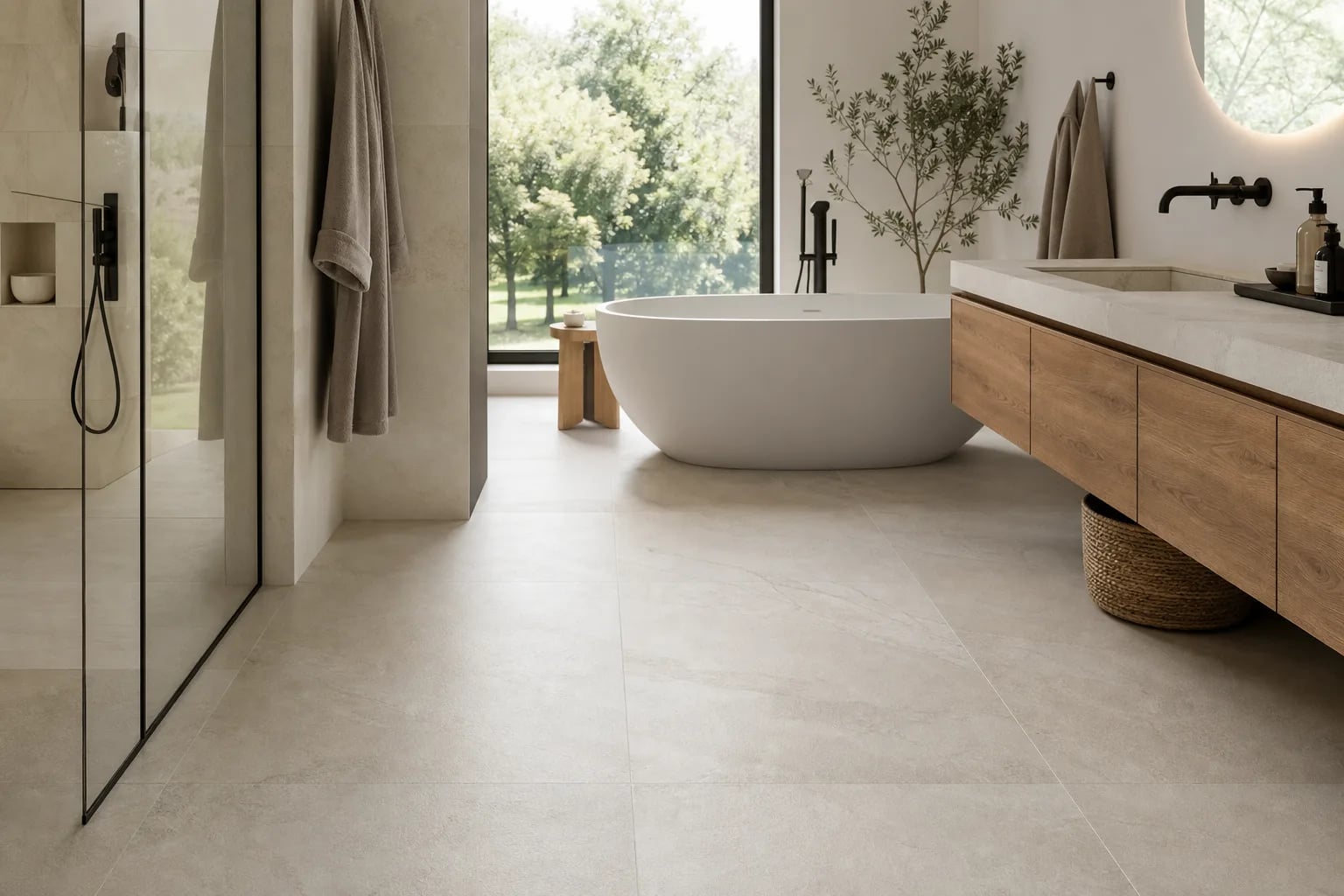
Over the past few years interior design has moved in one clear direction — towards fewer joints and larger surfaces. Where a decade ago a grid of 30×30 cm tiles would have gone down, today a single 120×120 cm slab is laid instead. This is not simply fashion: large-format tiles genuinely change how a room looks and how the eye reads it. This guide explains why big formats became the premium standard, where they work best, what the real fitting challenges are, and what drives the final price.
Why large formats took over
The main reason is straightforward — grout joints. Every joint tells the eye “one tile ends here and the next begins”. The more of those lines there are, the more fragmented the floor looks and the smaller the room feels. Swapping 60×60 cm tiles for 60×120 cm halves the number of joints; moving to 120×120 cm cuts it further still. The result is an almost seamless, monolithic surface that reads like a slab of natural stone rather than a mosaic of tiles.
The second reason is the premium feel. Large formats are what we associate with good hotels, contemporary architecture and minimalist interiors. An unbroken surface lets the pattern — marble veining, concrete texture — run across the whole slab instead of stopping every 60 cm. In our floor tile collection, large-format models such as EndlessLove Empire or the lighter EndlessLove Perlato look like one continuous seam of marble for exactly this reason.
The third is hygiene and upkeep. Fewer joints mean fewer places for dirt to gather and for grout to darken. That is valued most in kitchens and bathrooms, a subject we return to below and cover in a separate guide to tiles for kitchens and bathrooms.
Our formats: from standard to XXL
“Large format” is a broad term, so it is worth being precise about what we mean. In our range the standard large format is 1200×600 mm (120×60 cm) — the most versatile size, at home in most living rooms, hallways and open-plan spaces. For a more dramatic effect there is the XXL format, 120×120 cm, which takes the area of a single slab to 1.44 m².
Almost all large-format tiles are also rectified: their edges are mechanically ground to an exact 90° angle, so they can be set with a joint of just 2–3 mm. Without rectification a large tile would never look continuous, because on a big surface even a millimetre of size variation becomes visible. The material itself is dense, all but non-absorbent porcelain stoneware, resistant to abrasion, staining and UV light.
Format, room and fitting difficulty
Not every format suits every room equally well. The table below links size to space and gives a sense of how demanding the installation will be.
| Format | Rooms it suits | Fitting difficulty |
|---|---|---|
| 60×120 cm (standard) | Living rooms, hallways, kitchens, bathrooms from about 8 m² | Moderate — needs an experienced tiler |
| 120×120 cm (XXL) | Open-plan spaces, large living rooms of 15 m²+ | High — two people, with vacuum lifters |
| 60×60 cm | Smaller bathrooms, entrance halls, balconies | Standard |
| 30×60 cm | Walls, small wet areas | Straightforward |
Where large formats work best
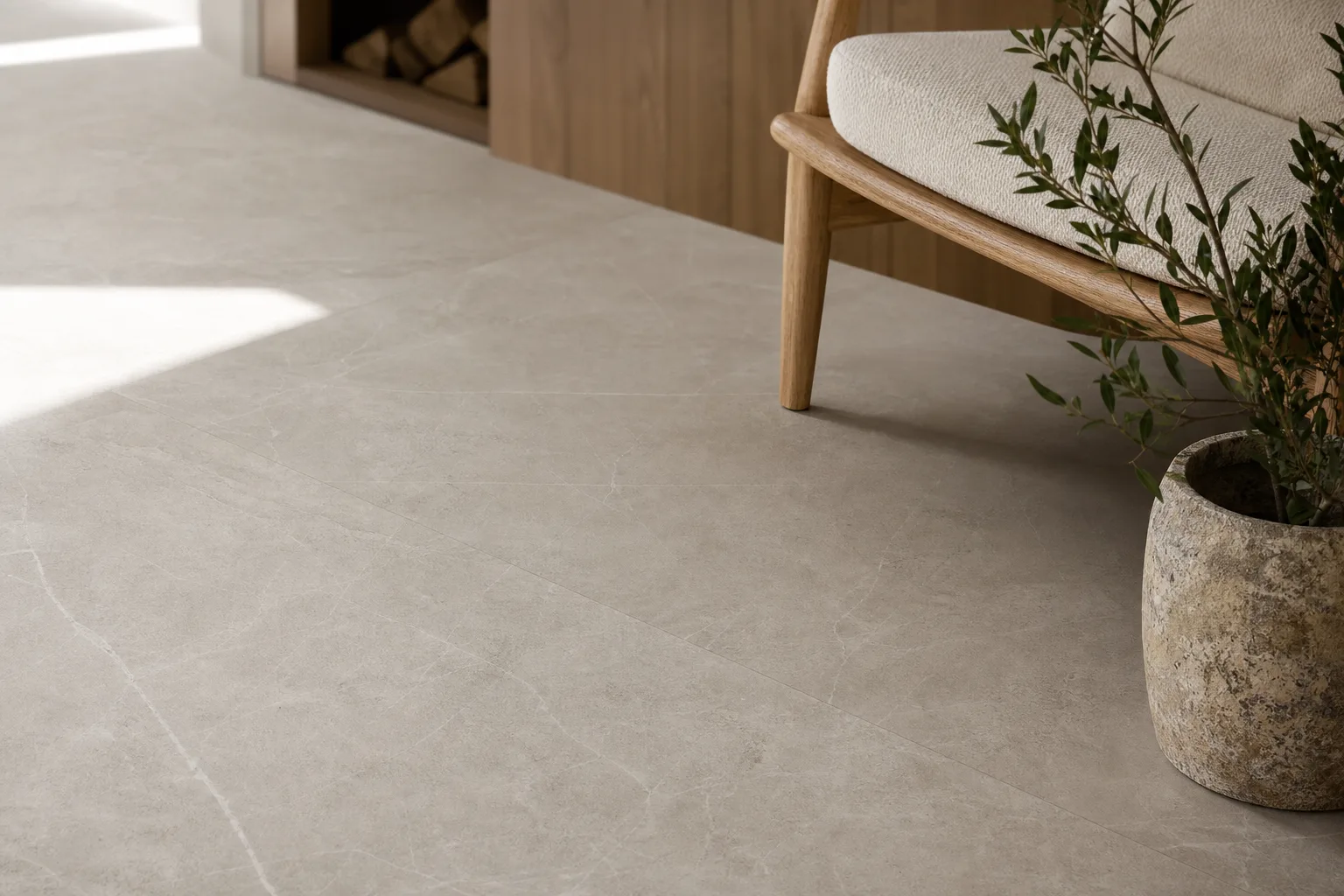
Large-format tiles have the greatest effect in open-plan layouts and larger rooms, from roughly 15 m² upwards. Where kitchen, dining area and living room flow into a single zone, an unbroken field of 120×120 cm tiles ties the space together and dissolves the boundaries between “rooms”. The same covering also works beautifully in hallways and stairwells, where one long, uninterrupted line stretches the perspective.
In commercial settings — showrooms, offices, cafés — big formats are valued for durability as well: fewer joints mean fewer weak points in high-traffic areas. Our tiles carry a 10-year guarantee, and porcelain stoneware takes furniture feet and intensive cleaning in its stride.
What about small rooms?
A common myth says large-format tiles do not belong in small rooms. In practice the opposite is true: a large tile with minimal joints makes even a small bathroom or entrance hall look wider. The one genuine constraint is more cuts — in a small room the slabs have to be trimmed around walls, doorways and pipework, so the waste percentage rises. That matters when you work out quantities; we explain how to do it properly in our guide to calculating how much flooring you need, and you can get a quick estimate from our tile calculator.
Fitting challenges worth naming
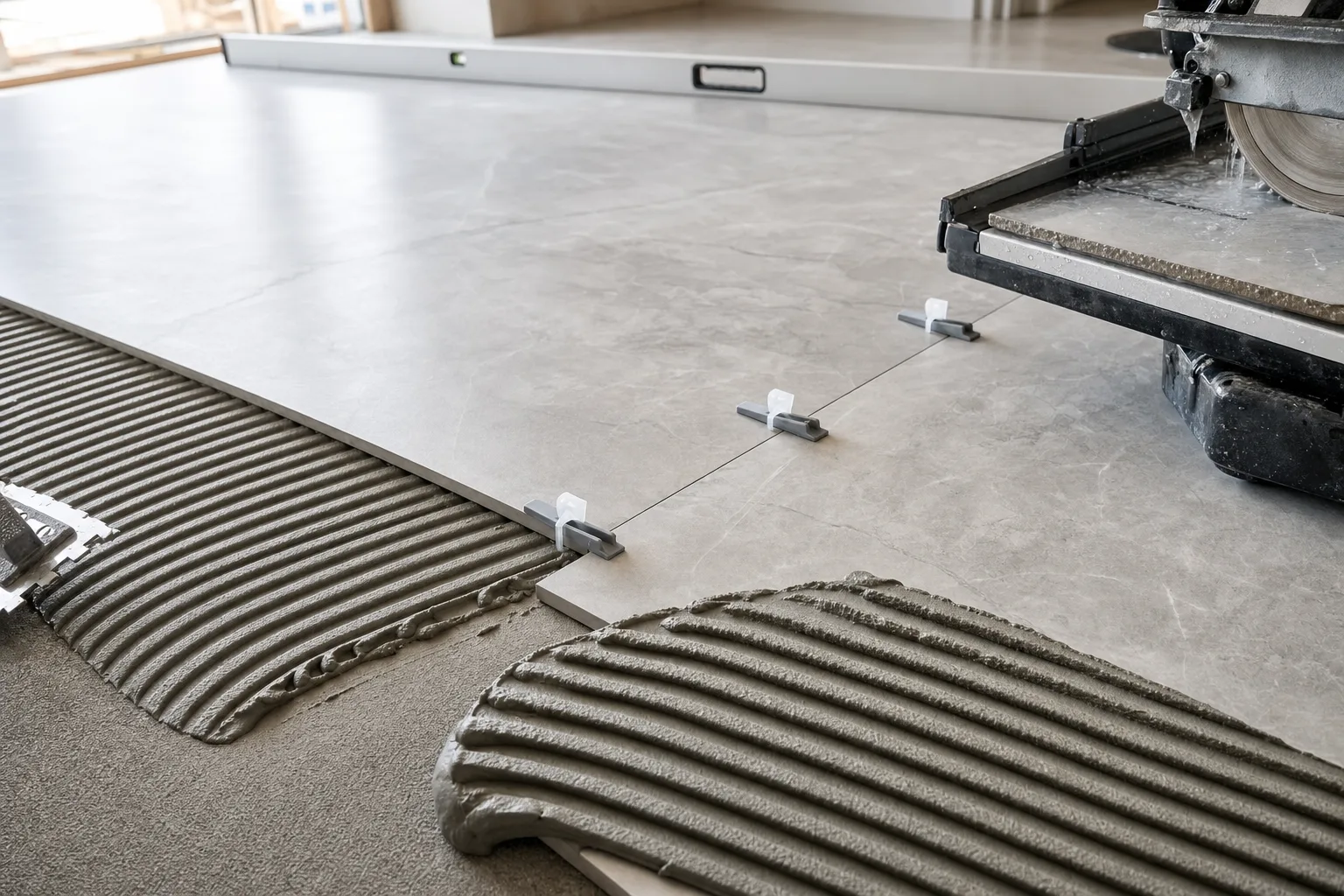
A large format looks luxurious, but it is harder to lay than an ordinary tile. Here is what has to be allowed for:
- A genuinely flat subfloor. A large slab will not follow undulations — deviation should stay within roughly ±2 mm over a 2 metre span. Even a slight rise leaves a hollow void under the tile, and the slab can then crack under load.
- Weight. A single 120×120 cm porcelain slab weighs several kilograms and is fragile in bending — it takes two people, usually with vacuum suction lifters, to lift and place it accurately.
- Cutting. Precise cuts and cut-outs are made on a wet saw with a diamond blade; on a large format an angle grinder tends to leave chipping and cracks.
- Adhesive. Full-bed coverage with back-buttering (adhesive on both the substrate and the tile), with the joints levelled using levelling systems so that no lippage develops.
- The joint. 2–3 mm as standard — anything thinner leaves no room to absorb thermal movement, particularly over underfloor heating.
In short, this is a job for an experienced tiler. If you want the finished floor to look like the catalogue image, have it set by a specialist — fitting rates and trade practice vary considerably from one country to another, so gather local quotes before you budget. We are happy to advise on format and layout at the design stage.
XXL tiles: when 120×120 and larger are worth it
XXL tiles is the trade name for slabs of 120×120 cm and above. They give the strongest “single slab of stone” effect, but the requirements grow in proportion to the size: subfloor deviation must stay within roughly ±2 mm over two metres, adhesive goes on both the substrate and the slab (back-buttering), and carrying and cutting take two people with vacuum grippers.
XXL is therefore the right choice when the space is large and the subfloor is sound — an open-plan living room, or a generous bathroom. In a small room with many corners a big slab simply turns into waste, because the offcuts are rarely reusable; there, plan the overage at 15 %, not 10 %.
Large tiles for walls and for floors — the difference
Large wall tiles and floor tiles often look identical, but they are chosen on different criteria. On a wall, appearance and weight are what count, and a polished finish is perfectly fine because slip is irrelevant. On a floor, slip resistance and abrasion resistance decide it: for large bathroom tiles and for kitchens, choose R10 with a matt or structured surface.
In practice the same 60×120 cm collection is often used on both surfaces — polished on the wall, matt on the floor. That keeps a single tone running through the whole bathroom. We set out the slip ratings in detail in our article on non-slip tiles, and the surface differences in matt or polished tiles. Quantities, including the overage, are quickest to work out with the tile calculator.
What large-format tiles cost
Our large-format porcelain tiles start at €35.95/m², incl. VAT. The final figure depends on the collection, the surface finish (matt, polished, structured) and the format — XXL slabs are normally dearer than the standard size. Alongside the material, budget for the fitting itself and for levelling systems; installation rates differ widely across Europe, so treat any figure you have seen as indicative and ask locally. Good workmanship matters more here than it does on cheaper coverings.
Pallet delivery across the EU — cost and lead time are shown at checkout or confirmed on request. Tiles ship directly from our Italian manufacturers. We do not post tile samples; free samples (up to 3) apply to engineered parquet and vinyl flooring only. To settle a shade or a format, book a free video consultation. And if you are still weighing large-format tiles against another covering, our broader guide to choosing a floor is the place to start.
Frequently asked questions
Do large-format tiles suit small rooms?+
Yes. A large tile with minimal joints makes even a small bathroom or entrance hall look wider and gives a calm, continuous surface. The only difference is that a small room brings more cuts around walls and pipework, so allow a slightly larger waste margin.
What joint width is used between large-format tiles?+
2–3 mm as standard. Because large-format tiles are almost always rectified, with precisely ground edges, a fine 2 mm joint still reads as seamless, while 3 mm is recommended over underfloor heating, where thermal movement has to be absorbed.
Can I lay large-format tiles myself?+
We would not recommend it. A large slab needs a genuinely flat subfloor (within ±2 mm over 2 m), a wet saw, levelling systems and usually two people with vacuum lifters. This is work for an experienced tiler — a badly bedded slab can crack or leave hollow voids underneath.
What do large-format tiles cost?+
Our large-format porcelain tiles start at €35.95/m², incl. VAT. The price depends on the collection, the surface finish and the format — XXL 120×120 cm slabs are normally dearer than the standard 60×120 cm. We do not post tile samples; free samples apply to engineered parquet and vinyl flooring only.