Comparison
Matt or polished tiles — which surface should you choose?
1 September 2026
You have narrowed the choice down to a tile you like, and now the last question is the finish: matt or polished. It is one of the most common decisions buyers face with porcelain, because both surfaces look excellent in a photograph and then behave completely differently in real life — in a wet bathroom, in a sunlit living room, in a hallway that takes traffic every day. In this guide we compare matt and polished tiles on slip resistance, cleaning, light reflection and how visible scratches become, and give a clear answer on which surface suits which room.
What actually separates matt from polished tiles?
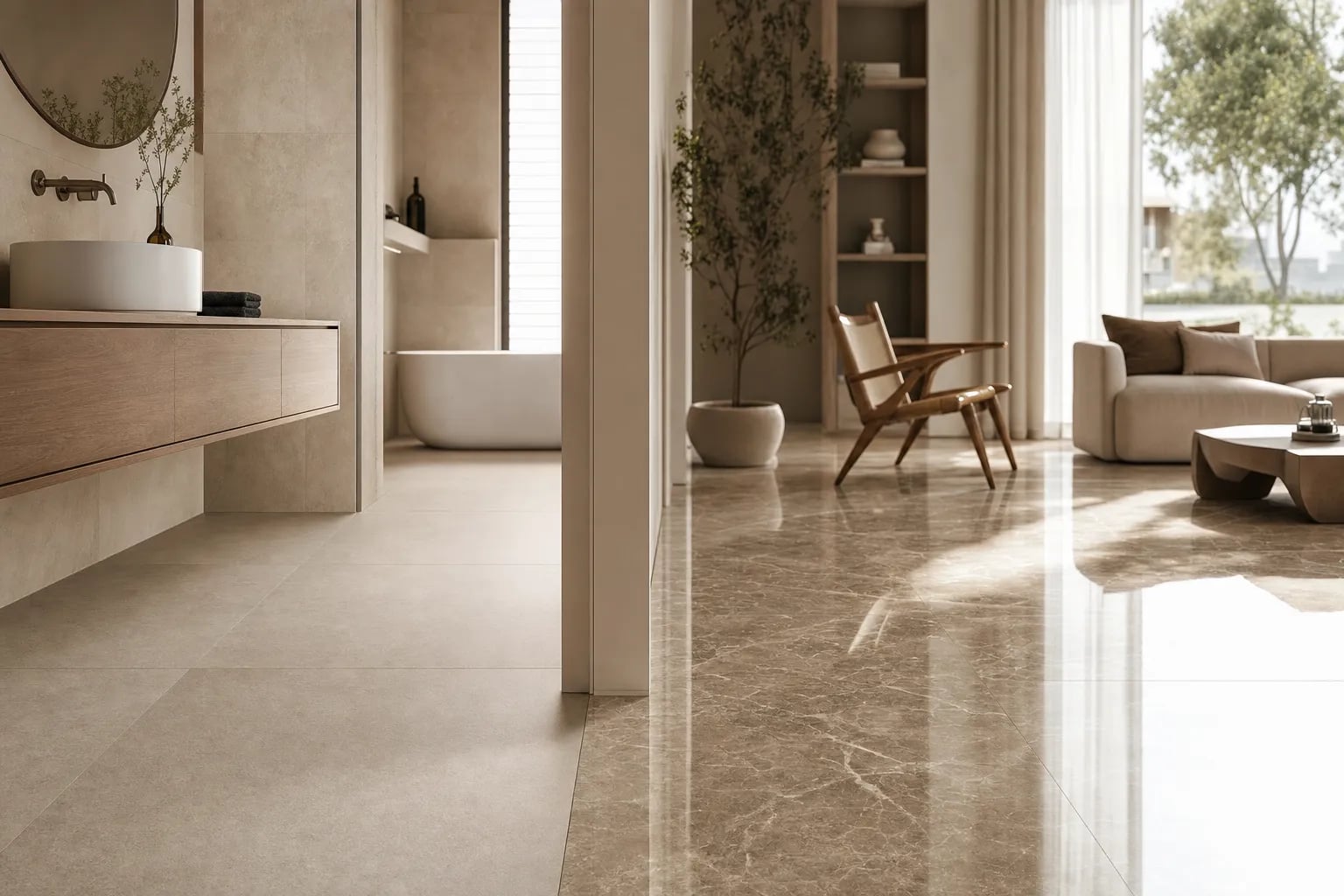
It is easy to assume matt and polished are two different products with different technical specifications. In our range they are not. Both are the same porcelain tile: 9 mm thick, rectified edges, made in Italy. The only difference comes at the very last stage of production. A matt surface is left as it comes out of the kiln after high-temperature firing, while a polished surface is mechanically ground and buffed until the top layer takes on a mirror-like shine.
In practice this means the properties that matter most — resistance to water, wear, staining and temperature swings — are essentially identical. Both work well over underfloor heating, and thanks to their rectified edges both can be laid with minimal joints, so the floor reads as one continuous stone surface. You are not choosing quality here, you are choosing character: how the surface will behave with light, with water and with daily use. That is where the two diverge sharply, and it is why the decision should be made room by room rather than from a photograph.
Matt tiles: the practical everyday choice
Our matt range covers 16 models, from pale stone effects to warm, saturated concrete tones. Their main advantage is surface texture, which gives noticeably better grip for a shoe or a bare foot even when the floor is wet. If safety is your first criterion — a household with small children, or with older family members — start with our overview of anti-slip tiles.
The second advantage is that a matt surface hides the marks daily life leaves behind. Water spots, limescale, dust and fine scratches are all but invisible on it. In practical terms the floor stays looking tidy for longer, needs cleaning less often, and needs nothing more specialised than water and a mild cleaner.
The main strengths of matt tiles:
- Grip in wet areas — the textured surface reduces slip risk in the bathroom, the shower zone and around the kitchen sink.
- Hides marks and spots — water droplets, limescale and fingerprints barely register.
- Micro-scratches stay invisible — grit carried in on shoes leaves no obvious trace.
- Natural look — stone and concrete effects read as authentic, without an artificial sheen.
The drawbacks? A matt surface absorbs light, so a small room with one modest window can end up feeling duller than you hoped. Marble veining is also more restrained on a matt finish — the veins are less deep and less contrasted than on the polished version. If what you have in mind is a dramatic marble effect in the living room, a matt surface will not deliver it at full strength.
Polished tiles: light and a sense of luxury
Our polished selection is considerably wider — 36 models. That is no accident: a polished surface is what really reveals the beauty of a marble effect, and marble-effect tiles are currently the most requested choice for living rooms and entrance spaces.
Polishing gives the surface a mirror quality. The tiles reflect both daylight and artificial light, so the room looks larger and brighter than it is. Marble veining gains depth on a polished surface — the pattern reads richer and more contrasted, much closer to real polished stone. The effect is at its most striking in generous rooms where light falls at a wide angle and travels across the floor.
When polished tiles are the right answer:
- You want more light — a glossy surface reflects windows and light fittings, and the space feels bigger.
- The marble pattern matters — polishing brings out the veining and gives it authentic stone depth.
- The room is on show — a living room, dining room or spacious hall takes on an elegant, hotel-lobby character.
The weaknesses are equally clear. A polished surface becomes slippery once wet, so we do not recommend it for damp areas. Water marks, dust and footprints show up more on gloss, particularly on darker tones, which means cleaning more often. And in high-traffic spots such as just inside the front door, where grit comes in on soles, micro-scratches appear sooner on a polished finish than on a matt one.
If you are still undecided, answer three questions. First: will water regularly land on this floor? If yes, matt, with no exceptions. Second: how much daylight does the room get? In a north-facing room a polished surface helps compensate for the shortfall, while a sunny space will carry either finish well. Third: how much time do you want to spend cleaning? If the answer is "as little as possible", a matt surface is far more forgiving. Those three answers usually settle the matter faster than any catalogue.
Comparison table: matt versus polished
| Criterion | Matt tiles | Polished tiles |
|---|---|---|
| Safety in wet areas | Better grip; suited to bathrooms and shower zones | Slippery once wet — not recommended for damp areas |
| Visibility of marks and spots | Hides water marks, limescale and fingerprints | Water marks, dust and footprints show, especially on dark tones |
| Light reflection | Absorbs light; a calm, restrained surface | Reflects light — the room looks larger and brighter |
| Visibility of scratches | Micro-scratches are all but invisible | Scratches show sooner on a glossy surface |
| Depth of pattern | Natural, understated pattern | Deeper, more contrasted marble veining |
| Best suited to | Bathroom, kitchen, hallway, utility rooms | Living room, dining room, spaces on show |
| Models available | 16 models | 36 models |
| Price | from €35.95/m² | from €35.95/m² (marble effect from €39.95/m²) |
Which finish for which room
Bathroom and shower zone
There is no debate here — choose matt. A wet bathroom floor is an everyday reality, and a matt surface keeps its grip even for bare feet stepping out of the shower. There is a second argument too: the limescale and water marks that are unavoidable in a damp room simply do not show on a matt finish. For more on this, see our guide to choosing a bathroom floor.
Kitchen
Matt is the more practical choice in a kitchen: water and grease inevitably reach the floor around the sink and the hob, and a matt surface is both safer and more forgiving of stains. That said, in an open-plan space where the kitchen flows into the living area you often want one continuous floor throughout — polished tiles work there as long as you put a mat down in the working zone. We look at this question in more detail in our guide to choosing a kitchen floor.
Hallway and entrance
The entrance is the hardest-wearing zone in any home: grit carried in on shoes acts like sandpaper. On a matt surface those micro-scratches stay invisible, whereas on a polished floor a visible path can develop over time along the most-walked line. If you do choose polished tiles at the entrance for the light and the impression they make, use a good dirt-trapping mat by the door.
Living room and dining room
This is where polished tiles come into their own. In a dry room slip resistance is not the deciding factor, while the reflected light and the depth of the marble veining create a sense of space and luxury that a matt surface cannot match. It is no surprise that most of the 36 polished models are marble effects, made precisely for rooms that are on show.
Or combine the two?
Because matt and polished tiles are the same 9 mm porcelain with the same rectified edges, you can confidently mix them within one home: matt in the bathroom and hallway, polished in the living and dining rooms. Keep the colour palette consistent and the home still reads as one scheme, while each room gets the surface that suits it. Maintenance is straightforward either way — no specialist products needed, damp mopping is enough. Full instructions are in our tile cleaning guide.
What do matt and polished tiles cost?
Good news for the budget: the finish has virtually no effect on price. Every porcelain tile in our catalogue starts at €35.95/m², and the marble-effect collections at €39.95/m², whether you choose matt or polished. Add fitting to your budget as well: tiling rates vary widely from country to country, but an indicative market range is roughly €15–25/m², and rates in your own country may sit above or below that. We look at what drives the figure in our tile fitting cost overview. To build up a full project estimate, see our floor tile price guide, and work out how much material you need including wastage with the flooring calculator.
The full range — 16 matt and 36 polished models from €35.95/m² — is in the tile catalogue, and the polished marble-effect collections from €39.95/m² are in the marble-effect tiles section. We ship on pallets across the EU; delivery cost and lead time are shown at checkout or quoted on request. The minimum floor order is 20 m².
Worth knowing: we do not send tile samples — free samples (up to 3) are available only for parquet and vinyl flooring. When choosing tiles we therefore recommend studying the photographs and descriptions closely, and if you have any doubts about a shade or a finish, write to us and we will advise on your specific room.
Frequently asked questions
Are polished tiles slippery?
Dry polished tiles are not slippery, but once wet they become more slippery than matt ones. For bathrooms, shower zones and other damp rooms we therefore recommend matt tiles, and suggest keeping polished tiles for dry spaces such as the living or dining room.
Are matt tiles lower quality than polished ones?
No. In our range both are the same 9 mm porcelain tile with rectified edges, made in Italy. Only the surface finish differs — resistance to water, wear and staining is essentially identical.
Are polished tiles harder to look after?
Cleaning is straightforward in both cases, but water marks, dust and footprints show up more on a polished surface, so it needs cleaning more often. A matt surface hides everyday marks better and stays looking tidy for longer.
Do matt and polished tiles work with underfloor heating?
Yes, all our porcelain tiles — matt and polished alike — are well suited to underfloor heating. Ceramic conducts heat well, and the 9 mm thickness means the floor warms up quickly.
Can I order tile samples?
We do not send tile samples — free samples (up to 3) are sent only for parquet and vinyl flooring. When choosing tiles we recommend studying the photographs and descriptions closely, or speaking to our team.