Guide · 10 min
Porcelain tiles for underfloor heating: why they are the best covering
2 September 2026
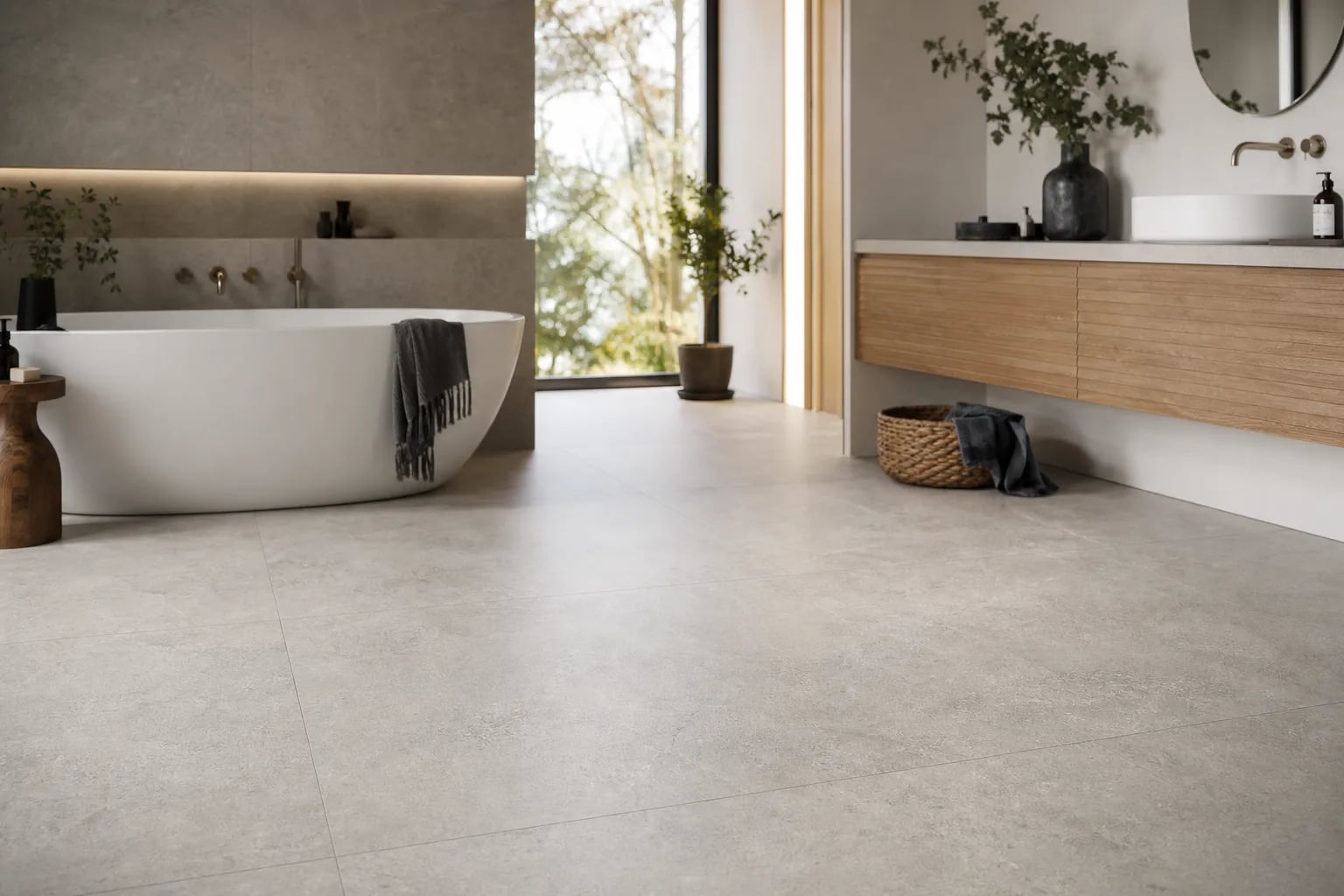
In short: Tiles are the best covering for underfloor heating because they have the lowest thermal resistance (0.02–0.05 m²K/W) and tolerate the highest surface temperature (35 °C). Good porcelain floor tiles in our range start at €35.95/m² (incl. VAT), the adhesive must be flexible (C2 S1 or S2), and the heating cannot be switched on until at least 14 days after laying.
Once there is a heating circuit under the floor, the choice of covering stops being a question of taste alone and becomes a question of physics. Materials pass heat on very differently, so the same flow temperature that produces gentle, even warmth under one floor gets lost on the way into the room under another. This guide explains why ceramic and porcelain tiles are the benchmark for underfloor heating, how wet and electric systems differ, which adhesive is essential, and when the heating may be switched on once the floor is laid.
Why tiles are the best covering for underfloor heating
It comes down to a single figure: thermal resistance (R). The lower it is, the more of the energy the circuit generates reaches the room rather than staying trapped in the covering itself. Porcelain has no real rival here — its resistance sits at roughly 0.02–0.05 m²K/W. Wood and synthetic coverings, by comparison, behave as partial insulators, so the system has to work at a higher temperature to deliver the same level of comfort.
The mass of the material adds a second benefit. A dense ceramic surface does not only pass heat through quickly, it also stores it, so the floor stays warm long after the heating cuts out. With a heat pump that matters more than anywhere else: the system can run at the lowest flow temperature of any covering, and a lower flow temperature always means smaller bills.
In practice this means three things. First, a quick response: tiles begin giving off heat almost immediately, so the room warms up faster. Second, lower running costs: the heat pump or boiler never needs to push its flow temperature up. Third, a higher permitted surface temperature — tiles may be heated to 35 °C, whereas SPC vinyl and engineered parquet should not exceed roughly 27 °C. That matters in cold rooms and in spaces with large glazed areas, where more output has to come from the same square metre of floor.
Coverings compared: tiles, vinyl and parquet
Here is how the three most popular coverings behave over underfloor heating. All figures are indicative manufacturer averages; the data for a specific product is always given in its technical sheet.
| Covering | Max. surface temp. | Thermal resistance | Suitability for heating |
|---|---|---|---|
| Tiles (porcelain) | 35 °C | 0.02–0.05 m²K/W | Excellent — the benchmark |
| SPC vinyl | ~27 °C | ~0.05–0.10 m²K/W | Very good |
| Parquet (oak) | ~27 °C | ~0.10–0.15 m²K/W | Good — glue-down recommended |
The table explains why tiles are so often chosen for kitchens, bathrooms and hallways, where the point is to get as much as possible out of a heated floor. If you are weighing up two specific coverings, our direct comparisons of parquet versus tiles and tiles versus vinyl will help; if you are choosing room by room, start with the broader guide to choosing a floor.
What if you would rather have a different covering?
Tiles win the conductivity table, but in a living room or bedroom many people still want the warmth of wood — and that is entirely compatible with underfloor heating. Glued engineered parquet over a heated floor performs reliably as long as the surface temperature stays below roughly 27 °C, and vinyl flooring over underfloor heating — SPC in particular — is probably the simplest compromise between comfort and practicality. We compare all three coverings, both heating systems and the most common mistakes in one place in our full guide to flooring for underfloor heating — start there if you have not made a final decision.
Wet or electric underfloor heating beneath tiles
Tiles work well with both systems, though the two have different characters.
Wet (water-based) heating
Pipes embedded in the screed circulate warm water from a heat pump or a boiler. This is the primary heating solution in new-build houses and deeply renovated homes. Heat spreads evenly, and the system runs at a low temperature and economically. Porcelain tiles are ideal here — a low-profile, dense covering that stores heat and gives it back well.
Electric heating
A thin heating cable or a heating mat is laid directly into the tile adhesive bed. This is popular in renovations and for individual zones — a bathroom or kitchen where you want a warm floor underfoot without redesigning the whole house. Installation is simpler and the build-up shallower, but running costs are higher than with a wet system. Tiles suit both options without any restrictions.
Adhesive and installation: what you cannot skip
Ordinary budget adhesive has no place over underfloor heating. Heating and cooling cycles produce microscopic movement between covering and substrate, so the job calls for a flexible, deformable adhesive (classified C2 S1 or S2 to EN 12004). An adhesive of that type stays elastic and stops tiles and joints cracking as the temperature changes. The same principle applies to what goes into the joints — choose a deformable grout.
The substrate matters just as much. A cement screed must be fully cured and dry, free of cracks, with the heating circuit properly integrated. We set out substrate preparation and the whole order of work — from primer to grout — step by step in our guide to laying floor tiles, and the article on preparing a subfloor goes into more detail; the principles apply to tiles as well. This is work best handed to an experienced tiler: over a heated screed, the sequence and the waiting times are what keep the floor sound.
When to switch the heating on after laying
This is the most common mistake, and it is paid for in cracked joints. Before the tiles go down, a new heating circuit has to be commissioned — brought up in stages and taken back down — so that the system is proven and the screed has stabilised. Once the tiles are laid, the heating may not be turned on until at least 14 days have passed: the adhesive and the grout need to cure completely. When you do start it, raise the temperature gradually, by around 5 °C per day, until you reach the working setting. That slow start protects the floor from thermal shock.
Formats, sizes and price
Practically every ceramic and porcelain format works over underfloor heating, but a few details are worth knowing. Large formats (60×120 cm, 80×80 cm) create a minimalist, continuous surface with fewer joints — attractive to look at and easier to clean; there is more on them in our guide to large-format tiles. Smaller formats adapt better to awkward, irregular floor areas. Rectified tiles allow joints of just 1.5–2 mm; our article on rectified tiles explains how that works.
Our porcelain floor tiles start at €35.95/m² (incl. VAT) — the easiest way through the range is to browse it from the lowest price. We currently stock 52 models, among them marble-effect tiles from €39.95/m² and striking onyx and stone effects. The popular EndlessLove Empire collection, in the large 60×120 cm format, suits heated living rooms and kitchens equally well. Floor coverings carry warranties of up to 15 years, and we ship on pallets across the EU — delivery cost and lead time are shown at checkout or quoted on request.
When you budget, do not forget the labour. Fitting rates vary from country to country, and within a country by region, floor area and the state of the substrate, so treat the following as indicative market ranges rather than our prices: tile laying commonly runs at roughly €25–35/m², and large 60×120 cm formats at roughly €40–65/m². Ask two or three local tilers for a quote before you fix a figure. Our guides to floor tile prices and to flooring installation costs will help you build the full estimate — tiles, adhesive and labour together.
Where tiles over underfloor heating make the most sense
The obvious choice is wet rooms and high-traffic areas. In a bathroom, a heated tiled floor means warm feet and a surface that dries quickly — just be sure to choose a slip-resistant finish, which we cover in the article on anti-slip tiles. In a kitchen, tiles shrug off water, grease and dropped pans. In hallways and entrances they take the mud and damp off outdoor shoes. To choose a covering for one particular room, our guide to tiles for kitchens and bathrooms and the full floor tile buying guide are the places to start.
How to get started
To work out exact quantities and a budget, use our material quantity calculator — and note that the minimum floor order is 20 m². If you are choosing coverings for other rooms at the same time, order up to 3 free samples to your address (samples are sent for engineered parquet and vinyl flooring); if you are still undecided about the covering itself, the floor guide will narrow it down. For tile shades, adhesive or heating compatibility we would rather talk it through live: book a free video consultation, or simply get in touch.
Frequently asked questions
Are tiles really the best floor covering for underfloor heating?+
Yes. Tiles have the lowest thermal resistance of any covering (0.02–0.05 m²K/W) and tolerate the highest permitted surface temperature — up to 35 °C, whereas SPC vinyl and engineered parquet should not exceed roughly 27 °C. The room warms up faster and the system runs more efficiently.
What is the maximum floor surface temperature with tiles?+
A tiled surface may be heated to 35 °C. That is considerably higher than the limit for vinyl or engineered parquet (around 27 °C), so tiles can deliver more heat from the same floor area.
When can the heating be switched on after tiling?+
Not until at least 14 days after laying, so that the adhesive and the grout cure completely. Then raise the temperature gradually — by about 5 °C per day — until you reach the working setting.
Which adhesive is needed for tiles over underfloor heating?+
A flexible, deformable adhesive is essential — classified C2 S1 or S2 to EN 12004. It stays elastic through heating and cooling cycles and stops tiles and joints cracking. For the joints, choose a deformable grout.
How much do tiles for underfloor heating cost?+
Our porcelain floor tiles start at €35.95/m² and marble-effect tiles at €39.95/m² (incl. VAT). Floor coverings carry warranties of up to 15 years, and we ship on pallets across the EU — delivery cost and lead time are shown at checkout or quoted on request.
Are tiles the only covering suitable for underfloor heating?+
No — engineered parquet works well if it is glued to the substrate and the surface temperature stays below roughly 27 °C, and SPC vinyl also pairs well with underfloor heating within the same ~27 °C limit. Tiles remain the most conductive covering, though: they pass heat on fastest and allow the highest surface temperature.