Inspiration
Onyx, stone and concrete-effect tiles: the most striking interiors of 2026
1 September 2026
Marble has become the classic, so in 2026 attention is turning to other stone looks: dramatic onyx, warm travertine, restrained concrete. We go through four types of stone-effect tile — which one suits what, when to choose a matt and when a polished surface, and how to get the most striking result.
Marble effect has settled into safe-classic territory, so interiors in 2026 are looking further afield with growing confidence: to onyx with its amber glow, to the warm layering of travertine, to the quiet composure of concrete. Modern porcelain reproduces these looks so faithfully that you will only notice the difference by touch — minus the cost, the fragility and the endless sealing of natural stone. In this guide we go through four stone looks: which one suits what, when to choose a matt and when a polished surface, which format gives the most striking result, and how to look after it all.
Why 2026 is looking beyond marble
Only a few years ago, a stone look in an interior meant marble almost by default. Digital printing changed that: modern porcelain tiles reproduce not just the pattern but the surface relief, the depth of the sheen and the way tones shift across a slab — which is why they now carry off semi-translucent onyx, gritty travertine and poured concrete equally convincingly. Our tile catalogue holds 52 models from €35.95/m², all of them porcelain and all suitable for floors and walls alike.
The direction of travel for 2026 is clear: designers are choosing large formats, natural textures and quiet colours, and preferring surfaces that scatter light softly over cold gloss. That is exactly why onyx, in amber and ivory tones, and warmed-up concrete paired with the softness of wood are stepping forward alongside marble. If tiles are new territory for you, start with the full floor tile guide — from here on we go deeper into the looks themselves and how to combine them.
Onyx-effect tiles: drama of light in the bathroom
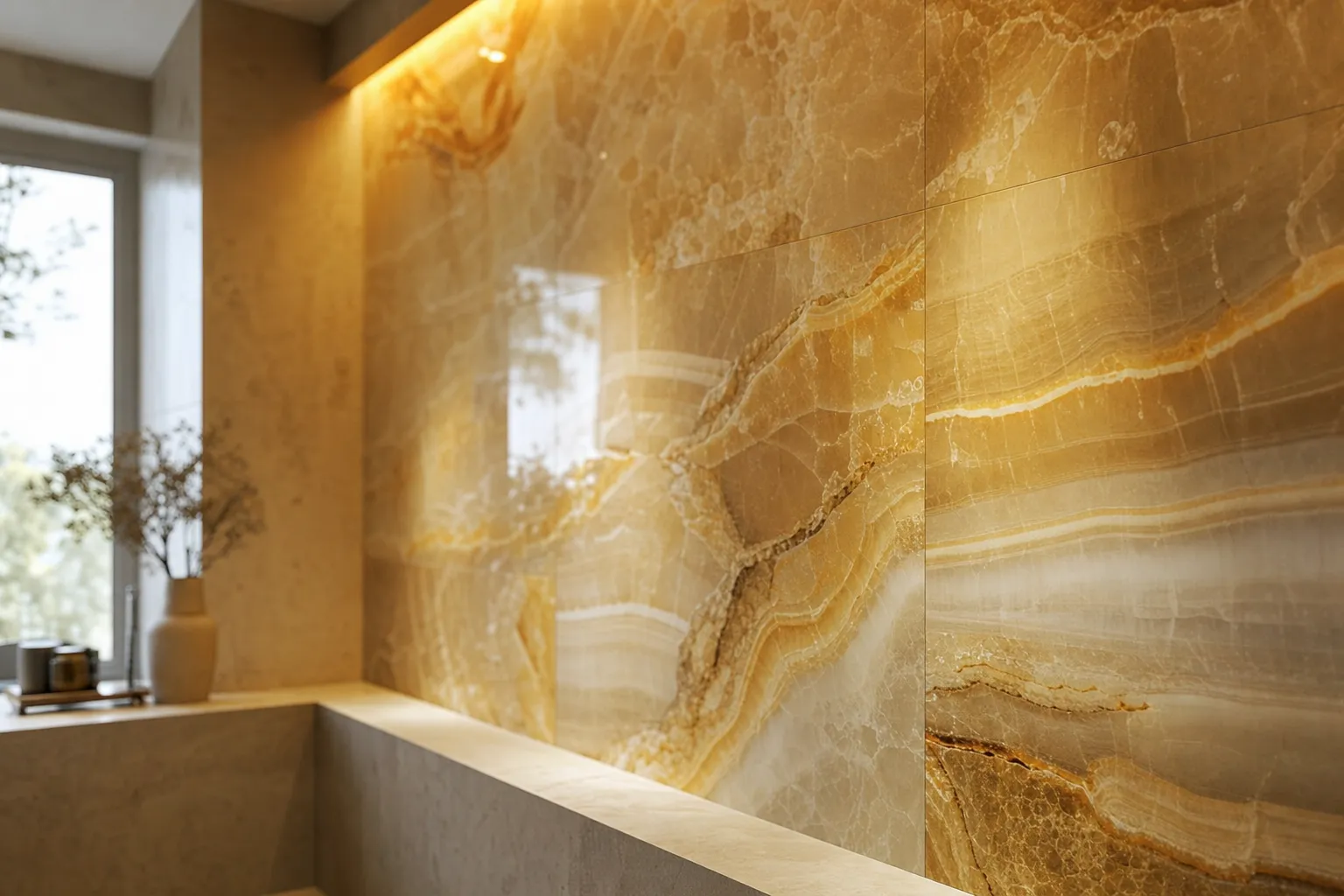
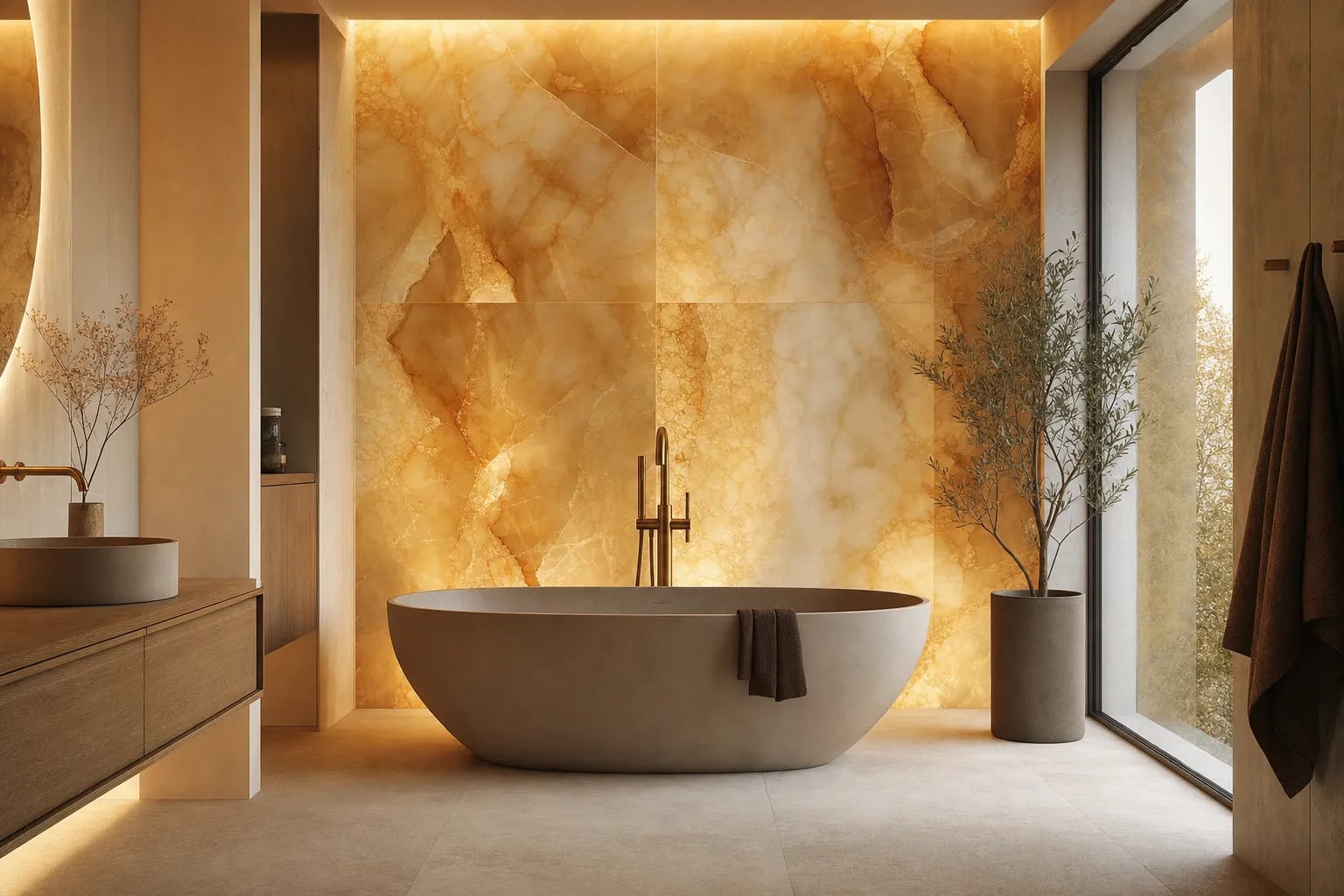
Onyx is arguably the most theatrical natural stone: semi-translucent, veined in amber, honey, ivory and sometimes green, and often backlit in luxury hotels. The catch is that real onyx is soft, porous and extremely expensive, which makes it all but unusable underfoot. Onyx-effect tiles resolve that dilemma: porcelain carries the depth and the glow, yet it is hard, absorbs no water and never needs sealing.
Where the onyx look works
Onyx is an accent stone, so it shows best in measured doses: a bathroom feature wall or shower zone, a cloakroom, a fireplace surround, the sides of a kitchen island, or a niche with directional light. The most striking interiors do not spread onyx over every surface — one luminous wall is set against calm matt flooring so that the drama has a backdrop. In a small room such as a cloakroom you can be bolder: there it works like a jewellery box, an effect you see briefly and remember for a long time.
Matt or polished surface?
With onyx the answer is almost always polished: it is the gloss that creates the sense of depth and inner light, as though the tile were lit from behind when there is no LED anywhere near it. The single exception is a floor that gets wet — a polished surface is more slippery underfoot when damp, so choose matt for the shower zone and keep polished for the walls.
Care is straightforward: porcelain is non-porous, so a damp cloth and a neutral cleaner are enough. The one quirk of a polished surface is that limescale and water droplets show more readily on it, so in a bathroom it is worth wiping the surface dry after a shower.
Natural stone effect: travertine calm and slate character
If onyx is drama, natural stone-effect tiles are calm. Two looks dominate here: travertine, with its warm sand and cream tones and subtle layering, and slate, a graphite-grey stone with a more pronounced relief. Both suit the moment when you want something natural without the formality of marble.
Travertine: warmth without gloss
The travertine look creates a spa mood in a bathroom, sits comfortably in a kitchen or hallway, and — run continuously across a whole ground floor — pulls the rooms into one calm whole. It is probably the most versatile choice of 2026 for anyone who finds marble too dressy and concrete too cold.
Slate: character for darker schemes
The slate look has more character: graphite tones and a deeper relief suit more dramatic interiors, rooms with plenty of daylight, and homes that want the feeling of nature underfoot. Dark floors need their lighting thought through properly, so in small or dim rooms it is worth keeping slate for accents.
The surface here is almost always matt — stone does not shine in nature, so a polished travertine would look manufactured. A matt, lightly textured surface has a practical advantage too: it grips better when wet, which matters most in bathrooms and entrance halls — we covered that in our article on anti-slip tiles. Ordinary mopping is enough for maintenance; a more pronounced texture is worth going over with a soft brush occasionally so that dirt does not build up in the grooves.
Concrete effect: loft, minimalism and warmth underfoot
Concrete effect is the favourite of minimalists and loft schemes: a smooth, quiet surface with no strong pattern lets the furniture, the art and the architecture do the talking. The concrete of 2026 is no longer cold and industrial — the tones chosen now are warmer greys and greige, set against wooden furniture and soft textiles. Concrete-effect tiles are almost always produced with a matt surface; the whole matt tile range sits in one section of the catalogue.
Where does it work? Open-plan living rooms and kitchens, home offices, hallways — anywhere you want an unbroken, timeless backdrop. The key rule: the larger the format and the fewer the joints, the stronger the poured-concrete impression. With the narrow joints of rectified tiles, grouted in the same tone, the surface reads from a few steps away as a single monolith.
Concrete effect is particularly well suited to underfloor heating: of all floor coverings, tiles conduct heat best, so a loft with a heated floor looks industrial and still feels warm underfoot. More on that in our article on tiles for underfloor heating. In maintenance terms a matt grey surface is the most forgiving of all: it shows neither dust, nor fingerprints, nor water marks.
And where does marble effect fit?
Marble is not going anywhere — it simply becomes one of four looks rather than the only option. Marble-effect tiles remain the most versatile of the set: quieter than onyx, dressier than concrete, at home in classic and contemporary interiors alike. The practical rule is simple: choose marble when you want a whole room to feel luxurious, and onyx when you want one strong accent. The looks can also be combined — marble floors with an onyx feature wall, or concrete floors with a travertine bathroom — as long as one dominates and the others defer to it. We covered the marble direction, its most popular patterns and how to combine them in a separate article on marble-effect tiles.
Four looks in one table
Here are all four stone looks compared by character, best-suited rooms, recommended surface and maintenance.
| Look | Character | Where it shows best | Surface | Maintenance |
|---|---|---|---|---|
| Onyx | Dramatic, luminous, luxurious | Bathroom feature wall, shower zone, cloakroom, fireplace surround | Polished (matt for floors that get wet) | Easy; limescale shows more readily on polished |
| Natural stone (travertine, slate) | Calm, warm, natural | Spa-style bathrooms, hallways, one continuous floor across a whole storey | Matt, often lightly textured | Easy; go over the texture with a brush now and then |
| Concrete | Restrained, minimalist | Lofts, open-plan living rooms, kitchens, home offices | Matt | The easiest of all — dust and marks do not show |
| Marble | Classic, versatile | All living spaces, bathrooms, kitchens | Polished or matt, according to the scheme | Easy, as with every porcelain tile |
Format and joints: why 60×120 rectified is worth it
The stone impression comes not only from the pattern but from the joints: the less they are seen, the more the surface reads as a natural slab. That is why most of our collections are 60×120 cm (or 120×60 cm) rectified tiles: their edges are trimmed precisely after firing, so a joint of around 2 mm is all you need. Large-format tiles with joints that fine create an almost unbroken surface — exactly what an onyx wall and a concrete floor both call for.
The one price of large format is a more demanding installation: a perfectly level substrate and an experienced tiler are essential. Large-format work generally costs more per square metre than standard tiling, and fitting rates differ considerably from one European country to the next, so treat any figure you are quoted as indicative and country-specific; the final cost also depends on the condition of the substrate. We look at the process and at indicative market rates in our tile fitting article, and at how a full budget comes together in the floor tile price overview.
Two things worth knowing when you plan quantities: the minimum floor order is 20 m², and we ship on pallets across the EU, with delivery cost and lead time shown at checkout or quoted on request.
Frequently asked questions
Do onyx-effect tiles look like real onyx?
Yes. Modern digital printing reproduces onyx veining, tonal shifts and the sense of depth very convincingly, especially on a polished surface. The difference is that porcelain is hard, non-porous and absorbs no water, so it works in places where real onyx would be too soft and too expensive.
Matt or polished tiles — which are more practical?
Matt tiles are the more practical choice day to day: they grip better when wet and limescale marks do not show on them. A polished surface looks more luxurious and strengthens the depth effect in onyx and marble designs, but in damp areas it is better used on walls than on floors.
Are concrete-effect tiles suitable for underfloor heating?
Yes, they are ideal. Of all floor coverings, tiles conduct heat best, so a concrete-effect floor with underfloor heating feels warm underfoot while still looking industrial.
Which format should I choose for stone-effect tiles?
Large formats look the most impressive: most of our collections are 60×120 cm rectified, so a joint of around 2 mm is enough and the surface reads as almost unbroken, like a natural stone slab.
Can I have tile samples sent to my home?
We do not send tile samples — free samples apply only to engineered oak parquet and vinyl flooring. Instead we offer a free video consultation: we will show you the tiles close up, discuss the tones under your own lighting and help you decide.