Guide · 9 min
Rectified tiles: why the joints almost disappear
2 September 2026
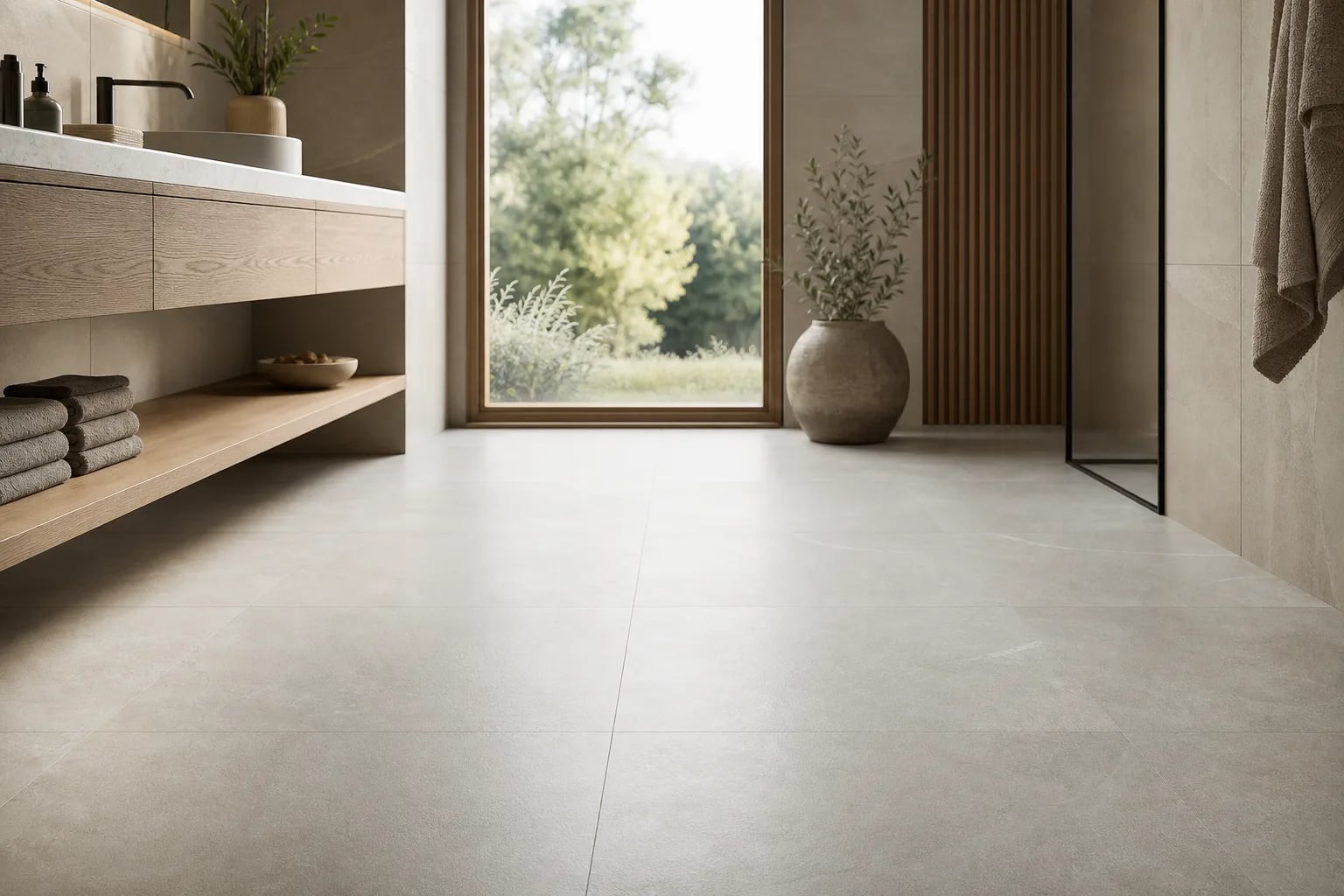
If you have ever stood in front of a large-format tiled wall and wondered why it reads as a single slab of stone rather than a grid of tiles, you were almost certainly looking at rectified tiles. Rectification is not a separate material or a different raw body — it is a finishing step in the factory that fundamentally changes how a tile looks once it is on the floor or the wall. This guide sets out what “rectified” actually means, how such a tile differs from a conventional bevelled one, what you gain and what you give up, and what to check before you commit to laying them.
What “rectified” actually means
When a tile is fired above 1200 °C, its edges never come out perfectly straight. The body shrinks slightly in the kiln, and the finished dimensions of individual tiles can differ by 0.5–1 mm. That is simply how ceramics behave. On a conventional tile the discrepancy is concealed in two ways: a small rounded bevel (chamfer) is left along the edge, and the tile is laid with a wider grout joint that absorbs the variation.
Rectification is an additional production stage in which the edges of the already-fired tile are ground or cut back mechanically with diamond blades, to an exact and consistent size across the whole batch. After that operation every tile has a square 90° edge with no bevel at all and a calibrated, all but identical dimension. That is precisely why rectified tiles can be butted up so closely — with a joint of only 2 mm.
The material itself is usually the same porcelain stoneware (gres porcellanato) — a very dense ceramic that absorbs almost no water. Rectification alters the geometry of the edges, not the composition of the tile or its resistance to wear. For a fuller picture of the material and of format choice, start with our floor tile buying guides.
Rectified versus conventional tiles
The difference is visible straight away, in the width of the joint and in the character of the surface as a whole. The table below sets out the essentials so the choice is easier to weigh up.
| Property | Rectified | Conventional (bevelled) |
|---|---|---|
| Edge | Square 90°, precisely cut | Rounded bevel (chamfer) |
| Recommended joint | 2 mm | 3–5 mm |
| Overall look | Seamless, monolithic, contemporary | A clearly visible tile grid |
| Substrate requirements | High — must be very flat | More forgiving |
| Fitting difficulty | Higher (experience needed) | Standard |
| Suits large formats | Yes (60×120, 120×120 and similar) | Less elegantly |
A conventional tile is not the poorer product — it has its place. The rounded edge is far more forgiving of an uneven substrate and of small inaccuracies during fitting. But if you are after a contemporary, minimal result in a large format, rectified tiles are in practice the only route to it.
The main benefit: thin, almost invisible joints
The visual effect is the reason demand for rectified tiles keeps rising. Once the joint narrows from the usual 3–5 mm to 2 mm, the eye stops reading the floor as a collection of separate tiles and begins to see a single plane. That makes a room feel larger — particularly in small bathrooms or narrow kitchens, where a wide grid of grout lines optically chops the area into pieces.
Beyond the aesthetics, a thinner joint brings a practical advantage: less grout means less room for dirt to gather. The grout line is traditionally the weakest part of any tiled surface — it stains sooner and asks for more cleaning. The narrower the joint, the smaller that problem becomes. One caveat: rectified tiles still cannot be laid with no joint at all — the minimum 2 mm is there so the tiles can expand and contract with temperature and so the adhesive bed distributes properly.
Choosing a grout colour
With rectified tiles the grout colour matters more than ever, because even a thin line will draw the eye if its colour contrasts sharply with the tile. There are two main strategies:
- Tone on tone: the grout is matched as closely as possible to the colour of the tile. This reinforces the seamless, monolithic effect — grey tiles with grey grout read as one block of stone.
- Contrasting: a darker grout against a light tile produces a graphic, structured look. The practical benefit is that everyday dirt shows less on dark grout, which makes it a sound choice for a hallway or entrance.
Either way, choose a good-quality, water-resistant epoxy or modified cement grout — in wet rooms that is what decides how long the joints stay clean. We look at how tiles behave in wet areas specifically in our guide to tiles for kitchens and bathrooms.
Why you need a precise substrate and an experienced fitter
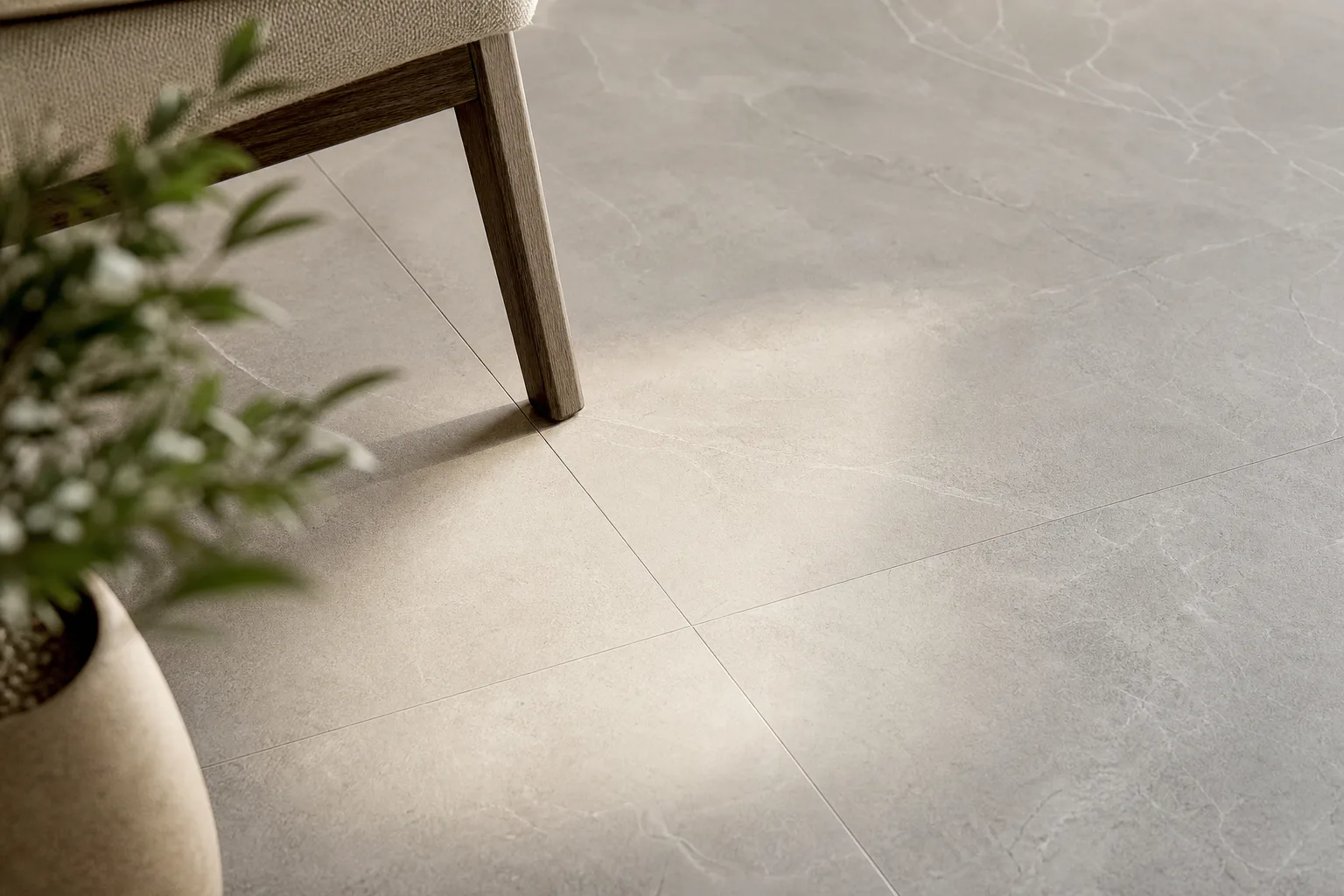
This is where the real trade-off with rectified tiles sits. A wide joint works as a shock absorber — it hides both the dimensional variation between tiles and small irregularities in the substrate. With a 2 mm joint that reserve is gone. Any tile standing proud of its neighbour — what fitters call lippage — is visible at once and can be felt with a hand.
Rectified tiles, large formats above all, therefore require a genuinely flat substrate. In practice that usually means a self-levelling compound over an existing floor. For the fitting itself, tilers use levelling systems (clip and wedge) that hold adjacent tiles in the same plane while the adhesive sets. This is not work to hand to a casual helper — carelessly laid rectified tiles look worse than neatly laid conventional ones.
If you are unsure about the condition of your substrate, or would rather the job were done by experienced specialists, get in touch and we will help you arrange professional tiling — it is the cheapest way to avoid the kind of mistake that later has to be put right by lifting the whole floor.
Where rectified tiles work best
Rectified tiles earn their keep wherever a clean, contemporary surface matters:
- Open-plan living and kitchen areas: an uninterrupted surface without a pronounced grout grid ties the space together visually.
- Bathrooms and showers: less grout means fewer places for mould and dirt to settle; ideal for the single-slab-of-stone aesthetic.
- Hallways and entrances: a large format with a thin joint looks composed and is easy to clean.
- Underfloor heating: porcelain stoneware conducts heat exceptionally well, and a large rectified tile with a minimal joint spreads the temperature evenly.
Among our own ranges, rectified large-format collections such as EndlessLove Perlato, with its pale marble figuring, or the darker EndlessLove Empire, deliver exactly that monolithic, luxurious effect. The full selection is in the tiles category — from €35.95/m² incl. VAT.
Before you order: how to judge the shade
A tile's colour and surface texture can look entirely different in a catalogue and under the light in your own rooms — grey and sand tones especially, since they respond strongly to warm or cool light. So it is worth taking advice before a large order. We do not send tile samples to customers: our free samples (up to 3) cover engineered oak parquet and vinyl flooring only. Instead we offer a free video consultation, in which we show you the tiles close up and talk through how the tone will shift in your light at different times of day.
We supply our tiles directly from Italian factories and ship them on pallets across the EU; the delivery cost and lead time are shown at checkout or confirmed on request. Every tile carries a 10-year warranty. Our team has been working with flooring since 2014, so if you have questions about a particular project — square metres, format or grout colour — book a free video consultation and we will work through the solution with you.
Frequently asked questions
What does “rectified tiles” mean?+
Rectified tiles are tiles whose edges are mechanically cut back with diamond blades after firing, to an exact, consistent size and a square 90° profile. That is what allows them to be laid with a very narrow 2 mm joint and to read as an almost seamless surface.
What joint width do rectified tiles need?+
Rectified tiles are laid with a minimum 2 mm joint, where a conventional bevelled tile calls for 3–5 mm. Laying them with no joint at all is not an option — the 2 mm minimum is needed so the tiles can move with temperature and so the adhesive bed distributes properly.
Are rectified tiles harder to lay?+
Yes, they demand more precision. Because the 2 mm joint is so narrow, any tile sitting proud of its neighbour shows immediately, so a perfectly flat substrate and levelling systems are essential. This is work worth entrusting to an experienced tiler.
Are rectified tiles more durable than conventional ones?+
Durability comes from the material, not from rectification. Most rectified tiles are made of porcelain stoneware (gres porcellanato), which is very hard and absorbs almost no water. Rectification changes only the geometry of the edges, not the strength of the tile.