Guide · 10 min
Floor tiles for bathrooms and kitchens: what to choose in 2026
2 September 2026
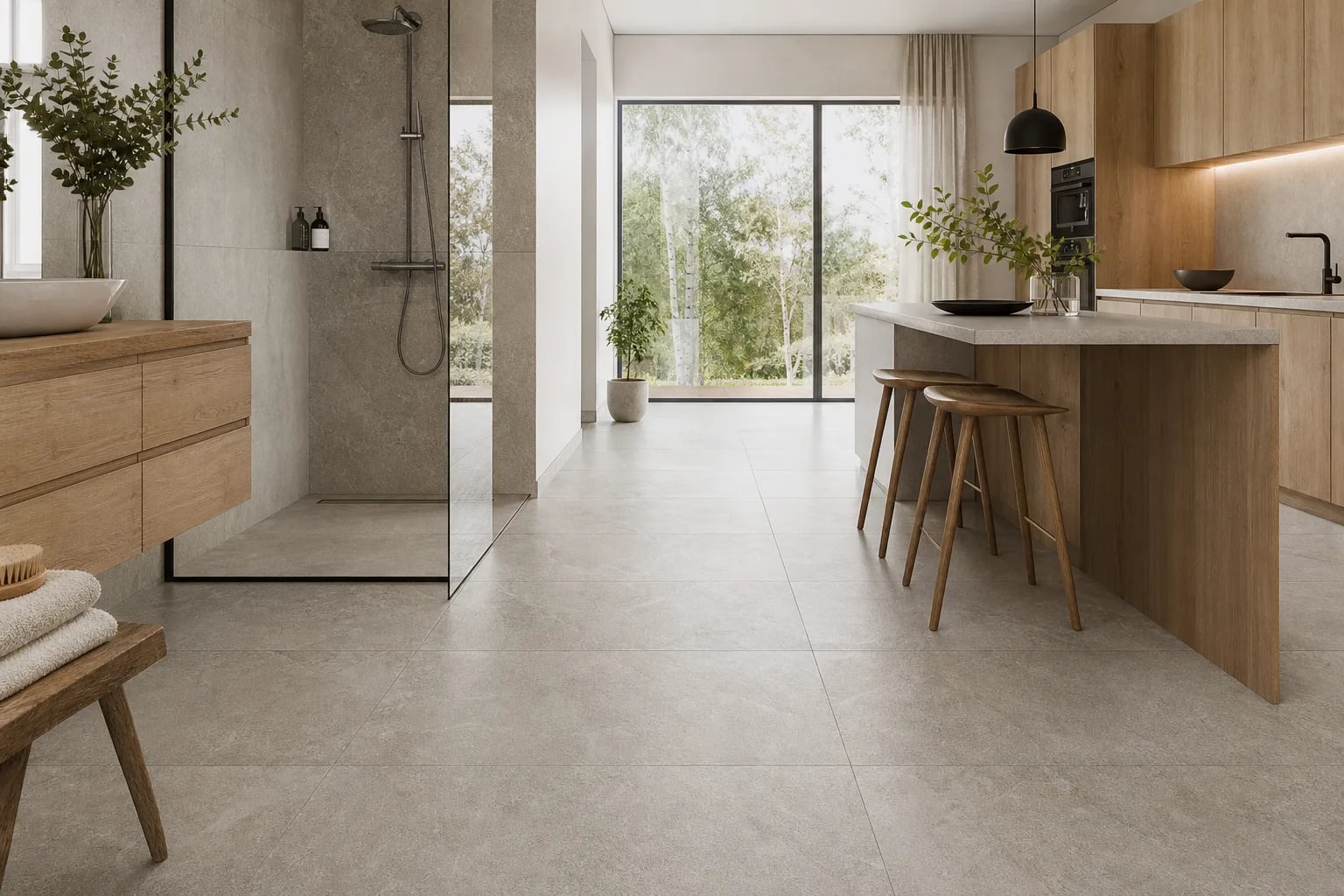
Tiles remain the most dependable moisture-resistant floor covering there is. Unlike their vinyl counterpart, they are completely impervious to water, and they shrug off hot pans, cooking fats and acids. That makes them the default choice for bathrooms, kitchens, entrance halls and terraces. This guide explains how to choose the right ones in 2026.
Why tiles are the first choice for bathrooms and kitchens
Three reasons tiles still dominate wet rooms:
- Completely impervious to water — water absorption below 0.5% in the porcelain class, so they will never swell or distort
- Unbothered by temperature swings — next to a hot oven in the kitchen, or beside a heated towel rail in the bathroom
- Easy to clean — a damp mop and a neutral cleaner; grease and acids such as lemon, wine and coffee do no harm
Tiles also pair better with underfloor heating than any other covering, which is why the two are so often specified together in bathrooms.
Porcelain stoneware — what it is and why it performs best
Porcelain stoneware (from the Latin porcelanum) is the premium tile type, pressed from densified clay and fired at over 1,200 °C. The result is a surface that is:
- Harder than natural stone — difficult to scratch even with a metal object
- Effectively impervious to water — under 0.5% water absorption, against 5–10% for natural marble
- Acid-resistant — lemon juice, wine and coffee leave no marks
- Colourfast — no fading from UV light or disinfectants
- Frost-resistant — suitable for unheated terraces and balconies
Our EndlessLove collection is Italian rectified porcelain, certified to EN 14411, with a 10-year manufacturer's warranty.
Slip ratings — which room needs which
A tile surface is not always as smooth as it looks; it can be glassier or more textured. Slip ratings tell you how much grip the surface keeps when wet. The classification comes from the German standard DIN 51130 (R9–R13):
| Rating | Slip resistance | Suitable for |
|---|---|---|
| R9 | Low (dry areas) | Living rooms, bedrooms, hallways, kitchens where the floor stays dry |
| R10 | Moderate | Bathrooms, kitchens, entrance halls |
| R11 | High | Open terraces and pool surrounds (our collection is not an exterior range) |
| R12–R13 | Very high | Industrial settings and commercial kitchens |
For a family home the sensible split is R10 in the bathroom and kitchen, R9 everywhere else. The exact rating is stated on each product page.
Formats — 60 × 60, 60 × 120 and 120 × 120 cm
Format changes how a room reads. Smaller tiles give a classic, finer-grained pattern; large ones give a modern, near-seamless plane.
- 60 × 60 cm — the all-rounder, good for small bathrooms of 3–6 m² and for entrance halls
- 60 × 120 cm — our main format. It stretches a room visually, cuts the number of joints and simply feels more expensive. Suits bathrooms of 6–15 m² and kitchens
- 120 × 120 cm — the XXL format, for open-plan spaces and living areas of 20 m² and up. It needs an experienced tiler, as the panels are heavy and demand real precision
The whole EndlessLove collection comes in 1200 × 600 × 9 mm, which suits the majority of rooms.
Marble-effect tiles — the alternative to real marble
Porcelain tiles with a marble pattern (Calacatta, Statuario, Onyx) read as the real thing but carry serious practical advantages:
- Far better stain resistance — natural marble etches from citric acid, wine and coffee; porcelain does not react at all
- Considerably cheaper — a fraction of the cost of a genuine Calacatta marble slab
- No sealing — marble needs resealing every one to two years; these tiles never do
- Scratch-resistant — pet claws and furniture feet leave no trace
The texture comes from high-resolution digital printing, so each tile carries its own veining, exactly as a real marble slab would. Our most popular options: EndlessLove Empire (Calacatta pattern), Onyx Ivory (a cream tone) and Perlato (polished gloss).
Rectified tiles — what that means
"Rectified" means the edges are trimmed perfectly straight at the factory after firing. That allows a minimal 2 mm grout joint which is barely visible. Conventional, non-rectified tiles need a 3–5 mm joint. All of our tiles are rectified, which is what gives them their cleaner, more contemporary look.
Underfloor heating and tiles
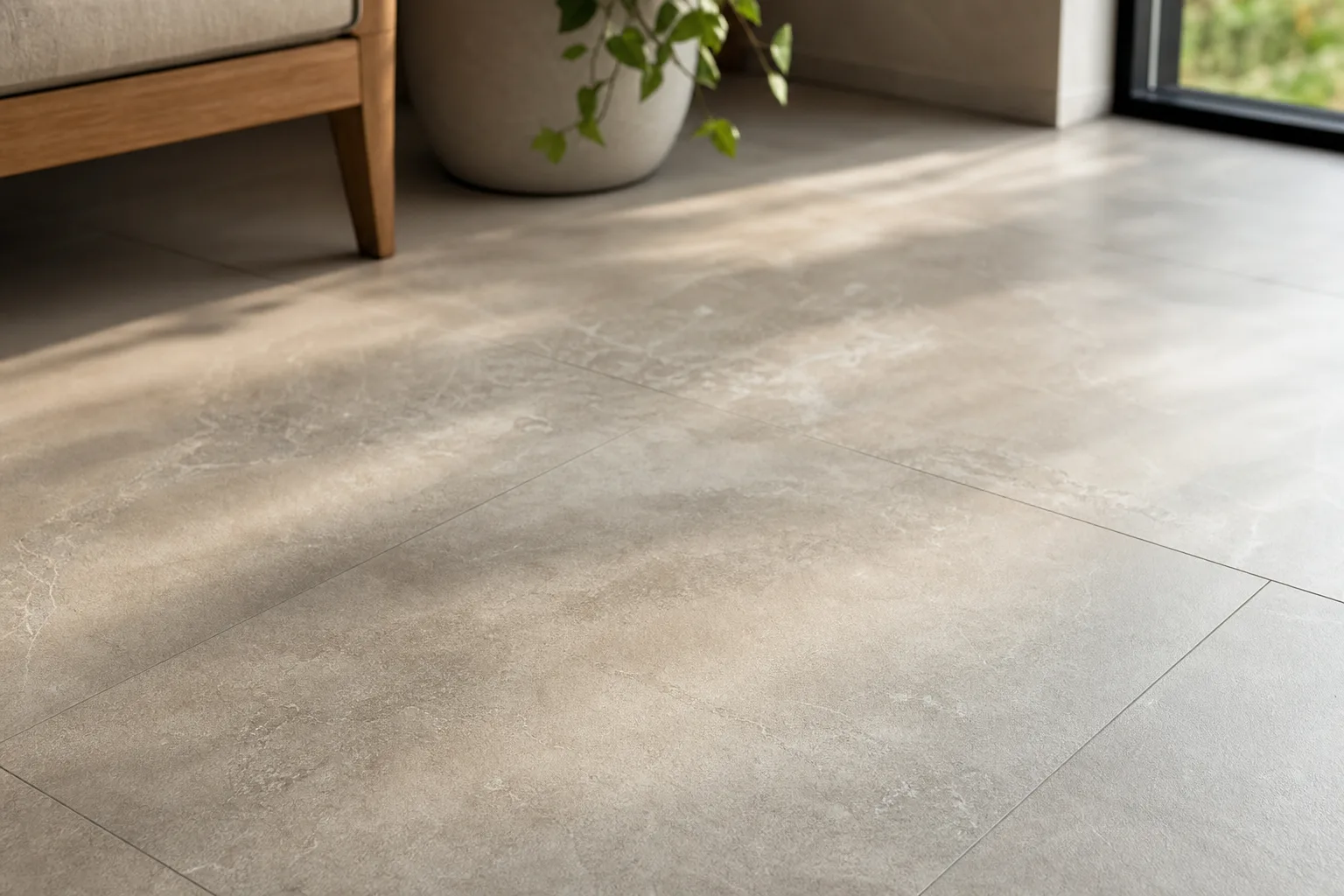
Tiles are the best covering there is for underfloor heating: they conduct heat very efficiently, warm up quickly and offer very little thermal resistance (0.02–0.05 m²·K/W). The maximum surface temperature is 35 °C, higher than the 28 °C allowed for vinyl or the 27 °C for parquet. In practice that means a warmer floor underfoot and a more efficient heating system.
Use an adhesive rated for underfloor heating when laying — a flexible product that copes with expansion and contraction cycles. Do not switch the heating on until at least 14 days after installation, so the adhesive can cure fully.
Grout width and colour
Grout is the mortar that fills the joints between tiles. The decisions to make:
- Width: 2 mm for rectified tiles such as ours, 3–5 mm for conventional ones
- Colour: tone-on-tone (grout matched to the tile, for a more monolithic surface) or contrasting (darker grout against pale tiles, which emphasises the grid)
- Type: cement-based (the classic, and it needs sealing in wet rooms) or epoxy (tougher, roughly twice the price, and a good call in kitchens)
Mid-grey grout is the usual choice in bathrooms: it resists mould and does not discolour from shower gel.
Installation — why you want an experienced tiler
Unlike a vinyl or parquet click system, tiling is a trade. The sequence:
- Subfloor preparation — level with a self-levelling compound and measure moisture (max 2% in concrete)
- Applying adhesive — a dedicated tile adhesive, combed out to a bed of roughly 5 mm
- Laying — with 2 mm spacers, checking level on every row
- Cutting — on a wet saw; a hand cutter built for small formats will not cope with 1200 mm
- Grouting — after 24 hours, filling the joints with the grout mix
- Sealing (bathrooms) — a silicone bead between the tiles and the bath or shower tray
We are happy to talk fitting through our contact page. Tiling labour is bought locally and rates differ a great deal from one European country to the next — as a rough indication, budget somewhere around €25–45/m² depending on format and how awkward the room is, and get a quote in your own market.
Prices and how much to over-order
Our EndlessLove collection runs to 18 models priced from €41.95/m² to €46.95/m², and the full tile range starts at €35.95/m² incl. VAT. Add fitting (an indicative €25–45/m², depending on the country) plus adhesive and grout at around €5/m², and an 8 m² bathroom floor typically lands near €550–900 all in.
Over-order allowance:
- Straight (stack) layout: 10%
- Diagonal layout: 15%
- XXL format (1200 × 1200 mm): 12%, because the offcuts are larger
Work out the exact quantity in our calculator.
Maintenance
Tiles are the simplest floor of all to look after. Day to day, a damp mop with a neutral cleaner is enough — nothing containing ammonia or abrasives. In bathrooms, add a check of the grout sealer every 2–3 years, as cement grout can start to harbour mould. Epoxy grout needs no maintenance at all.
The short version
Tiles are a dependable, long-lived answer for wet rooms and high-traffic areas. Our porcelain in the 60 × 120 cm format, rated R10 and with rectified edges, is the optimal specification for a bathroom or kitchen. We do not post tile samples: free samples (up to 3 pieces) apply only to engineered parquet and vinyl flooring.
Frequently asked questions
Which slip rating is right for a bathroom?+
R10 is the standard for bathrooms — enough grip underfoot when the floor is wet, without the coarse texture that makes cleaning hard. R11 or higher is only needed on open terraces and around pools.
Do marble-effect tiles really look like marble?+
Yes — high-resolution printing reproduces Calacatta, Statuario and other marble patterns convincingly. You notice the difference only on close inspection, whereas the advantages (stain resistance, lower cost, no sealing) show up every day. Polished surfaces are particularly persuasive.
What does a tiled bathroom floor cost, fitted?+
Our porcelain tiles start at €35.95/m² incl. VAT. Fitting, including adhesive and grout, is an indicative €30–50/m² and varies widely by country. A typical 8 m² bathroom floor comes to roughly €550–900 in most markets, excluding wall tiles — always confirm labour with a local quote.
Are tiles suitable for underfloor heating?+
Yes — tiles are the best covering for underfloor heating. They conduct heat very well and warm up quickly. The maximum surface temperature is 35 °C, higher than vinyl or parquet allow. Use a flexible adhesive and leave the heating off for at least 14 days after installation.
How much extra should I order?+
Straight layouts, 10%. Diagonal, 15%. XXL format (1200 × 1200 mm), 12%, because the offcuts are bigger. You can work the allowance out in our calculator.