Advice · 8 min
Parquet in the kitchen: does it actually work?
2 September 2026
Why kitchens ended up with wood floors
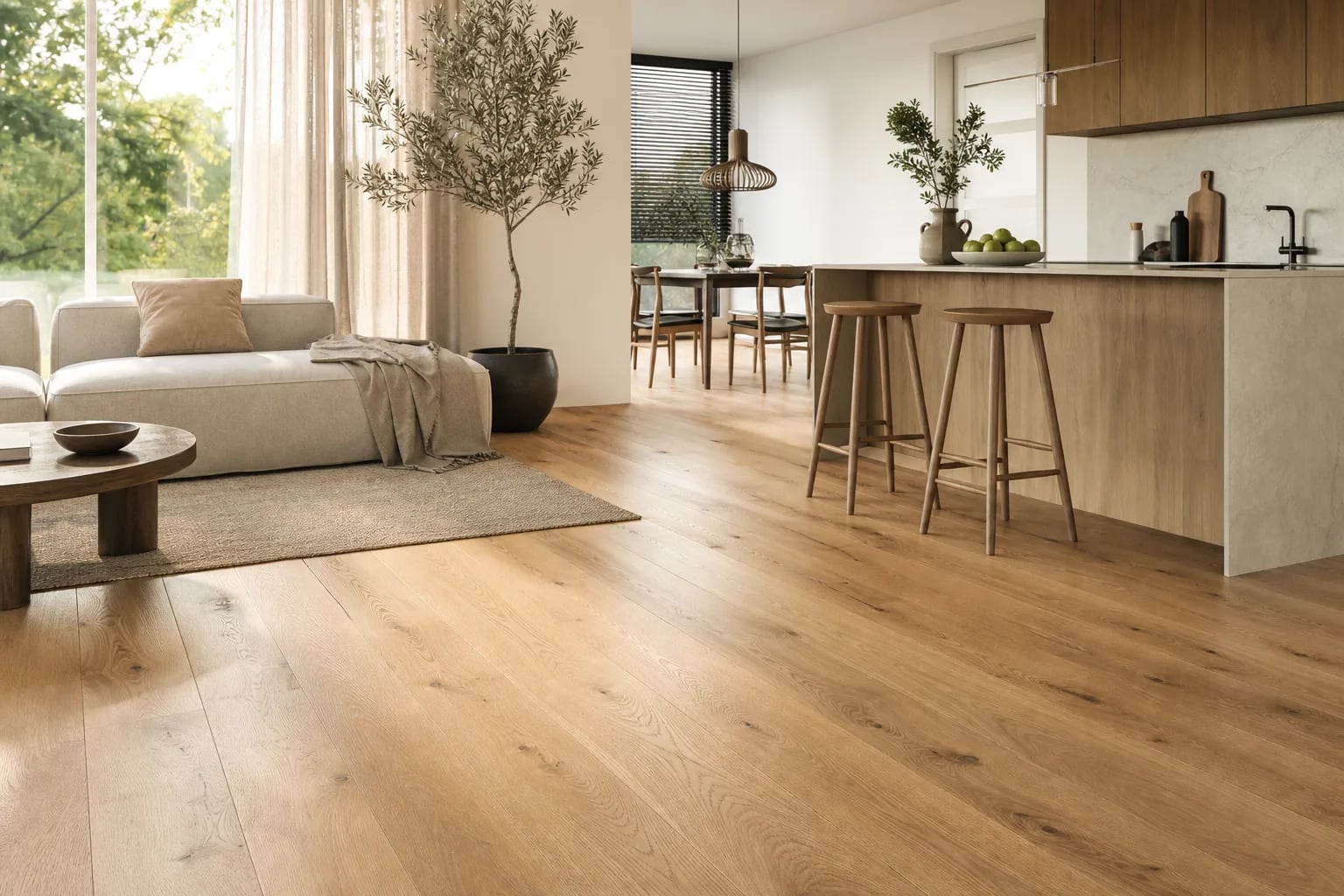
The kitchen stopped being a separate working room some time ago. It now opens onto the dining table and the sofa, and an open-plan ground floor wants one floor covering rather than three. Parquet in the kitchen:
- Creates a seamless visual run between cooking, dining and living areas
- Brings the warmth of real timber into a room that used to feel clinical
- Tends to hold its value at resale — across most European markets buyers read real wood as a quality signal
- Feels warmer underfoot than tiles, which counts for a lot through a northern European winter
If you are still weighing wood against ceramic, we compare the two in detail on the Terris Timber blog.
The risks, and what actually happens
Splashes at the sink
Washing up, a knocked-over glass, a dripping colander — water lands on the floor. A lacquered board with tight, well-fitted joints shrugs off short contact. Wipe it up within a few minutes and there is no damage to speak of.
Cooking fat and oil
Frying spits. On a lacquered surface the fat sits on top of the finish instead of soaking into the timber, so a damp cloth and a mild cleaner deal with it. Oil left to dry on an open-pore oiled floor is a different matter, and it is the main reason we steer kitchen customers towards lacquer.
Dropped pans and knives
Plates, bottles, cast-iron pans — kitchens are hard on floors. Dense oak takes most of it in its stride. Something heavy enough will leave a dent, but the same drop onto porcelain chips or cracks the tile: wood dents, ceramic breaks. Minor marks in a lacquered floor can usually be dealt with locally, and we cover the methods in our care and repair guides.
A leaking dishwasher
This is the real risk, and it is not the splashing. A failed dishwasher connection releases water slowly, usually behind a cabinet plinth where nobody sees it for days. By the time the floor tells you, the damage is significant. The answer is dull but effective: a mat in the dry zone, and a check of the dishwasher and sink connections every three months.
What a kitchen floor has to get right
1. A lacquered surface
Lacquer is the right finish for a kitchen. The film sits on the surface and stops moisture and grease reaching the wood beneath. Oiled floors, with their open pores, mark more readily here and ask for a stricter maintenance routine. Lacquered or oiled is a bigger decision than it first looks, and we cover it separately on the blog.
2. Full glue-down installation
A floating floor keeps a thin air gap under the boards, and in a kitchen that gap is exactly where moisture collects and stays. A fully bonded floor — laid with a moisture-tolerant adhesive such as Berger Seidle PUR parquet adhesive — has no void beneath it, and it feels more solid underfoot as a bonus.
3. A dense hardwood
Oak is the obvious species: hard, dimensionally stable, and naturally high in tannins, which give it a degree of resistance to fungal attack. Walnut, teak and merbau also perform well. Avoid softwoods — pine and spruce dent and stain far more easily. Everything in our parquet range is European oak.
4. Protection where it matters
- A mat at the sink, where the splashing happens
- A mat at the hob, where the fat lands
- A check of the dishwasher, coffee machine and sink connections every few months
- Any leak dried and dealt with straight away, not at the weekend
What we would put in a kitchen
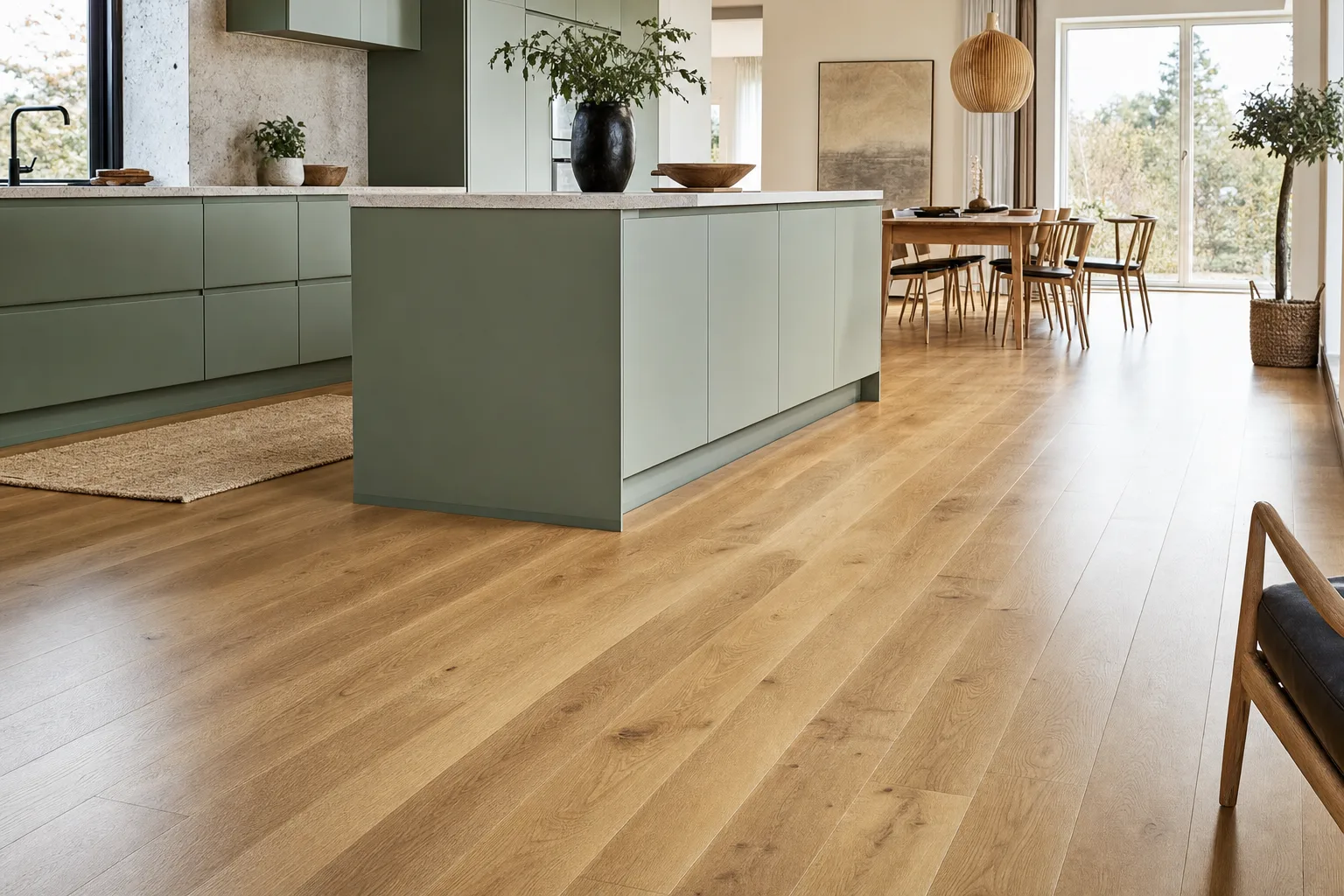
- Oak Bergen — brushed and matt lacquered. The straightforward kitchen board: the most forgiving finish we stock, and the easiest to keep clean.
- Oak Oxford — brushed and dark brown oiled, for a deeper, more graphic kitchen. It works, but only with the oiled-floor routine set out below.
- Oak Milano — brushed and white oiled, for a light, calm room. The same caveat applies: lovely to live with, but it asks more of you than lacquer does.
Day-to-day care
- Daily: a dry sweep, or a vacuum with a soft parquet head
- Once or twice a week: a barely damp mop with WOCA Wood Floor Soap
- Immediately: water, oil and coffee wiped dry within five minutes
- Annually: oiled floors take a maintenance oil; lacquered floors need nothing beyond normal cleaning
- Every 5–7 years: a surface refresh on a lacquered floor
The full routine for each finish is set out in our floor care guides.
If parquet still feels like too much risk
- SPC vinyl flooring — fully waterproof, with convincing wood décors. The sensible answer for a busy family kitchen.
- Porcelain tiles — the classic choice, and hard to beat over underfloor heating
- A hybrid layout: parquet through the living and dining area, tiles in the working zone, joined with a proper transition profile
FAQ
Is parquet safe underneath kitchen units?
Yes, as long as nothing above it can drip unseen. Check the dishwasher and sink connections every three to six months.
Can I lay a floating floor in a kitchen?
Better not. A full glue-down is the more reliable specification in kitchen conditions.
What happens if water sits on the floor?
Five minutes does nothing at all. Several hours can swell the board edges. Dry spills as soon as you see them.
Do I need a special kitchen parquet?
Not special — just correctly specified: lacquered, oak, fully bonded. Our collection is European oak throughout, so it is a question of choosing the right finish rather than a different floor.
Ready to start?
Order free samples to see the boards in your own light, or get in touch to book a video consultation.