Maintenance · 9 min
Parquet maintenance: everyday and annual care
1 September 2026
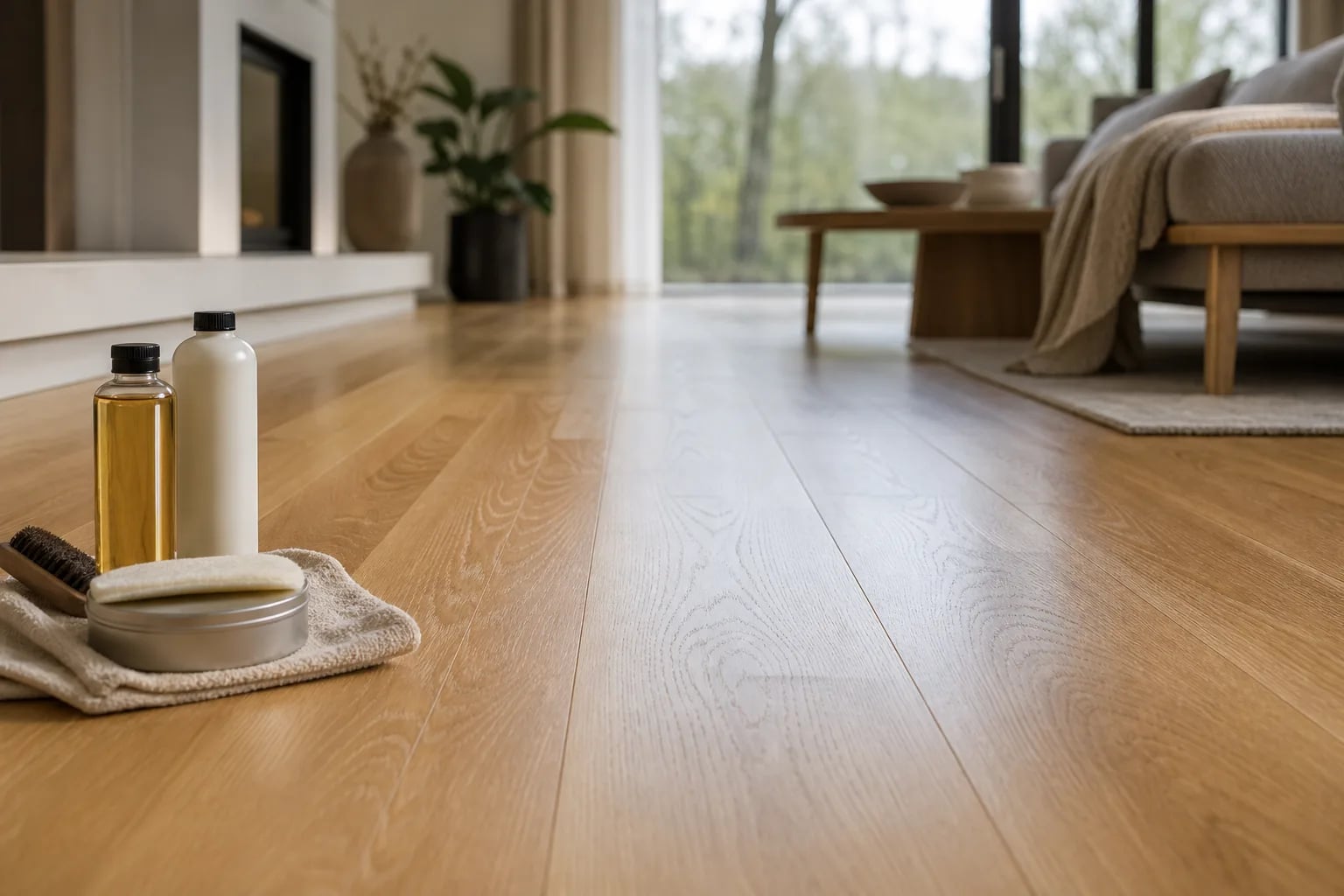
A well-made parquet floor will last 30 years or more — provided it is looked after. Poor maintenance ruins an oiled or lacquered surface far faster than heavy footfall ever will. This guide sets out the daily and annual routines that keep a floor looking the way it did the day it was laid.
The maintenance calendar at a glance
Below is the full schedule, split by frequency and by finish. Print it or save it — it is the simplest way to remember what needs doing and when.
| Frequency | Oiled parquet | Lacquered parquet |
|---|---|---|
| Daily | Dry cleaning (vacuum, microfibre mop) | Dry or damp cleaning with plain water |
| Once or twice a month | Damp cleaning with WOCA wood soap | Damp cleaning with a pH-neutral cleaner |
| Every 3–4 months | WOCA Oil Refreshing Soap in the mop water | — |
| Every 6–12 months | Surface refresh with WOCA Maintenance Oil | Spot repairs where needed |
| Every 3–5 years | — | Screen sand and re-coat (indicative €10–15/m²; rates vary by country) |
| Every 10–15 years | Full sanding and re-oiling | Full sanding and re-lacquering |
Everyday care
Cleaning
- Vacuum with a soft floor head two or three times a week. A hard plastic head leaves micro-scratches over time.
- A microfibre mop — sweeps dust with no water at all.
- Damp cleaning — only with a well-wrung mop. No puddles left standing on the floor.
- Never use a steam mop — hot steam opens up the wood and lifts the lacquer film.
Spills
Water is the main enemy of any wood floor. A spill needs wiping up within a few minutes, not a few hours. That matters most in kitchens and around pet bowls.
Protection
- Doormats at every entrance — around 80 % of the grit that scratches a floor is walked in from outside.
- Felt pads under furniture — chairs, side tables and bookcases above all.
- A protective mat under office chairs — plastic castors score the surface.
- A humidifier in winter — aim for 45–60 % relative humidity.
Caring for an oiled floor
Oiled floors ask for more attention, and repay it: they can be repaired in place, one area at a time, without redoing the whole room.
Every 3–4 months
Add WOCA Oil Refreshing Soap to the mop water. It cleans and feeds the oil layer at the same time. Roughly one capful to 5 l of water.
Once a year in busy rooms, every two years elsewhere
The floor needs re-oiling. Use WOCA Maintenance Oil Natural or the product your manufacturer specifies:
- Vacuum the floor thoroughly.
- Clean it with WOCA Wood Cleaner.
- Let it dry properly (1–2 hours minimum).
- Spread the oil evenly with an applicator or a polishing pad.
- After 20 minutes, lift the excess with a clean cotton cloth.
- Keep off the surface for at least 12 hours — 24 is better.
Too much oil is worse than too little. Left sitting on the surface, it cures into a tacky film that has to be sanded off.
Quick repairs on an oiled floor
Scratches and stains in an oiled surface can usually be dealt with on the affected board alone:
- Sand gently with fine paper (P320–P400), always along the grain.
- Wipe off the dust, then work in a little WOCA maintenance oil.
- Remove the excess after 20 minutes.
Caring for a lacquered floor
Lacquered floors are easier day to day and harder to repair.
Every day
- Vacuum, then damp-mop with plain water (or with WOCA wood soap).
- No aggressive cleaners — no ammonia, bleach or abrasives.
Every 3–5 years
In the busiest spots — in front of the sofa, along a hallway — the lacquer starts to wear thin and go dull, which is exactly why a hallway floor is held to a stricter standard. At that point a screen sand and re-coat is the answer:
- The whole floor is abraded very lightly (screen sanding) — the lacquer film only.
- One or two fresh coats of lacquer go on, usually water-based, in matt or satin.
- Fitters across Europe tend to quote somewhere in the region of €10–15/m² for this, though rates vary widely from country to country. The wood itself is never touched — only the coating.
The full refurbishment (after 10–15 years)
Once scratches reach the wood, the floor needs a full sanding back to bare timber and a new lacquer build. That can be done two or three times in a floor's life — which is precisely the advantage of engineered oak parquet: a 3–4 mm wear layer leaves room to repeat it.
What never to do
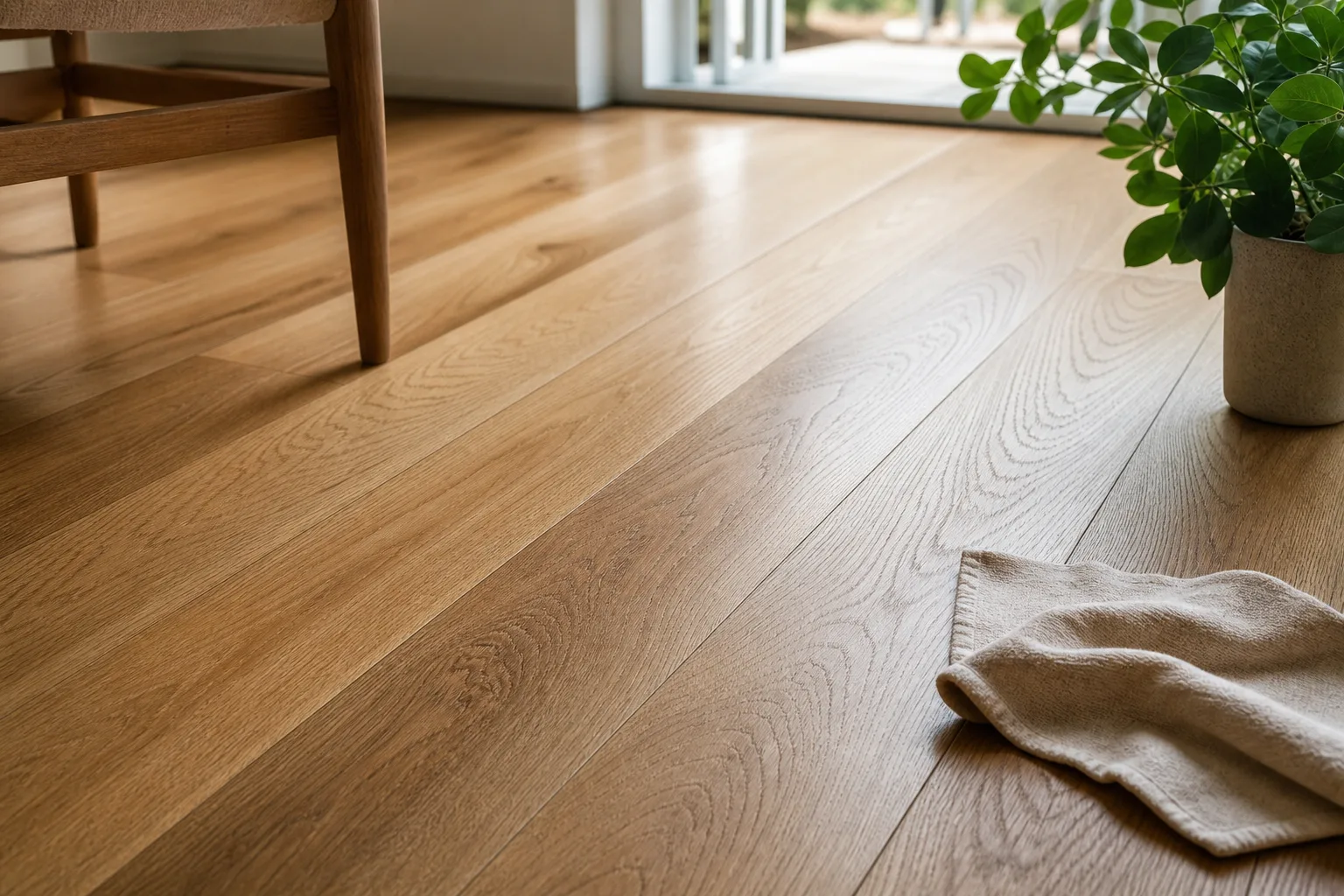
- Steam cleaners — they open up the wood and attack the adhesive beneath it.
- Harsh cleaners — ammonia, bleach, abrasives, all-purpose kitchen sprays.
- Wax and silicone polishes — they leave a greasy film on a lacquered surface.
- Too much water — a soaking mop is not thoroughness. Wring it out properly.
- Rubber-backed mats at the door — moisture builds up underneath and prints a square stain into the floor.
Season by season
Winter (the heating season)
Dry indoor air draws moisture out of the wood. Fine gaps opening between the boards are entirely normal, particularly on an oiled floor — they close again in spring. A humidifier keeps the movement small.
Summer (the humid season)
The opposite happens: the boards take up moisture and expand again. Use air conditioning and ventilation sensibly.
When to call in a specialist
- Several boards are damaged — not just the surface, but the timber underneath.
- Wide gaps between the boards that stay open even at normal humidity.
- The whole surface has gone dull with wear and the lacquer or oil needs renewing.
Get in touch and we will point you towards a qualified parquet fitter wherever we have a contact in your country.
In summary
Parquet is not a fit-and-forget floor, but nor is it demanding: 15 minutes a week, plus re-oiling every year or two on an oiled surface, keeps it looking better than new. We stock WOCA and other care products — the same ones we use ourselves.
Frequently asked questions
How often does an oiled parquet floor need maintenance?+
Dry cleaning daily. Damp cleaning with WOCA wood soap once or twice a month. Every 3–4 months, add WOCA Oil Refreshing Soap to the mop water. Every 6–12 months, refresh the surface with WOCA Maintenance Oil in the busiest areas.
Can parquet be cleaned with steam?+
No, never. Hot steam opens up the layers of the wood, damages the lacquer film and softens the adhesive under the boards. Even where a steam cleaner claims to be “wood safe”, parquet manufacturers rule it out in their warranty conditions.
How do I remove scratches from an oiled parquet floor?+
Light scratches: sand gently along the grain with P320–P400 paper, wipe off the dust and work in a little WOCA maintenance oil, then lift the excess after 20 minutes. Deeper damage means replacing the individual board (see replacing a parquet board).
What is the difference between cleaning parquet and re-oiling it?+
Cleaning — with wood soap or a pH-neutral cleaner — is everyday hygiene: it lifts dust and marks. Re-oiling is periodic feeding: the wood takes up a fresh layer of oil, the protective film is restored and the natural tone deepens again. Lacquered floors are never oiled; their equivalent is a screen sand and re-coat every 3–5 years.
What humidity and temperature suit parquet best?+
45–60 % relative humidity at 18–22 °C. Through the heating season indoor air can drop to 25–30 %, and fine gaps open between the boards — normal, and they close again in spring. A humidifier keeps the movement small. Over underfloor heating, keep the surface temperature at or below 27 °C.