Comparison
Engineered or solid parquet: which should you choose?
1 September 2026
When you are choosing a wooden floor, the question comes up sooner or later: engineered (three-layer) or solid parquet? Both are genuine timber, but their construction, the way they behave as humidity moves, their suitability for underfloor heating and their realistic service life differ fundamentally. This guide compares the two honestly on the criteria that matter — from construction to cost — and explains why our own range is engineered oak boards from 37,95 €/m², incl. VAT.
What is actually different inside the board?
Seen from above the two floors look identical — real timber with natural figure. Below the surface, the engineering is entirely different. If the vocabulary is confusing, start with our guide to parquet terminology; here we will define both types briefly.
Engineered (three-layer) parquet
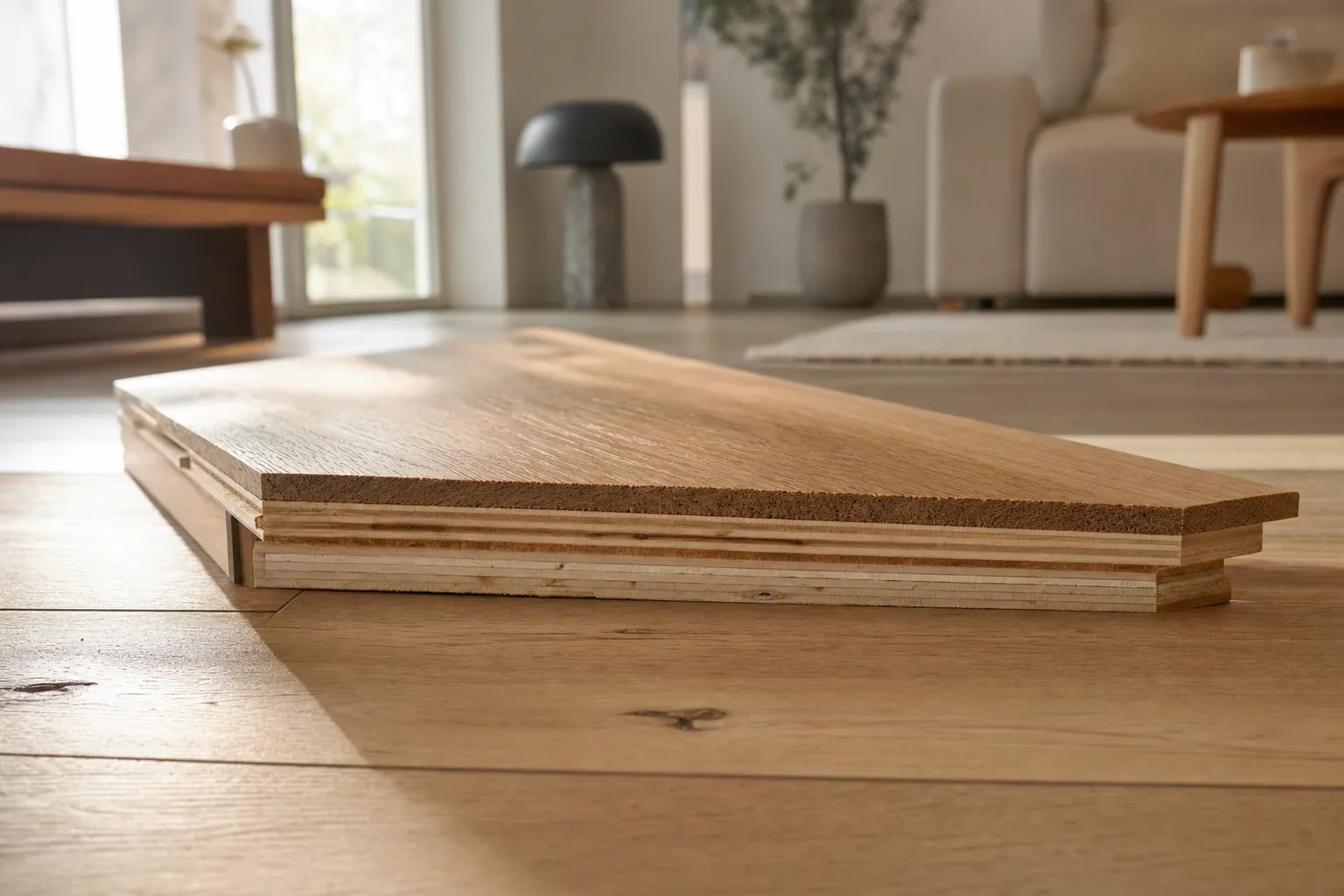
An engineered board, also called a three-layer or multilayer board, is built from three bonded layers: a top layer of 3 or 4 mm of hardwood — usually oak — a middle layer of softwood slats laid across the grain of that top layer, and a stabilising backing layer. Total board thickness is 14–15 mm. We looked at what each layer does in our article on how a parquet board is built.
The point worth holding on to: the surface you see and walk on every day is real oak — knots, growth rings and natural texture included. Once laid, an engineered floor is visually indistinguishable from a solid one. You will also come across two-layer boards on the market; we compared those separately in our guide to two-layer versus three-layer parquet.
Solid parquet
Solid parquet is a board or block cut from a single piece of timber: the same wood from top to bottom. It is the oldest type of wooden flooring, and it is what you find in older apartment buildings and country houses across Europe. It sounds reassuringly substantial, yet that single-piece structure is also its greatest weakness: the timber is free to respond to humidity and temperature through its full thickness, and nothing in the construction holds it steady.
Fitting a solid floor is correspondingly more demanding. The boards need a long acclimatisation period in the room, subfloor moisture has to be measured carefully, and the work is only reliable in the hands of a fitter with real experience of solid timber. Mistakes are expensive here — a solid floor that has cupped or gapped badly usually has to be lifted and relaid.
Engineered or solid parquet: the comparison table
| Criterion | Engineered (three-layer) | Solid parquet |
|---|---|---|
| Construction | 3–4 mm oak wear layer on a cross-laid core, 14–15 mm thick | One piece of timber through the full thickness |
| Stability as humidity moves | Very good — the layers cancel out the timber’s movement | Poor — boards expand, shrink and can deform |
| Wide and long formats | Fine, without significant risk | Risky: the wider the board, the greater the movement |
| Underfloor heating | Suitable when the boards are glued to the subfloor | Not recommended — gaps and lifting boards are likely |
| Installation | Factory finish — the floor is usable straight after fitting | Usually needs sanding and finishing on site |
| Sanding | 2–3 times (3–4 mm wear layer) | More in theory, limited in practice by the tongue |
| Price | From 37,95 €/m², incl. VAT, with no finishing work to add | Usually dearer, plus on-site finishing |
Stability: why the cross-laid core wins
Timber is hygroscopic: it constantly takes up moisture from the air and gives it back, expanding and shrinking as it does. Across most of Europe that cycle is pronounced — indoor air dries out through the heating season, and relative humidity climbs again in summer. For a solid board it means continuous movement: gaps open between the boards in winter, the boards swell in summer, and the edges can lift.
In an engineered board the middle layer runs at right angles to the wear layer, and the backing layer balances the construction further still. Forces working in opposite directions cancel each other out, so the board stays flat even when the indoor climate swings. The practical benefit is obvious: you can specify wide, long boards and run large unbroken areas — formats that would be a permanent source of risk in solid timber.
The general rule for wood still applies to engineered floors, of course — a stable indoor climate is worth maintaining, particularly through the heating season. The difference is that an engineered board forgives those swings, while a solid one records every one of them as a gap or a deformation.
Underfloor heating: the clearest difference of all
If your home has underfloor heating, or is being planned with it, the question is essentially answered. Every engineered board we sell is compatible with underfloor heating, with one condition that matters: the boards must be glued to the subfloor so that heat is transferred evenly and efficiently. The detailed rules are set out in our guide to parquet over underfloor heating.
Solid parquet over underfloor heating is a risky experiment. Thick single-piece timber conducts heat less readily and works continuously as the temperature cycles: the heating dries the board, gaps appear, and sharper changes can end in splits. Most manufacturers of solid flooring either advise against underfloor heating or withdraw the warranty where it is used.
A practical note for anyone planning the work: before laying over underfloor heating the system must be commissioned and tested, the subfloor dry and level, and the temperature raised gradually afterwards. Gluing the boards down brings the heat to the surface faster, stops the floor sounding hollow underfoot, and makes the whole construction more stable again.
Sanding: does solid really last longer?
The commonest argument for solid timber runs like this: a thick board can be sanded many times, so it will last a century. In theory that is true; in practice only in part. A solid board can only be sanded down as far as the tongue, so the real number of sandings is considerably lower than the board thickness suggests.
The more useful question is how often a floor is sanded at all over its life. In practice, only a handful of times — a full sanding is a serious piece of work, undertaken once a decade at most and often less. The 3–4 mm oak wear layer on an engineered board takes 2–3 full sandings, which covers decades of use. For how the process itself works, see our article on sanding a parquet floor.
Sanding is also not the only way to refresh a floor. An oiled surface can be revived periodically with maintenance oil and no sanding at all — a difference we covered in detail in our guide to oiled or lacquered parquet.
Cost and installation: the hidden expense of solid
On material price alone, solid parquet usually costs more than an engineered board of comparable appearance. The real gap, though, only emerges once the whole project is added up. Solid is often sold unfinished — once it is down, it still has to be sanded and then oiled or lacquered on site. That means extra labour, dust, and several days before the floor can be used at all.
Engineered boards arrive from the factory already oiled or lacquered, so the floor can be walked on the day it is laid. Fitting rates for parquet are indicatively around 8–15 €/m², depending on the pattern and on how much subfloor preparation is needed — and they vary considerably from one country to the next. More figures in our articles on parquet fitting costs and parquet prices.
Our range is engineered oak throughout: parquet boards from 37,95 €/m², incl. VAT, and for lovers of the classics, herringbone boards from 52,95 €/m², incl. VAT (12 models). Before ordering, choose up to 3 free samples — you will see the real colour and texture in the light of your own home — and if you are still weighing options, answer a few questions in the flooring finder. We ship on pallets across the EU; delivery cost and lead time are shown at checkout or quoted on request. If you need fitting as well, or advice on subfloor preparation, write to us and we will help you plan the whole project.
What to look for when choosing engineered boards
If the comparison has moved you towards engineered construction, a few practical points are worth checking before you order.
- Wear layer thickness. Our range carries 3 or 4 mm of oak: the thicker the layer, the more sanding reserve you keep for later.
- Finish. A factory-oiled surface looks more natural and can be repaired locally; a lacquered one is simpler in day-to-day care.
- Format and pattern. A wide single-strip board makes a room read larger, while a herringbone pattern gives an interior classic elegance.
- Installation method. Over underfloor heating, choose glue-down — it is the best answer for both heat transfer and acoustics.
One practical point on ordering: the minimum floor order is 20 m², so work out your quantity with the waste allowance for your chosen laying pattern included from the start.
When does solid parquet still make sense?
In fairness, let us say it plainly: solid parquet is not a bad product. It makes sense in heritage restoration, where an authentic old floor has to be extended or recreated, and in interiors without underfloor heating where the indoor climate stays steady all year and the fitter has genuine experience of working with solid timber.
But in a new build or a renovated home with underfloor heating, wide board formats and a tight installation schedule, engineered construction wins on every practical count. That is precisely why our range is engineered boards only: they give you the look of solid parquet and the feel of real wood, without the risks that come with it.
Frequently asked questions
Is engineered parquet real wood?
Yes. The top 3–4 mm layer is genuine oak, so once the floor is laid it looks and feels exactly like solid timber. The only difference is the construction beneath the surface, which is there to stabilise the wood.
How many times can an engineered board be sanded?
A 3–4 mm oak wear layer takes 2–3 full sandings. Since a floor is in practice only sanded a handful of times over its whole life, an engineered board lasts as long as a solid one in real use.
Is solid parquet suitable for underfloor heating?
It is not recommended. Single-piece timber conducts heat less readily and reacts strongly to temperature cycles — gaps open and boards can deform. Engineered boards glued to the subfloor work very well with underfloor heating.
Which lasts longer — solid or engineered parquet?
In practice they are comparable. Solid timber can in theory be sanded more often, but the real number is limited by the tongue, and floors are rarely sanded anyway. An engineered board with a 3–4 mm wear layer lasts decades and is far more resistant to movement.
How much does engineered oak parquet cost?
In our range engineered oak boards start at 37,95 €/m², incl. VAT, and herringbone from 52,95 €/m², incl. VAT. Fitting rates are indicatively around 8–15 €/m² and vary from country to country.