Comparison · 9 min
Parquet or engineered boards? A clear guide to the terms
1 September 2026
“Parquet or engineered boards?” comes up in almost every conversation about wood floors, and most buyers have no idea the two words describe different things. In loose usage “parquet” has become the catch-all name for any wooden floor, but in the strict sense it means traditional solid blocks, while engineered boards are the modern three-layer planks that have become the market standard. This guide separates the terms, compares the two constructions, their history and their costs, and tells you exactly what to ask in the shop so that you buy what you actually think you are buying.
Why “parquet” and “engineered boards” keep getting confused
In everyday English, “parquet” long ago stopped meaning one specific thing. It gets used for the oak blocks in a pre-war flat, for the wide three-layer planks in a new-build, and — quite wrongly — for laminate, which contains no wood at all. Retailers add to the muddle: in one shop “parquet” means only glued-down solid blocks, in the next the word is stuck on anything with a wood grain on it, on the theory that this makes life simpler for the customer.
Technically the line is perfectly clear. Traditional parquet means small pieces of solid timber, glued to the subfloor and then sanded and finished in place. Engineered boards are factory-finished three-layer planks: real oak on top, a cross-bonded core beneath it for stability. If you want the wider picture of how wooden floors are classified, our guide to parquet types covers it.
A little history: from palace salons to the three-layer board
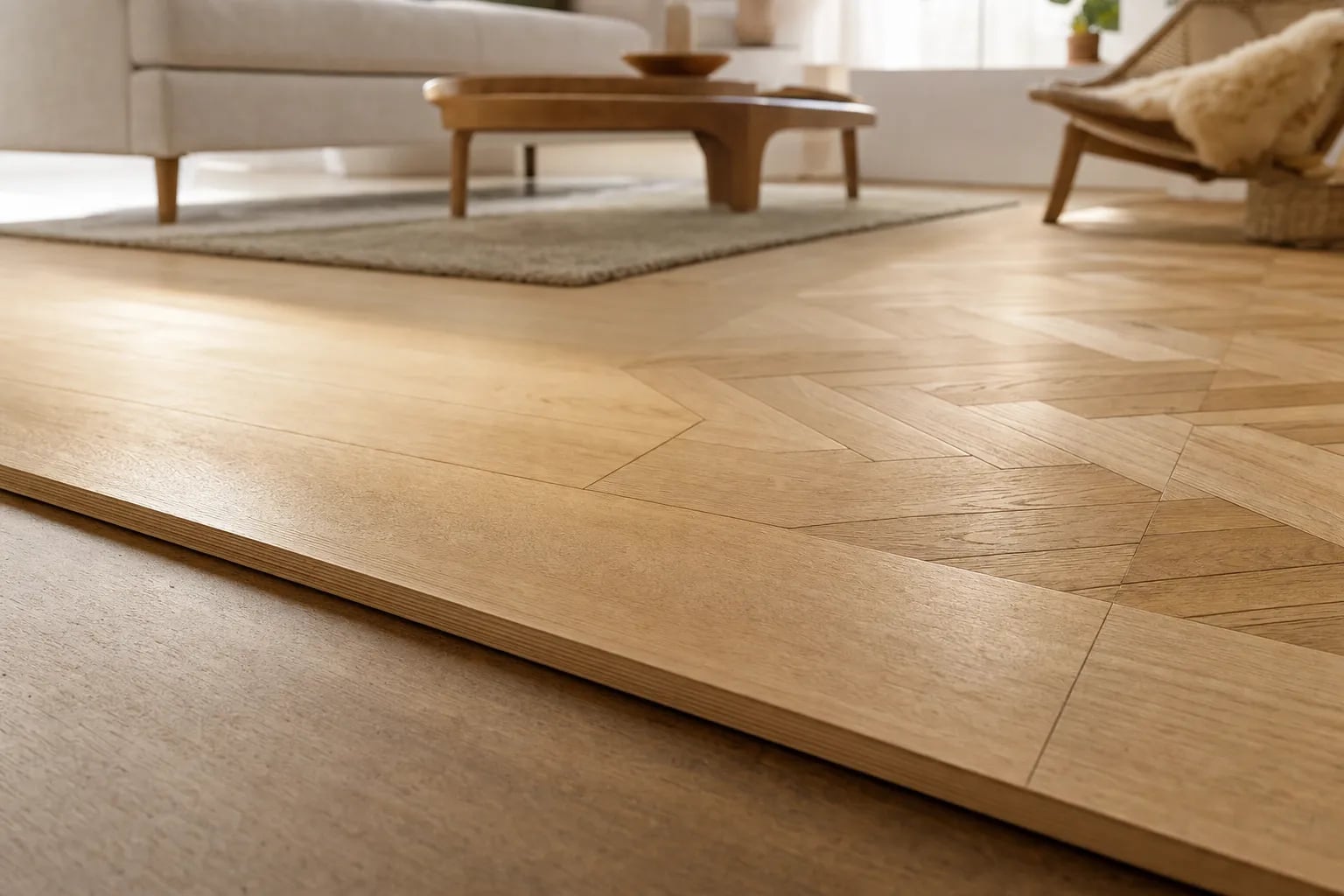
Parquet as a floor covering came into its own in seventeenth-century France, when palace halls were set with elaborate geometric patterns made from small oak pieces. That is where the classic herringbone parquet comes from, a pattern that has signalled luxury and good taste for three centuries.
Across Europe, traditional parquet is most familiar to anyone who has lived in a pre-war or mid-century apartment block: oak blocks went into hundreds of thousands of homes, and many of those floors, after several sandings, are still in service — the best proof there is of what real timber can do. Solid wood has one weakness, though: it expands and contracts continuously as humidity changes. We compare every type of wooden floor in our article on solid, engineered and laminate flooring. The three-layer board, developed in Scandinavia in the mid-twentieth century, solved that problem at the root — cross-bonded layers lock one another in place and stop the plank moving. Boards built that way are what the trade now calls engineered parquet, and they have become the wood-flooring standard right across Europe.
What is traditional parquet — solid blocks?
A classic parquet block is a single piece of timber through its full thickness. Blocks are glued straight onto a prepared subfloor and all the finishing happens on site: once laid, the floor is sanded, primed and sealed with lacquer or oil. The result can serve for decades, but the process is long, dusty and heavily dependent on the fitter's hands — a badly prepared subfloor or a rushed sanding will ruin even the most expensive timber.
Solid wood breathes through its whole thickness: in winter, when indoor air is dry, gaps open between the blocks; in summer they close up again. For that reason solid parquet is not recommended over underfloor heating and needs a stable indoor climate. We look at the two constructions head to head in our piece on engineered versus solid parquet.
To be straight with you: Terris Timber does not sell solid parquet, and that is deliberate. Modern three-layer construction solves the real problems of solid wood without giving up any of its advantages, so our entire range is engineered oak boards.
What is an engineered board? The construction up close
An engineered board is a three-layer plank, 14–15 mm thick overall. On top sits a 3 mm or 4 mm wear layer of real oak: that is what you see and walk on, which is why a finished engineered floor is indistinguishable from solid. Beneath it runs a cross-oriented softwood core, and under that a stabilising backing. Because the grain of the layers is bonded at right angles, the plank barely reacts to swings in humidity or temperature. We take each layer apart in our article on how engineered parquet is built.
The wear layer is the same oak as in traditional blocks, so the character, texture and ageing of the floor are identical to solid. Why oak dominates in northern and central Europe is the subject of our oak flooring guide. A 3–4 mm top can be sanded two or three times, so even after twenty years the floor can be brought back to as-new condition. Two-layer boards also exist — how they differ, and why we stock only three-layer, is set out in our comparison of two-layer and three-layer boards.
One more fundamental difference: completeness. Engineered boards arrive from the factory already sanded and finished in oil or lacquer, so no site sanding is needed at all — lay them in the morning, move the furniture back in the evening. There are two ways to fit them: glued to the subfloor, or floating on a click system.
Compared: parquet blocks, engineered boards and laminate
We have put laminate in the table too — not because it is a wooden floor, but because it is still routinely sold as “laminate parquet”, and buyers still get caught.
| Criterion | Parquet blocks (solid) | Engineered boards (three-layer) | Laminate |
|---|---|---|---|
| Construction | One piece of solid timber | Three cross-bonded layers, 3–4 mm oak on top | HDF core with a printed decor layer |
| Is it real wood? | Yes | Yes — the surface is real oak | No, only a wood imitation |
| Installation | Glue-down only, finished on site | Glue-down or floating (click) | Floating |
| Surface finish | Sanded and sealed after laying | Factory-finished — oil or lacquer | Factory-finished |
| Renewal by sanding | Many times | 2–3 times | Not possible |
| Stability in changing humidity | Sensitive — expands and contracts | Stable | Sensitive to water |
| Underfloor heating | Not recommended | Suitable (must be glued down) | Depends on the manufacturer |
| Time to install | Several weeks with finishing | 1–2 days | 1–2 days |
What does the table say in plain terms? If you want real wood without a long, dusty job, choose engineered boards: you get the same oak surface as solid, with a predictable result, quick fitting and the option of underfloor heating. Solid blocks remain a niche choice for heritage interiors and restoration work, and laminate is a separate, non-wood category to be judged on entirely different criteria.
How shops use the terms — and how not to get caught out
A few unwritten rules are worth knowing as you browse. “Oak parquet”, or simply “parquet”, in a modern online catalogue almost always means three-layer engineered boards — most retailers no longer carry solid blocks at all. “Solid parquet” means blocks or planks of one-piece timber. And “laminate parquet” is a marketing phrase covering plain laminate with not a gram of real wood in it.
The reliable way through is to read the specification rather than the name. Look for three things: the number of layers, the thickness of the wear layer and the overall thickness of the board. If the description mentions an “HDF core” and a “decor layer”, you are looking at laminate, however grand the name on the label. If it says “three-layer construction, 3–4 mm oak wear layer”, these are genuine engineered boards.
What to ask when buying: the 5 questions that matter
1. How thick is the wear layer?
This is the single best indicator of how long an engineered board will last. A 3 mm or 4 mm oak layer can be sanded two or three times, and each sanding buys the floor another decade or more. We describe the process itself in our article on sanding a parquet floor.
2. Which grade is the timber?
Grading describes character, not quality: a calm Select grade has almost no knots and an even tone, Natur is more natural with small knots, and Rustic gives you pronounced knots and strong contrast. It is a purely aesthetic choice, but one you have to see in the flesh rather than on a screen: the same grade can look quite different between manufacturers, and the light in your own home shifts the tone further still.
3. Click system or glue-down?
Floating installation on a click system is quicker and cheaper; glue-down installation is more solid, quieter underfoot and essential over underfloor heating. Which suits your situation is covered in detail in our guide to engineered flooring over underfloor heating.
4. Oiled or lacquered?
Oil brings out the natural texture of the wood and lets you refresh the floor in patches; lacquer stands up better to everyday life and is simpler to look after. We set out the merits of both in our comparison of oiled and lacquered floors.
5. What will fitting cost?
Add labour to the materials budget. Fitting is priced locally and varies a great deal from one EU country to the next, so treat any figure as an indicative market rate rather than as our price: roughly 8–15 €/m² in the lower-cost markets and appreciably more in western and northern Europe, depending on the fitting method and the pattern. We break the cost down line by line in our article on what it costs to lay a parquet floor.
What do engineered oak boards cost, and where do you start?
The Terris Timber range is three-layer construction with a real oak wear layer only: engineered oak boards from 37,95 €/m² incl. VAT, and for anyone set on the classic pattern, herringbone boards from 52,95 €/m², a collection of 12 models. Before you commit, order up to 3 free samples — the tone and texture of the wood have to be seen in the light of your own home.
We ship on pallets across the EU; delivery cost and lead time are shown at checkout or quoted on request, and the minimum flooring order is 20 m². If you are still weighing up which floor suits your home, our floor finder will give you an answer in a couple of minutes.
Frequently asked questions
Are engineered boards real parquet?
Yes. The wear layer of an engineered board is 3 mm or 4 mm of real oak — the same timber as in traditional parquet blocks. Only the construction underneath differs: instead of one solid piece there are three cross-bonded layers, which make the plank considerably more stable.
How do engineered boards differ from laminate?
Engineered boards are real wood — the surface is oak, so the floor can be sanded and renewed. Laminate is an HDF core with a printed decor layer imitating wood grain: it is not timber, and once worn it cannot be sanded, only replaced.
Can engineered boards be sanded?
Yes. A 3–4 mm oak wear layer can be sanded two or three times, so a well-maintained engineered floor serves for decades — and after every sanding it looks new again.
Solid parquet or engineered boards for underfloor heating?
Engineered boards. The three-layer construction reacts calmly to swings in temperature and humidity, so every Terris Timber board is suitable for underfloor heating — the important thing is to glue it to the subfloor. Solid blocks are generally not recommended over heating.
How much do engineered oak boards cost?
Terris Timber three-layer boards start at 37,95 €/m² incl. VAT, and herringbone boards at 52,95 €/m² (12 models). Fitting is a local cost that varies from country to country — indicatively around 8–15 €/m² in the lower-cost EU markets, and more in western and northern Europe.