Guide · 12 min
Wood flooring types: solid, engineered or laminate
1 September 2026
When a customer says “I want a wooden floor”, they usually have one of three quite different products in mind. At a glance they look alike, but their construction, price, lifespan and suitability for a modern European home differ considerably. A fourth option now joins the comparison more and more often: vinyl flooring with a wood decor. This guide sets out the differences and helps you pick the right one.
The three types of “wooden floor”
First, a short overview of what actually exists:
1. Solid parquet
A single block of timber — 100 % natural oak (or another hardwood) through the full thickness of the board, typically 18–22 mm. The classic option, in use since the 1700s. The longest-lived of the lot: looked after properly it runs to 80–100+ years. But it is very sensitive to changes in humidity and temperature — it can creak, split and cup. Not suitable for underfloor heating. Expensive, with market prices around 60–150 €/m² before fitting; the range shifts from country to country.
2. Engineered parquet (three-layer)
The modern alternative to solid wood, sold across Europe as engineered or multilayer parquet. Three layers:
- Top (3–4 mm): natural oak (or ash, maple) — exactly what you would see in a solid board
- Core (~9 mm): rigid spruce or pine slats laid crosswise — this is what supplies the stability
- Backing (2 mm): dense wood fibre — keeps movement in check
Total thickness 14 mm. Advantages over solid: suitable for underfloor heating, far less sensitive to moisture, easier to lay (Click 5G) and cheaper (37,95–106,95 €/m², incl. VAT; from 37,95 €/m² during promotions). It can be sanded 1–2 times over its life. Our entire parquet collection is engineered.
3. Laminate
Strictly speaking, not wood. The construction: an HDF (high-density fibreboard) core, a printed decor layer on top and a protective melamine overlay. It looks like wood but feels like plastic. Advantages: cheap (indicatively 8–15 €/m², or roughly 15–30 €/m² for a good AC5 board, depending on the market), abrasion-resistant (AC4–AC5 classes) and quick to lay yourself. Drawbacks: it cannot be renewed, it swells where water sits, it feels cold underfoot and it sounds hollow. The full head-to-head is in our article on parquet versus laminate.
A fourth option: wood-effect vinyl
Strictly, vinyl is not a wooden floor. But modern vinyl flooring reproduces the grain so convincingly — embossed surface, natural oak tones, realistic plank formats — that buyers now weigh it against parquet, especially in wet rooms. Two main types: rigid click SPC planks (from 25,95 €/m², incl. VAT) for DIY installation, and thinner glue-down LVT (from 16,95 €/m², incl. VAT) — we explain the differences in our article on SPC versus LVT vinyl.
Vinyl's biggest advantage over every wooden floor is water resistance: a spill does it no harm, which makes it the usual “wood” choice for kitchens and bathrooms. The drawbacks: it is still an imitation — you do not feel real grain underfoot, it cannot be renewed by sanding, and its effect on resale value is neutral. Our range holds 47 designs at 16,95–33,95 €/m², incl. VAT. In full: our complete guide to vinyl flooring.
Full comparison
The usual dilemma is engineered versus solid, so read those two columns first; laminate and wood-effect vinyl sit alongside them.
| Property | Solid | Engineered parquet | Laminate | Vinyl (wood effect) |
|---|---|---|---|---|
| Natural wood | 100 % | 3–4 mm on top | No (printed decor) | No (wood effect) |
| Thickness | 18–22 mm | 14 mm | 7–12 mm | Thinnest floor of all (SPC/LVT) |
| Suitable for underfloor heating | No | Yes (≤27 °C) | Yes (≤27 °C) | Yes (SPC, ≤27 °C) |
| Moisture resistance | Sensitive | Moderate — wipe spills at once | Can swell | Resistant — bathroom-ready |
| Renewal by sanding | 5–10 times | 1–2 times | No (replaced) | No (swap the plank) |
| Service life | 80–100+ years | 30–50 years | 10–20 years | Moderate, by abrasion class |
| Installation | Glue-down (fitter) | Click 5G or glue | Click system | Click (SPC) or glue (LVT) |
| Feel underfoot | Warm, authentic | Warm, authentic | Colder, plasticky | Warmer than laminate |
| Acoustics | Best (solid mass damps sound) | Good | Hollow, ringing | Quiet, absorbs footsteps |
| Effect on resale value | Raises it strongly | Raises it | Neutral | Neutral |
| Price (€/m²) | 60–150 (indicative, varies by country) | 37,95–106,95 | 8–30 (indicative, varies by country) | 16,95–33,95 |
If your choice has already narrowed to two, the detailed head-to-head is in our article on parquet versus vinyl.
Which option suits you?
Choose solid parquet if:
- You are building or restoring a period property with traditional architecture
- You want a floor that lasts a century — something to hand on
- Budget is not the constraint (indicatively 60–150 €/m² plus costly fitting, both varying by country)
- The room has no underfloor heating and a stable humidity level
We do not stock solid parquet — our focus is engineered boards, the more practical choice for most households.
Choose engineered parquet if:
- You want the warmth and beauty of real wood, not an imitation
- You have or are planning underfloor heating
- You value longevity — 30–50 years with no major work
- You want the option of sanding the floor back in 15–20 years
- Your budget is 37,95–106,95 €/m², incl. VAT (mid-range to premium)
This is what 95 % of our customers choose. Start with Oak Bergen (entry level) or Oak Vienna (mid-premium).
Choose vinyl (wood effect) if:
- You need the look of timber in wet rooms — kitchen, bathroom, utility room
- Your budget is 16,95–33,95 €/m², incl. VAT, but laminate's weak points (swelling, hollow sound) put you off
- There are children or pets at home — the floor is quiet, tough and easy to clean
- You want a straightforward installation: most people lay click SPC planks themselves
The lowest-priced designs are in the vinyl catalogue sorted by price, and the numbers are broken down in our article on vinyl flooring costs.
Choose laminate if:
- The budget is very tight (indicatively around 8–15 €/m²)
- It is a rental, or a home you expect to live in for 5–10 years
- It is a children's room with heavy traffic, where dropped toys are a daily event
- The properties of real wood do not matter to you — only the look does
We do not sell laminate, but we accept it is a logical answer in certain situations. Even so, for a similar or slightly larger budget vinyl is usually the more practical floor, and where the floor is a real investment we recommend engineered parquet.
Underfloor heating and wood floors
Across much of Europe, underfloor heating is now standard in new build and in serious renovations. That makes it one of the most important criteria when choosing a floor covering.
- Solid: not suitable. Too much solid timber in a single board, all of it reacting to temperature swings — the result is gaps and creaking. Even where a manufacturer claims its solid boards are “suitable for underfloor heating”, it remains a significant risk.
- Engineered parquet: suitable, provided it is fully bonded to the subfloor rather than laid floating. Maximum surface temperature 27 °C. Our whole collection is certified for underfloor heating.
- Laminate: suitable, and usually cheaper to install (the floating version). Maximum temperature 27 °C.
- Vinyl (SPC): suitable up to about 27 °C — more in our article on vinyl over underfloor heating.
For the conditions in detail see our guide to parquet over underfloor heating, and for every floor covering compared from a heating point of view, flooring for underfloor heating.
Renewal and lifespan
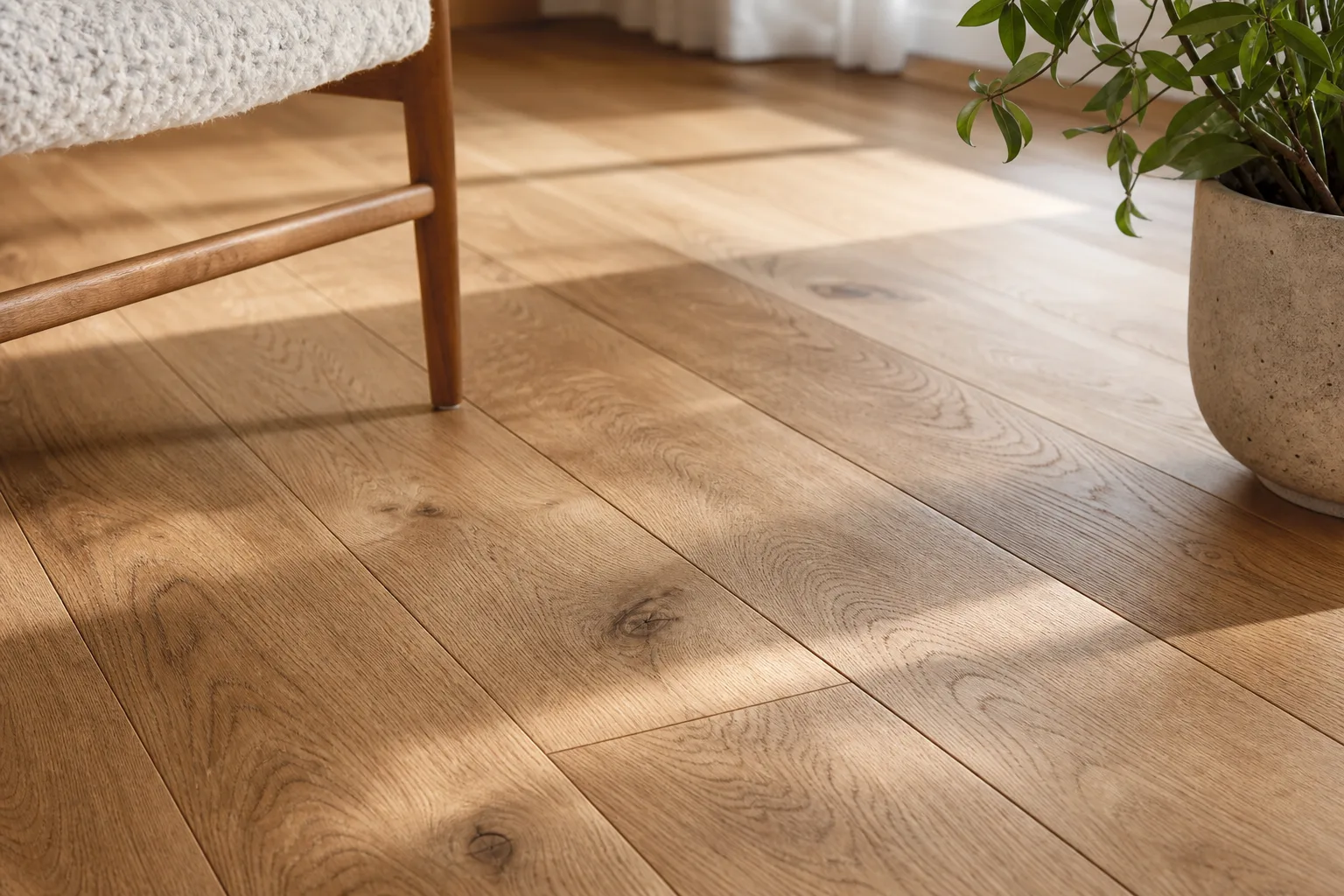
One of the great advantages a wooden floor holds over vinyl or laminate is that it can be renewed by sanding. That takes enough wear layer to work with:
- Solid (18+ mm of oak) — can be sanded 5–10 times over its whole life
- Engineered with a 3 mm top layer — once
- Engineered with a 4 mm top layer — twice (our XL boards and some standard designs)
- Laminate — never (an HDF core will not take sanding)
- Vinyl — never (a damaged plank is swapped for a new one)
Sanding with re-oiling costs in the region of 15–25 €/m² depending on the country and the contractor, and takes 2–4 days. Afterwards the floor looks new. More in our guide to sanding a parquet floor.
Our range — engineered parquet
Terris Timber offers 73 engineered oak parquet designs, from Scandinavian pale to rustic dark, in classic and XL formats, in herringbone or as traditional planks (37,95–106,95 €/m², incl. VAT; from 37,95 €/m² during promotions). Across the whole collection:
- 3–4 mm oak wear layer
- Click 5G joint (for DIY installation) or glue-down
- Suitable for underfloor heating up to 27 °C
- FSC/PEFC certified
- Manufacturer's warranty of up to 15 years
If it is the look of timber you are after, we also list 47 vinyl flooring designs from 16,95 €/m², incl. VAT. Order up to 3 free samples (available for parquet and vinyl) and you will see the real grain and colour in your own light.
Installation — contractor or DIY
Engineered parquet with a Click 5G system is realistic to lay yourself — a job of medium difficulty. Most of our customers either fit it themselves or bring in a local flooring contractor; if you would like help finding one, get in touch. The step-by-step guide is here: how to lay a parquet floor.
Solid parquet needs an experienced fitter (full bonding is demanding), while laminate and click vinyl are the simplest options for a beginner — fitting click vinyl runs to roughly 6–12 €/m² in many European markets, though rates vary widely; see laying vinyl flooring. Indicative figures for every stage of the job are collected in our flooring installation cost guide.
Conclusion
For “wooden floors” in a European home in 2026, engineered parquet is the optimal choice — every advantage of real timber (looks, longevity, warmth underfoot) without the drawbacks of solid boards (price, sensitivity to moisture, incompatibility with underfloor heating). Solid parquet remains the luxury answer for particular projects; laminate is the budget compromise, but not real wood. And where water resistance and a smaller budget matter most, wood-effect vinyl flooring (from 16,95 €/m², incl. VAT) is the most practical alternative for a kitchen or bathroom. Choose by what the room is for, by budget, and by whether you have underfloor heating.
Frequently asked questions
Is engineered parquet “real wood”?+
Yes. The top layer is natural oak, 3–4 mm thick — exactly what you would see in a solid board. The core and the backing are other timber layers (spruce or pine) that supply the stability. Seen and walked on from above, the two are identical.
What is the difference between engineered parquet and laminate?+
Engineered parquet carries 3–4 mm of natural wood on top. Laminate is an HDF fibreboard with a printed decor that looks like wood. Parquet feels warmer underfoot, lasts 2–3 times longer, can be renewed by sanding and lifts resale value. Laminate is cheaper and more stain-resistant.
Is solid parquet suitable for underfloor heating?+
Not recommended. Solid wood reacts strongly to shifts in temperature and humidity, which shows up as gaps and creaking. For underfloor heating choose engineered parquet bonded to the subfloor — it is designed for exactly this.
How many times can engineered parquet be sanded?+
Once with a 3 mm wear layer, twice with 4 mm. Our standard collection is 3 mm; the XL format and some premium boards are 4 mm. Sanding with re-oiling costs in the region of 15–25 €/m², and rates differ from country to country.
What does a wooden floor cost for a 30 m² room?+
Engineered parquet: roughly 1 100–3 200 € in materials plus about 210–600 € to fit ≈ 1 300–3 800 €. Solid parquet: several times more. Laminate: materials alone come to an indicative 240–900 €. Vinyl flooring: about 510–1 020 € in materials plus some 180–360 € to fit ≈ 690–1 380 €. Fitting rates vary widely across Europe, so treat them as a guide. Add 7–15 % for offcuts, plus accessories.
Vinyl or wood — which should I choose?+
For living spaces where real timber and resale value matter, engineered parquet (37,95–106,95 €/m², incl. VAT). For wet rooms such as a kitchen or bathroom, and for a smaller budget, wood-effect vinyl (16,95–33,95 €/m², incl. VAT): water-resistant, quiet and easy to clean. It is an imitation, though — it cannot be renewed by sanding.
Does wood-effect vinyl look like real parquet?+
From across the room, remarkably so: modern vinyl has an embossed surface and natural oak tones. The difference shows up close and underfoot. The surest test is to order free parquet and vinyl samples and compare them in your own light.