Vinyl
Glue-down or click vinyl flooring: which should you choose?
1 September 2026
Most people pick a vinyl floor by its decor — an oak grain, a herringbone pattern, a stone look. Yet one technical decision does more for durability and comfort than the design ever will: whether the floor is glued down (thin, flexible LVT planks bonded to the subfloor with adhesive) or clicked together (rigid SPC planks with a click system that float over the subfloor). This guide compares the two across the nine criteria that matter most, and says plainly when each one is the right call.
Construction: flexible LVT against rigid SPC
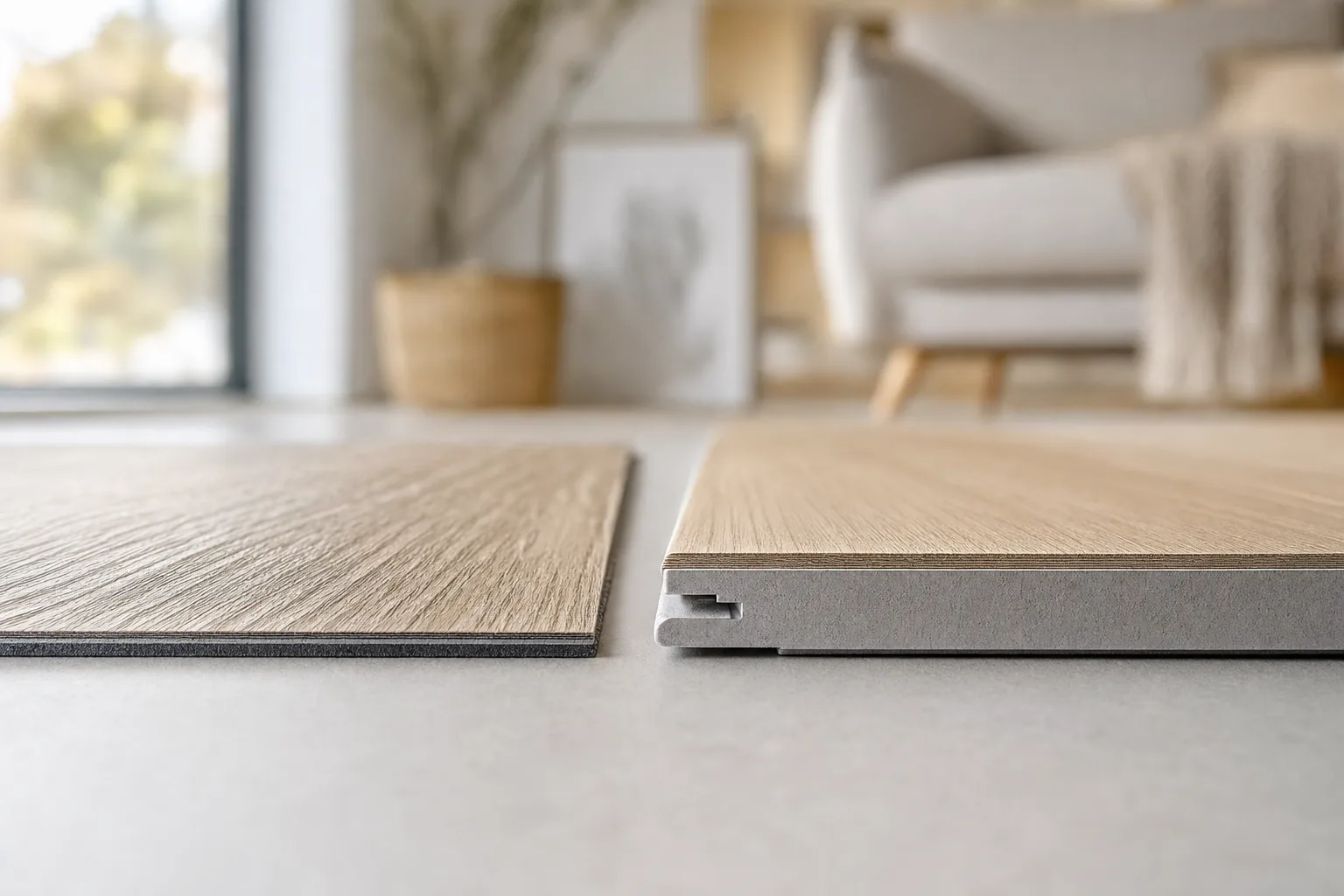
Glue-down flooring comes as thin, flexible vinyl planks, usually 2–2.5 mm thick, bonded straight to the subfloor with a purpose-made adhesive. No locking profile, nothing floating — the covering becomes one with the floor beneath it.
Click flooring is built on a rigid mineral core of stone powder and polymer (SPC), with a click system along the edges, typically 4–6 mm thick and often supplied with an acoustic underlay already bonded to the back. The planks lock into one another and float over the subfloor rather than being fixed to it. How SPC differs from flexible LVT is covered in more detail in a separate guide on our blog.
That single difference in construction explains nearly every advantage and drawback that follows.
Subfloor requirements and flatness tolerance
This is the most important practical difference. A thin glue-down LVT plank reproduces every irregularity underneath it: each bump, hollow, crack — even a grain of grit left behind — will eventually telegraph through the surface. A glued floor therefore needs a subfloor that is genuinely flat, dry, sound and clean, which normally means a self-levelling compound or proper professional preparation.
Rigid click SPC is far more forgiving. The stiff core bridges minor irregularities, so manufacturers generally allow up to 2–3 mm of height difference over 2 m. That makes renovation much simpler — SPC can often be laid straight over an existing, sound floor covering. Careful preparation still repays the effort every time; the step-by-step installation guide on our blog goes through the detail.
Dimensional stability: large areas, sunlight and heat
Both systems have a claim here, so it is worth being precise. Rigid SPC is a very stable material — the mineral core barely expands, which is why it is at home beside large windows and in sunny rooms. But because a click floor floats, long runs (beyond roughly 8–10 m) and rooms where the temperature swings by 15–20 °C with sun or heating accumulate movement that loads the click joints. Click floors therefore always need expansion gaps along the walls (around 5 mm as standard, more in large areas), and they must be free to move under fitted furniture and kitchen islands.
Glue-down LVT, by contrast, is bonded across its full surface and physically cannot move. That makes it the conservative, lowest-risk choice for very large sun-warmed areas, garden rooms and spaces with heavy or fixed furniture. No gaps, no risk of the floor shifting.
Sound and comfort underfoot
A floating click floor has a slight air layer beneath it and often an integrated underlay, so it feels softer, warmer and gives a little underfoot — welcome in a kitchen or anywhere you stand for long stretches. The drawback is that the same air layer can work as a resonator, so without a good underlay footsteps sound hollow, and the joints may start to creak over the years.
Glue-down LVT is bonded with no air gap at all, which makes it quieter and more solid — no drumming, no hollow feel. In exchange the surface is harder underfoot. In flats, where not disturbing the neighbours below matters, full bonding often wins.
Underfloor heating
Both types work over underfloor heating, but glue-down LVT has a clear edge: with no air gap the heat transfers more efficiently and more evenly, and the thin covering has the lowest thermal resistance. Click SPC is also suitable — it simply insulates slightly more.
The same rules apply either way: the surface temperature must not exceed around 27 °C, the system is brought up to temperature gradually, and the residual moisture in a cement or anhydrite screed has to meet the manufacturer's limits. There is a guide dedicated to vinyl over underfloor heating on our blog.
Repairs and replacing a single plank
Interestingly, the strengths swap over here compared with installation. A damaged glued plank can be cut out and replaced in place by an experienced fitter without touching the rest of the floor. A click floor is easy to dismantle completely (ideal when you move), but replacing one plank in the middle of a room usually means unclipping the whole row up to it, board by board. The advice in both cases is the same: keep a few spare planks from the same batch.
DIY or a fitter, and what it costs
Click flooring is the most DIY-friendly option on the market: no adhesive, no waiting, laid much like laminate, and you can walk on it straight away. Glue-down LVT calls for experience — accurate subfloor preparation, the right adhesive, an understanding of open time — so it is usually laid by professionals.
That changes the total cost. Glue-down planks are often cheaper per square metre as a material, but adhesive and dearer labour are added on top. Click planks cost more to buy, yet save money at installation, especially if you lay them yourself. Fitting rates differ widely from one European country to the next, so the fair comparison is never the plank price alone but the whole budget, subfloor preparation and labour included — a cheaper product can quietly become the more expensive project. Current indicative prices are on our vinyl flooring pages, and you can work out a rough figure for your own area with the price calculator.
| Criterion | Glue-down (LVT) | Click (SPC) |
|---|---|---|
| Thickness | 2–2.5 mm | 4–6 mm |
| Subfloor flatness | Must be genuinely flat | Tolerates up to ~2–3 mm / 2 m |
| Installation | Adhesive, better left to a fitter | Click, DIY-friendly |
| Expansion gaps | Not needed | Required along the walls |
| Large, sun-lit areas | Safest option | Works with gaps and limited run lengths |
| Sound / feel | Quieter, harder | Softer, can sound hollow |
| Underfloor heating | Best heat transfer | Suitable, insulates slightly more |
| Replacing one plank | Easy to swap in situ | The row has to be unclipped |
| Commercial / heavy loads | Very well suited | Homes and light commercial |
Commercial and residential spaces
For heavy commercial use — shops, offices, halls with castor chairs or trolleys — glue-down LVT is the usual specification: it does not move, it takes high point loads, and it gives a continuous surface that is easy to maintain. On a commercial project, look closely at wear layer thickness and usage class; those, rather than the installation method, decide how many years the floor keeps looking new in high-traffic areas.
For homes and light commercial spaces, click SPC is an excellent fit, combining durability with straightforward installation. It proves itself in flats, houses, rental properties and small offices, where quick fitting and the option to lift the floor again both count. In practice both systems will serve a home for decades — which is why the decision usually comes down to the state of the subfloor, the heating and who is laying it, rather than to any worry about durability.
Which to choose: a quick decision guide
Choose click SPC if: you want to lay the floor yourself or quickly, the subfloor is not perfectly flat, you are renovating and want to cover an existing floor, you value a warmer and softer feel underfoot, or you want to be able to take the floor with you when you move. Browse the click vinyl flooring range — the SPC Rio collection, for example.
Choose glue-down LVT if: you are covering a large or sun-warmed area, a wet room (bathroom, kitchen) or underfloor heating, you want the quietest and most solid result, you are planning for commercial traffic, or you already have (or will prepare) a genuinely flat subfloor. Have a look at glue-down vinyl, such as Glue-down vinyl Barcelona.
Still undecided? A free video consultation will help you settle on the right solution for your room — book one through our contact page, and request free samples if you would like to see the floor in person.
Related articles
- Vinyl flooring: the complete guide
- SPC or LVT vinyl: the differences and which to choose
- Installing vinyl flooring: step by step
- Vinyl over underfloor heating
Frequently asked questions
Which vinyl flooring is more durable — glue-down or click?
Both are durable, but their strengths lie in different places. Glue-down LVT copes better with high point loads and commercial traffic because it is fully bonded and cannot move. Click SPC has a rigid, impact-resistant mineral core and suits homes very well. Real-world durability depends far more on wear layer thickness (in mil or mm) and usage class than on the installation method.
Is click vinyl suitable for a bathroom?
The vinyl itself is water-resistant, but the weak point of a click floor is the joints and expansion gaps, through which water can reach the subfloor. For wet rooms and bathrooms, glue-down LVT is the safer solution, especially with sealed joints.
Can click flooring be laid over an existing floor covering?
Often yes — provided the old covering is sound, dry and flat enough (within roughly 2–3 mm over 2 m). This is one of the main advantages of click SPC in a renovation. For glue-down LVT the subfloor almost always has to be prepared from scratch.
Why do click floors need expansion gaps when glued floors do not?
A click floor floats and is free to expand and contract as the temperature changes, so a gap is left along the walls and hidden under the skirting board. Glue-down LVT is bonded across its whole surface to the subfloor and cannot move, so it needs no gaps.
Which is better over underfloor heating?
Glue-down LVT has a slight edge, because with no air gap the heat transfers more efficiently and the thin covering has lower thermal resistance. Click SPC is also suitable. In both cases the surface temperature should not exceed roughly 27 °C, and the system has to be brought up to temperature gradually.
Which option is cheaper?
The glue-down plank itself is often cheaper per square metre, but adhesive and dearer labour are added on top. Click SPC costs more as a product, yet saves money at installation, especially if you lay it yourself. Fitting rates vary widely from one country to another, so calculate the total with subfloor preparation and labour included.