Tips · 9 min
Oak flooring colours: how to choose the right shade
12 August 2026
People often settle on oak for its grain and durability — and then get stuck on the simplest question of all: which colour? It may seem a small detail, but it is the shade that does most to change how a room makes us feel. The very same board can look warm and inviting in one space, cool and greyish in another. In this guide we walk through the full spectrum of oak colours, explain how lighting and interior style shift the way a shade reads, and point you towards the collections worth a look. If you have not yet settled on the wood itself, start with our complete guide to engineered oak flooring.
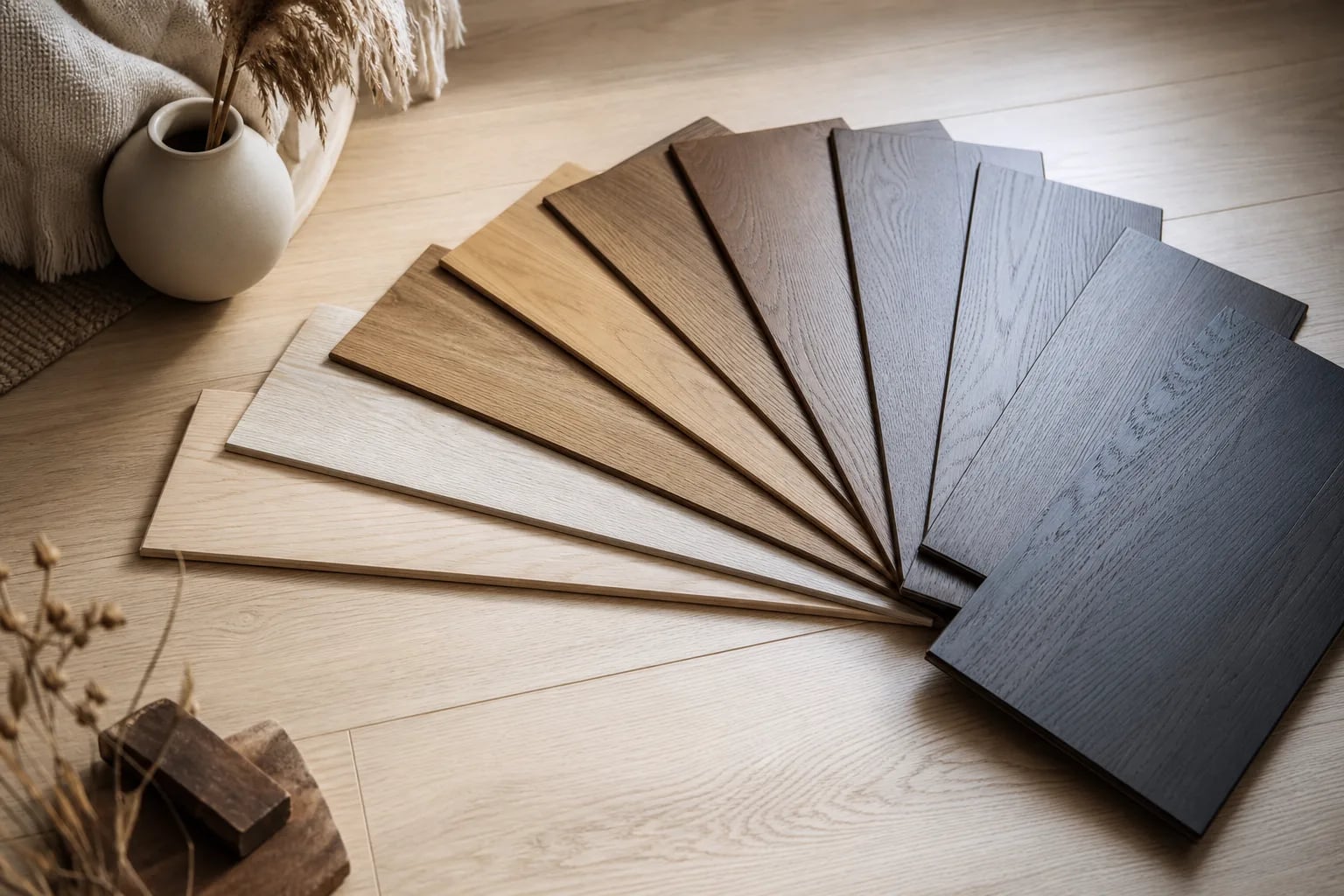
The oak colour spectrum: five main groups
Oak is an obliging timber — its natural tone is a warm, gentle yellow, so it can be stained, brushed or bleached in almost any direction. In practice, the entire choice fits into five groups.
1. Light and natural oak
This is our most popular category. Light oak flooring means pale sand, straw or milky-white boards with a clearly visible grain. They reflect plenty of light, which makes them ideal for smaller or darker rooms: the space feels larger and airier. A natural, untreated tone is one of the safest choices of all — it works under Scandinavian and modern interiors alike, and scratches and dust are barely visible on it.
2. Medium-tone oak
Warm brown, honey or walnut shades — a classic that never dates. Medium-tone oak lends a room warmth without overpowering the furniture. It is the golden middle ground for anyone worried that too light will feel cold and too dark will feel gloomy.
3. Dark oak
Dark flooring means chocolate, walnut or almost-black boards. It creates a luxurious, intimate, grown-up interior and pairs beautifully with light walls and contrasting furniture. Two things are worth knowing, though: a dark surface visually shrinks a room, and dust and pale footprints show on it more readily. In a small room that gets little sun, dark flooring can feel closed-in.
4. White and bleached oak
White flooring is achieved by bleaching or finishing with a white pigment. The result is a very light, almost Nordic space. It is an especially popular solution in minimalist and Scandinavian interiors. The advantage is a maximum sense of space; the drawback is that dirt and hair show more than they would on a medium tone.
5. Greyish oak
Greyish, smoked or concrete-toned shades are a restrained, cool, contemporary choice. They suit industrial and modern styles and look superb in open spaces with plenty of glass. Greyish oak is a neutral backdrop, so it lets bold furniture or textiles become the accent.
How lighting changes the way a shade reads
This is the single most important thing people forget when choosing flooring from a photo on a screen. Wood lives with light, and the same shade looks different under different lighting.
- A north-facing room receives cool, bluish light. Greyish or white oak can come across as gloomy and clinically cold here. In rooms like these, warm honey or natural tones restore the balance.
- A south- or west-facing room is bathed in warm, golden sun. Here light or natural oak can look overly yellow, while cooler greyish tones strike a beautiful balance.
- Artificial light shapes the result too: warm bulbs (2700 K) amplify the yellow, cool ones (4000 K and above) bring out the greys and whites.
That is exactly why we never recommend choosing a colour from a screen or under shop lighting alone. The only reliable way is to see the board in your own room, in the morning and in the evening. That is what our 3 free samples delivered to your home are for: place them by the window and in the far corner, and the decision becomes obvious.
How colour shapes the sense of space
Beyond lighting, a shade does a few predictable things to a room:
- Light floors open a space up. They reflect light, so the ceiling feels higher and the room more spacious. A small kitchen or hallway almost always wins with light oak.
- Dark floors draw a space in and ground it. In a large, bright living room, dark flooring creates a feeling of cosiness and luxury — but in a compact room it can feel oppressive.
- Board direction and format matter. Long, wide boards visually lengthen a room; a narrow herringbone pattern brings classic movement.
Oiled or lacquered surface — and how it changes the colour
Colour depends not only on the wood but on the finish. The same oak looks different oiled and lacquered. Oil soaks into the timber and leaves a very natural, matt, warm surface — the colour appears deeper and richer, and the texture is more tangible under the hand. Lacquer forms a protective layer on the surface; it can be matt or glossier and often slightly lifts the vibrancy of the tone. We cover which option suits your lifestyle in our article on oiled versus lacquered flooring.
The right shade for your interior style and room
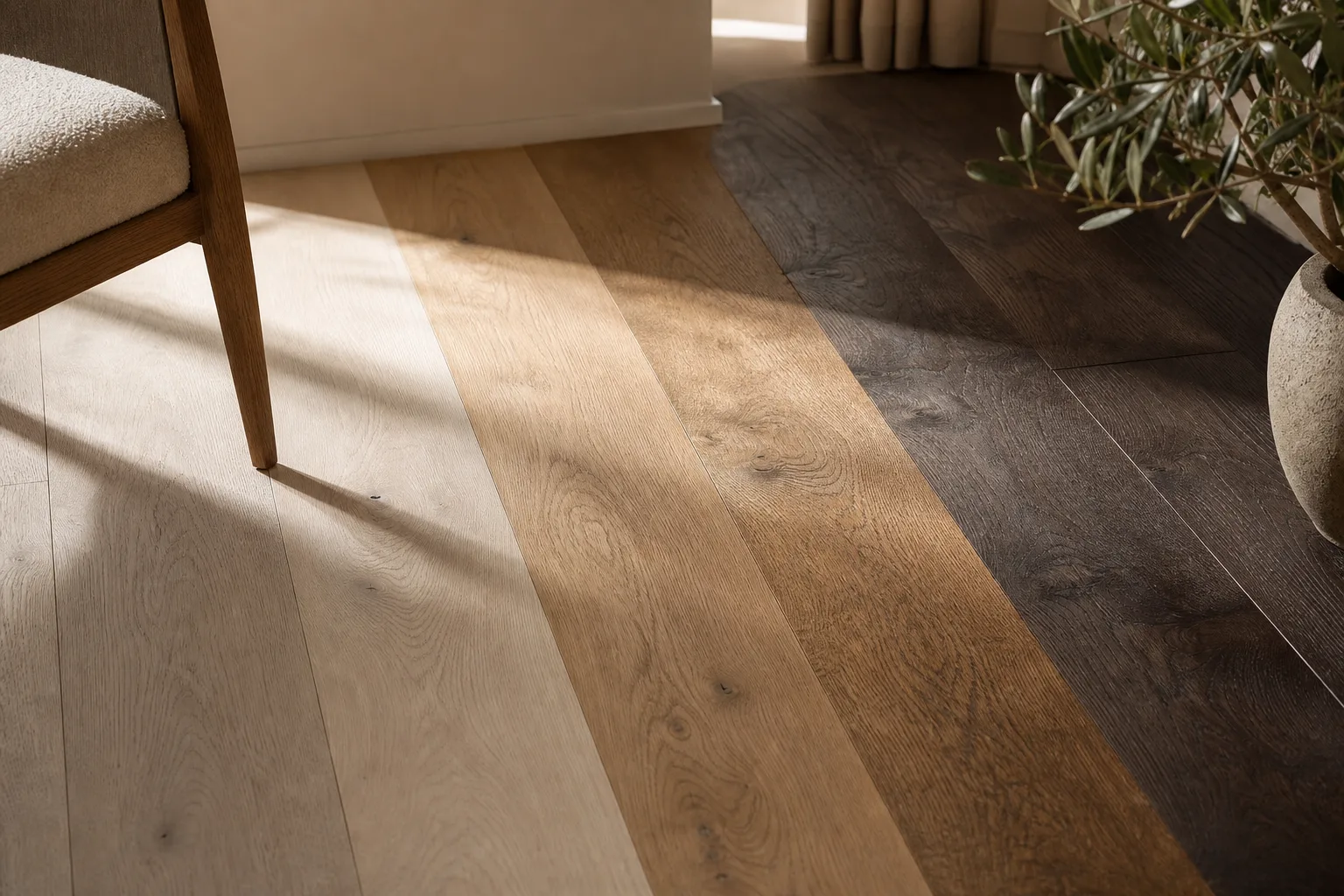
We have summarised which tone most often suits which space and style. Treat these as guidelines rather than rules — the final word always belongs to your own taste.
| Shade | Suits these interiors | Room / space |
|---|---|---|
| Light, natural | Scandinavian, modern, light classic | Small and dark rooms, hallways, bedrooms |
| Medium tone (honey, walnut) | Classic, traditional, rustic | Living room, dining room — universal |
| Dark (chocolate, almost black) | Luxurious, elegant, high-contrast | Large bright living rooms, bedrooms |
| White, bleached | Minimalist, Nordic, coastal | Spacious rooms where maximum brightness matters |
| Greyish, smoked | Industrial, contemporary, loft | Open-plan spaces, offices, kitchen-living areas |
Collections worth a look
We supply all our engineered oak flooring directly from factories in Germany, Austria and Italy, with warranties of up to 15 years and FSC and PEFC certification. Here are a few shade examples from our range:
- A light tone — take a look at Oak Vienna: a subtle, light board that opens up a space and suits almost any interior.
- A darker, richer tone — Oak Milano lends a living room maturity and a sense of luxury, and pairs beautifully with light walls.
- A warm, characterful tone — Oak Bergen is for those after a cosy, lively grain with visible character.
If you would like to grasp the colour logic of the whole range before you choose, it is also worth reading our general guide on how to choose flooring — it compares materials and formats, not just shades.
A practical selection plan
To avoid getting lost among dozens of options, a simple sequence serves well:
- Establish whether the room receives warm (southern) or cool (northern) light.
- Decide whether you want to visually enlarge the space (light) or create cosiness (dark).
- Shortlist 2–3 shades from the right group and order your free samples.
- Check them in your own lighting, morning and evening, next to your furniture.
- If you are torn, book a video consultation — we will go through photos of your space together and advise. Our team has been in the flooring trade since 2014.
We deliver across the EU within 5–10 working days for a flat 129.95 € — free on orders from 2 000 € — so your samples and your boards alike arrive comfortably at your door.
FAQ
Which oak flooring colour is the most popular?+
Light and natural oak shades are the most popular — pale sand, straw and honey tones. They reflect light, open a space up and work with most interior styles, while scratches and dust are barely visible on them.
Does dark flooring visually shrink a room?+
Yes. Dark floors absorb light and ground the space, so a small room can feel oppressive. In a large, bright room the opposite is true — dark flooring creates a luxurious, intimate feel. Dust also shows more readily on a dark surface.
Why does the same floor look different in a room and in a photo?+
Wood reads differently depending on the lighting. A north-facing room casts cool, bluish light; a south-facing one warm, golden light. The temperature of artificial lighting changes the tone as well. That is why a colour should be judged in your own space, not on a screen or in a shop.
Do oiled and lacquered floors look the same colour?+
No. Oil soaks into the wood and gives a more natural, matt, richer tone with a texture you can feel. Lacquer forms a layer on the surface and can slightly heighten the colour. The same oak with a different finish will look different.
How do I order samples to check the colour at home?+
You can order up to 3 free samples delivered to your home. Place them by the window and in a darker corner of the room, and look at them in the morning and in the evening — you will see the true shade in your own lighting and next to your own furniture before you decide.