Guide · 9 min
Oak parquet grades: how Select, Natur and Rustic differ
1 September 2026
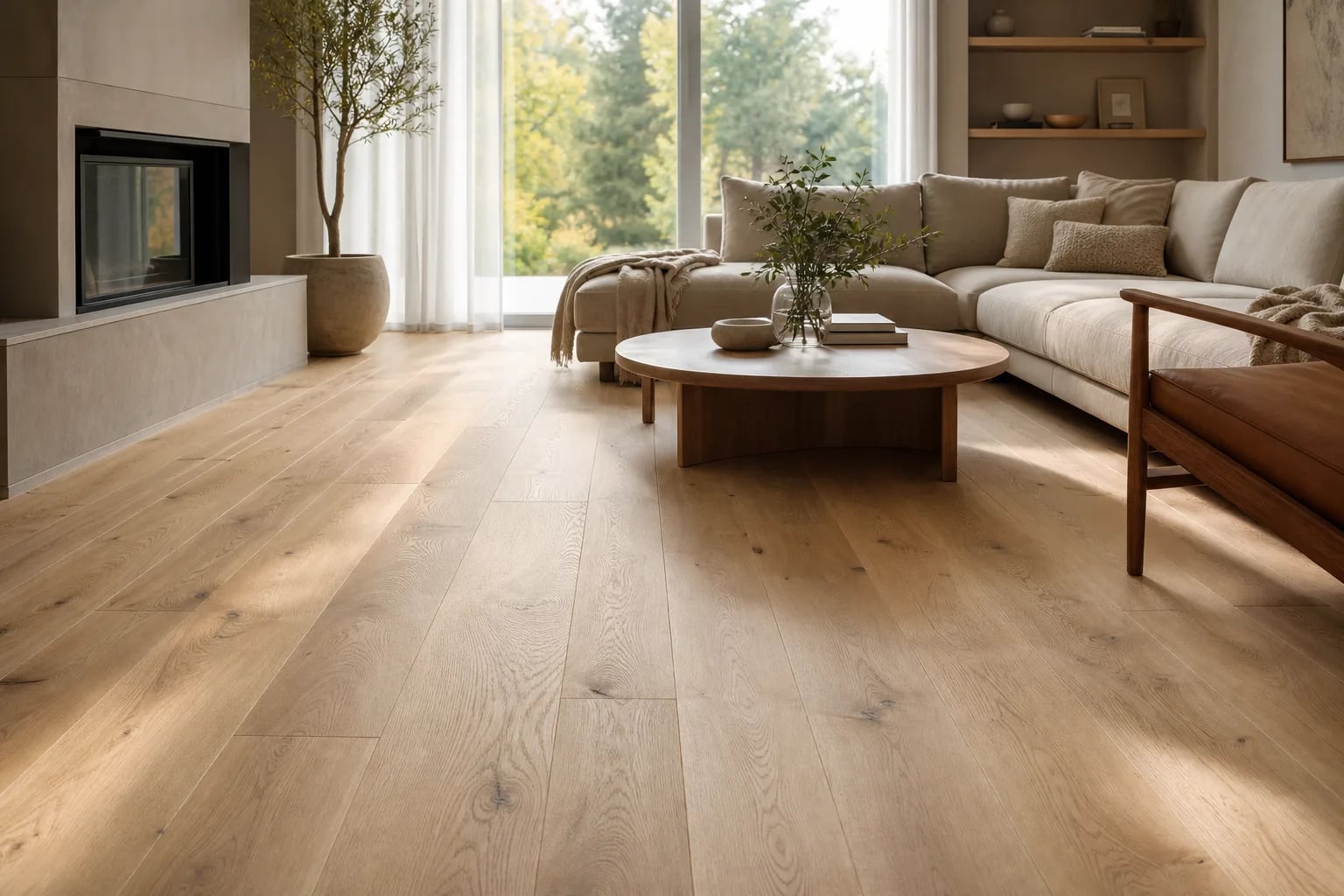
Open an oak flooring catalogue for the first time and you soon notice a word sitting beside the colour name — Select, Natur, Rustic, or a letter such as 'grade E'. Many buyers read these as quality tiers, rather like classes A, B and C. It is the most common misunderstanding in flooring. In truth, parquet grades describe the look of the timber rather than its quality — how many knots a board carries, how much sapwood and colour variation it shows, and how strongly the grain reads. Every grade is cut from the same sound European oak and every grade is equally durable.
What grading actually is
Once the timber has been cut, every oak lamella is sorted at the mill (the trade still uses the German word Sortierung) against strict visual criteria. Graders look at how many live and dead knots a board carries and how large they are, whether sapwood — the paler outer layer of the tree — is present, how far the colour of neighbouring boards diverges, and how pronounced the figure is. Those characteristics decide which grading class a board ends up in.
It is worth being clear about what grading does not touch: a Rustic board is exactly the same thickness, has exactly the same construction and serves exactly as long as a Select one. How a modern engineered board is built up, layer by layer, is set out in our guide to parquet construction. Knots in Rustic boards are not defects either — they are filled with a hard filler or left open as a natural accent, and neither weakens the board.
The three main parquet grades
Select (Prime) — calm and uniform
Select, sometimes sold as Prime, Natur Select or 'grade A', is the cleanest, most even look. Knots are absent or very small, there is no sapwood, and the colour difference between neighbouring boards is minimal. The result is a quiet, almost single-tone floor with a subtle figure. It opens a room up visually and suits modern, minimalist interiors where the floor should be a calm backdrop rather than the main event. Because only a small share of each log yields boards this clean, Select is normally the dearest grade.
Natur — the balanced middle
Natur (also written 'grade B', or Natur grade) is the most popular and the best-balanced choice. The boards show medium-sized sound knots, a natural variation in colour from board to board and a lively figure, but without strong contrasts. This is timber that reads as real wood — alive, yet never dramatic. Natur belongs in almost any interior, from Scandinavian to classical, from living room to bedroom, and for most homes it is the best compromise between character and cost.
Rustic — characterful and alive
Rustic (also written 'grade E', from Extra rustic, or sold as Markant) is the grade with the most character. The boards are full of knots, including larger and darker ones, colour varies strongly, streaks of sapwood run across the surface and the figure of the wood is unmistakable. A floor like this tells the story of the tree and creates a warm, lived-in, country or industrial-loft feeling. Rustic sits beautifully in log houses, converted farmhouses, attic conversions and wabi-sabi interiors. Because more of the timber's natural markings are kept rather than cut away, Rustic is usually the most economical option — a great deal of character for less money.
Parquet grades compared
The table gathers the main differences between the three grades in one place. Bear in mind that no grade is 'better' than another — they are simply made for different interiors and different tastes.
| Grade | Knots | Colour variation | Style | Price |
|---|---|---|---|---|
| Select / Prime | Almost none, very small | Minimal, uniform | Modern, minimalist, luxurious | Highest |
| Natur | Medium-sized, sound | Natural, moderate | Versatile — at home almost anywhere | Mid-range |
| Rustic / E | Bold, plentiful, varied in size | Strong, contrasting | Country, loft, farmhouse, wabi-sabi | Most economical |
How the grade changes a room
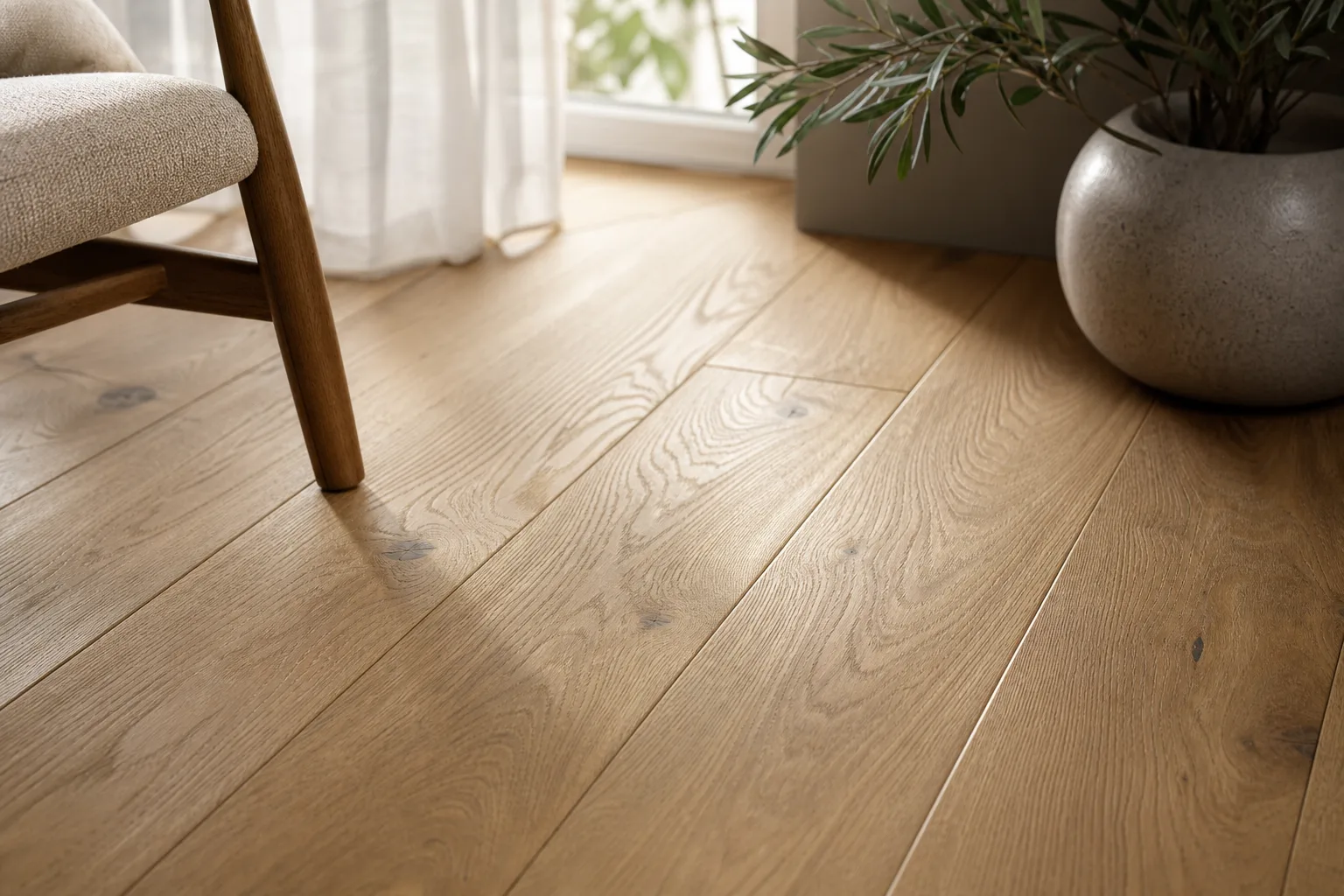
Grade shifts the character of a room more than most people expect. A Select floor reads as calm and continuous — it stretches the space visually and is the right call when the furniture or the architecture should hold the attention rather than the floor. A Rustic floor does the opposite: it becomes the feature itself, adding warmth and depth, though in a small room it can begin to feel busy.
Grade is also bound up with colour. On darker, oiled boards the knots and contrasts read more strongly; on pale and white-oiled boards they soften. How the finish shifts the tone is explained in our guide to oak flooring colours. For the wider picture — grading, finishes, laying patterns and prices in one place — see our complete engineered oak guide.
Which grade is right for you
A few questions make the decision straightforward. If you like clean lines and minimalism and want the floor to work as a neutral canvas, choose Select. If you want the feel of natural wood without the drama — the safe answer that fits almost anywhere — Natur will serve you best. If you love character, a visible history in the timber and the strongest ratio of looks to price, Rustic gives you the most for your money.
You can see all three grades for real in our oak collection. For a calm, uniform look, Oak Vienna is a fine example; for more natural character and a warmer tone, look at Oak Milano. The full range sits in the engineered oak category.
For specifiers we have prepared a separate piece covering specifications, grading and supply — parquet for architects and interior designers.
Why it pays to order samples
Even the best photograph cannot convey how the timber will look in your light and beside your furniture. Colour variation and the prominence of the knots depend heavily on daylight, wall tones and the colour temperature of your bulbs. So before committing to a full delivery, we recommend ordering 3 free samples delivered to your home — you can then compare the grades in the flesh, against your own skirting and doors, without any hurry.
There is a practical side as well: every grade is suitable for underfloor heating, and our flooring calculator — or our article on how to work out how much parquet you need — will get the quantity right. We ship on pallets across the EU; the cost and the delivery time are shown at checkout or quoted on request. Our engineered oak carries a 15-year warranty.
Frequently asked questions
Does the parquet grade tell you anything about quality?+
No. The grade (Select, Natur, Rustic) describes how the timber looks — the number of knots, the colour variation and the figure — not how good it is. Every grade is made from the same sound European oak, in the same thickness and the same construction, and every grade lasts equally long. A Rustic board is not one bit less durable than a Select one.
What does grade E mean?+
Grade E marks the Rustic sorting (E for Extra rustic). It is the most characterful grade — plentiful, bold knots, strong colour variation and a clearly readable figure. It gives a lively, country or loft feel and is usually the most economical choice.
Which grade is the most popular and the safest to choose?+
Natur is the most popular and the most versatile. It shows medium-sized sound knots and moderate natural colour variation, so the wood looks alive without turning dramatic. Natur suits almost any interior and strikes a good balance between character and price.
How does grade affect the price?+
Select is usually the dearest, because it takes the cleanest, most uniform, knot-free timber. Natur sits in the middle, and Rustic is the most economical, since it uses timber with its natural knots and sapwood left in. Terris Timber engineered oak boards start at 37,95 €/m² incl. VAT.
How can I be sure which grade suits me?+
The reliable test is to see the timber in your own light. Order 3 free samples and compare the grades against your furniture, your walls and your daylight. You can also book a free video consultation, in which we help you settle on the grade that fits your interior.