Guide · 10 min
SPC vinyl or laminate: which floor should you choose?
1 September 2026
In short: if water resistance matters — kitchen, entrance hall, or a floor over underfloor heating — choose SPC vinyl (from €25.95/m², warranty up to 15 years). Laminate is the cheaper option in dry bedrooms: across European markets budget boards sell for roughly €8–15/m² and a good AC5 board for roughly €15–30/m² (indicative figures that vary by country; we do not sell laminate) — but it swells on contact with water and has a shorter life.
Vinyl or laminate is one of the questions we are asked most often when someone is choosing a floor for a flat or a house. At a glance the two are hard to tell apart: both carry a wood or stone décor, both press together with a click joint, both sit happily on a concrete subfloor. Underneath the décor, though, they are built in completely different ways, and that construction decides where each one survives and where it fails early.
This article compares modern SPC (Stone Polymer Composite) vinyl flooring with classic HDF-core laminate. We work through every criterion that matters, set the two side by side in a full comparison table, and say plainly which floor wins in which room. If you want the whole picture on vinyl, from construction to day-to-day care, start with our complete guide to vinyl flooring.
The real difference is in the core
The heart of a laminate board is an HDF panel — high-density wood fibre, essentially compressed wood dust. That makes laminate a wood product: strong, but vulnerable to water. Leave moisture on it long enough and it wicks into the edges, the panel swells, the joints lift, and no amount of repair work brings the board back.
SPC vinyl contains no wood at all. Its core is a composite of stone powder (calcium carbonate) and polymer. That core absorbs nothing, expands with nothing and stays dimensionally stable even when a spill sits unnoticed until the evening. Above it sits a protective wear layer that shields the décor from scratches and abrasion.
- Laminate — HDF wood-fibre board + decorative paper + protective melamine. Sensitive to moisture.
- SPC vinyl — stone-polymer core + vinyl décor + wear layer. Indifferent to water.
Water resistance — the criterion that decides it
Here the comparison ends quickly. SPC vinyl is a fully waterproof floor: spilled tea, a mop bucket and steam are all non-events. That puts it in rooms where laminate has no business being — beside the kitchen sink, in an entrance hall that collects wet boots, even in a bathroom.
Laminate tolerates moisture only within limits. Water-resistant grades with impregnated edges exist, but they survive brief contact — a drop wiped up straight away, not standing water. In a damp room, laminate is a risky investment. If you are choosing for one specific room, our room-by-room flooring guides cover kitchens, bathrooms and other wet zones in detail.
And if you are weighing up the vinyl types themselves rather than vinyl against laminate, our explainer on SPC versus LVT sets out where the rigid and flexible constructions differ.
Durability and the wear layer
Durability comes down to the usage class (AC for laminate, usage class for vinyl) and the thickness of the wear layer. For domestic rooms look for laminate of at least class 32; for heavy traffic — children, pets, an entrance hall — class 33. The wear layer on SPC vinyl is measured in fractions of a millimetre: 0.3 mm for domestic use, 0.55 mm and above for heavy domestic or commercial use.
In practice SPC vinyl copes better with point loads and dents, because a stone core is harder than HDF and heavy furniture leaves shallower marks. Laminate's HDF is more easily chipped along the edges, and once the panel is broken, water has a way in.
Underfloor heating
Both floors work over underfloor heating, but SPC vinyl has the advantage: a thin profile and a mineral core conduct heat well, and the board is thermally stable. Laminate is also suitable, provided you respect the manufacturer's maximum surface temperature (usually up to 27 °C) and use an appropriate underlay so the joints do not work loose. Our guide to floors over underfloor heating compares every floor type on this point.
Sound and comfort underfoot
Laminate is the noisier floor to walk on: the HDF panel resonates, so footsteps carry, especially in a large room. SPC vinyl is quieter, particularly in versions with an integrated IXPE acoustic backing. Underfoot, vinyl feels slightly warmer and softer; laminate feels harder and more distinctly wooden.
Installation
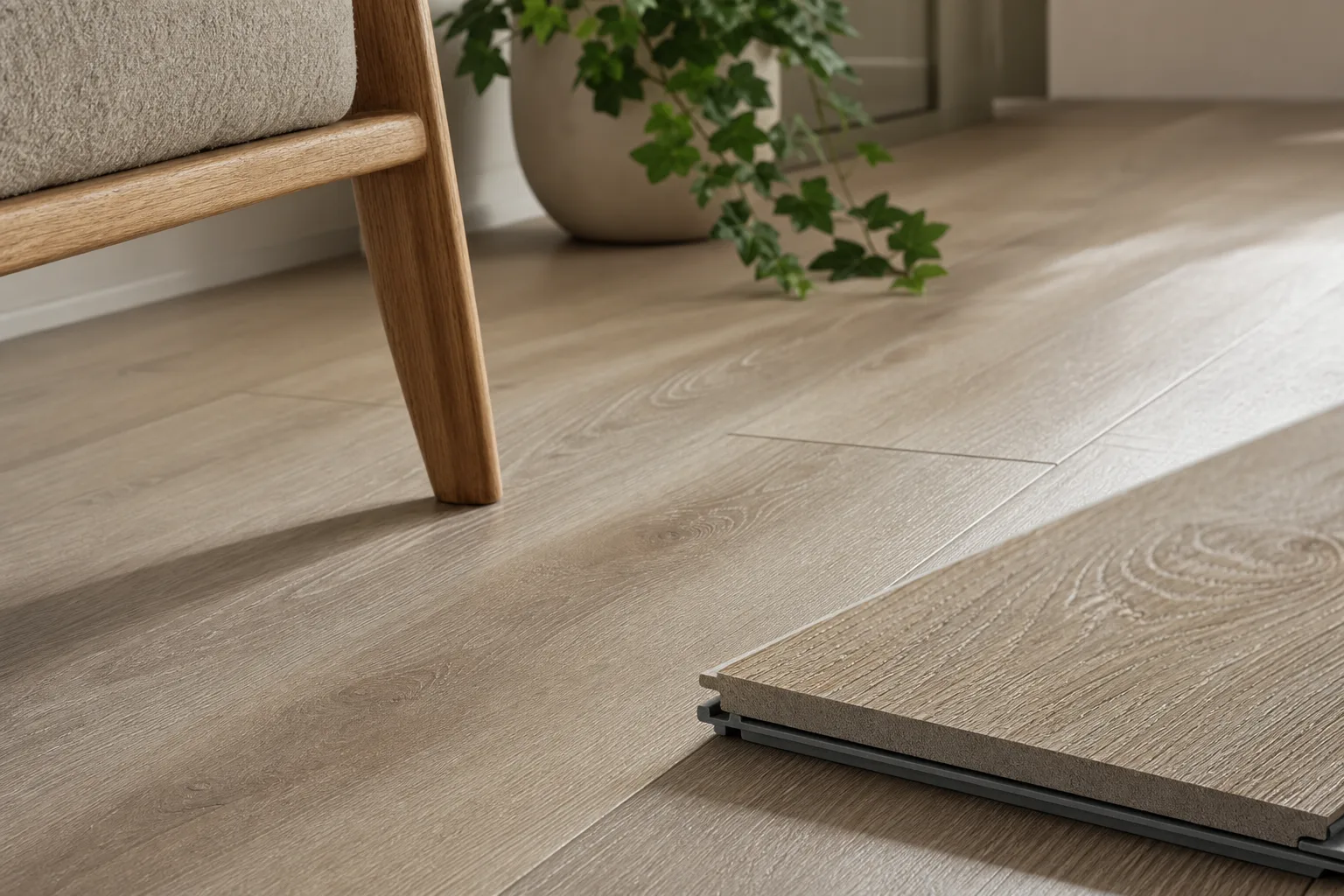
The good news: the two are laid almost identically — dry, click-together, no adhesive, with expansion gaps left at the walls. Installation is quick and well within reach of a competent DIY fitter. Both floors depend critically on a properly prepared subfloor that is flat and dry; unevenness produces creaking and damaged joints. Our installation guide sets out the principles, and if you would rather hand the job to a professional, a local fitter is the right route — get in touch through our contact page if you need help specifying the work.
SPC or laminate — the short answer
If you are comparing SPC against laminate, the decision almost always comes down to water. SPC vinyl has a mineral core of stone powder and PVC that absorbs nothing: soak it and it will not swell or blister. Laminate's core is HDF, which is compressed wood — even an aqua-grade board survives only brief contact, and water standing along the joints causes irreversible swelling.
So, briefly: for kitchens, entrance halls, bathroom zones and homes with pets, choose SPC. Laminate remains the cheaper alternative in dry rooms — a bedroom or a study where the risk of water is minimal. The second difference is renovation: neither floor can be sanded, so what really matters is the thickness of the wear layer rather than the price on the shelf. Our explainer on vinyl wear layers shows how to read those figures.
The full comparison table
| Criterion | SPC vinyl | Laminate |
|---|---|---|
| Core material | Stone-polymer composite | HDF wood-fibre board |
| Water resistance | 100 % — does not swell | Limited — swells with moisture |
| Suitable for kitchens / wet zones | Yes | Not recommended |
| Resistance to denting | Very good — rigid core | Good, but edges are vulnerable |
| Underfloor heating | Very well suited | Suitable, with conditions |
| Sound underfoot | Quieter (with IXPE backing) | Louder, hollow and wooden |
| Installation | Click, no adhesive | Click, no adhesive |
| Price (from) | From €25.95/m² (click SPC) | ~€8–15/m² budget, ~€15–30/m² AC5 (indicative) |
| Warranty | Up to 15 years | Usually shorter |
| Service life in damp rooms | Long | Short / risky |
Price — is laminate really cheaper?
The shelf price of entry-level laminate genuinely is lower. Across European markets budget laminate typically sells for around €8–15/m², and quality AC5 laminate for around €15–30/m². Those are indicative figures that move with the country, the retailer and the season, and we do not sell laminate ourselves, so we quote them purely for comparison. In our own catalogue, vinyl flooring runs €16.95–33.95/m²: glue-down LVT from €16.95/m², click SPC from €25.95/m².
| Floor | Price €/m² | Note |
|---|---|---|
| Budget laminate | ~€8–15 | Indicative market price (we do not sell it) |
| Quality AC5 laminate | ~€15–30 | Indicative market price (we do not sell it) |
| Glue-down LVT vinyl | From €16.95 | Terris catalogue |
| Click SPC vinyl | From €25.95 | Catalogue, cheapest first |
The second half of the budget is labour. Fitting click vinyl costs something in the order of €6–12/m² depending on the country and the fitter, and because laminate goes down by the same dry method, the labour lines for the two floors barely differ. Our cost breakdowns split a vinyl budget into floor, underlay and labour, and cover the whole job from subfloor preparation to skirting.
It pays, though, to count the whole life cycle. If laminate has to be replaced early — moisture damage, or simply wear — the total outlay overtakes SPC vinyl, which lasts longer and is not troubled by water. SPC vinyl from €25.95/m² is already competitive, and a warranty of up to 15 years shows how much confidence the manufacturer has in the board.
The easiest way to pin down area and budget is our quantity calculator: it works out how many packs your room needs, cutting allowance included.
Where each floor wins
- Choose SPC vinyl if you want a waterproof, hard-wearing, quieter floor for a kitchen, an entrance hall, a damp zone, a floor over underfloor heating, or a home with children and pets. The SPC Havana collection is a good place to start.
- Laminate can work if the budget is genuinely tight, the room is dry (bedroom, study) and you do not expect much contact with water.
If natural wood is still in the running, our comparison of engineered parquet against vinyl is worth reading alongside this one, and the parquet catalogue shows what that budget buys.
Check it by hand — free samples
The best decision is made with both floors in your own light, next to your furniture and your wall colour. Order up to 3 free samples — we deliver them across the EU. For a personal recommendation, write to us or arrange a video call through the contact page.
Frequently asked questions
Which is better, vinyl or laminate?+
For most rooms SPC vinyl is the better buy: it is 100 % waterproof, harder underfoot, quieter and carries a long warranty (up to 15 years). Laminate can be a cheaper entry point in dry rooms, but it swells once moisture reaches the core and usually has a shorter service life.
Is SPC vinyl really unaffected by water?+
Yes. The SPC core is made of stone powder and polymer, so it absorbs no water and does not swell. A spill causes no damage, which is why SPC vinyl works in kitchens, entrance halls and damp rooms where laminate would fail.
Can laminate be laid over underfloor heating?+
Laminate works over underfloor heating provided you respect the manufacturer's maximum surface temperature (usually up to 27 °C) and use a suitable underlay. SPC vinyl conducts heat better still, because the profile is thinner and the board is more thermally stable.
Which floor is easier to fit yourself?+
Both are laid the same way: dry, click together, no adhesive. What matters most is a flat, dry subfloor. SPC vinyl is often a little more forgiving of small irregularities thanks to its rigid core, so beginners tend to find it easier.
How much does laminate cost?+
Indicative European market prices: budget laminate runs roughly €8–15/m² and a good AC5 board roughly €15–30/m². Rates differ from country to country and from retailer to retailer. We do not sell laminate, so these figures are for comparison only. Our vinyl flooring runs €16.95–33.95/m², with click SPC from €25.95/m².
How much does SPC vinyl cost at Terris Timber?+
SPC vinyl starts at €25.95/m². We ship on pallets across the EU, with delivery cost and lead time shown at checkout or quoted on request, and we send up to 3 free samples. The minimum floor order is 20 m²; the quantity calculator works out exactly how much you need for your room.