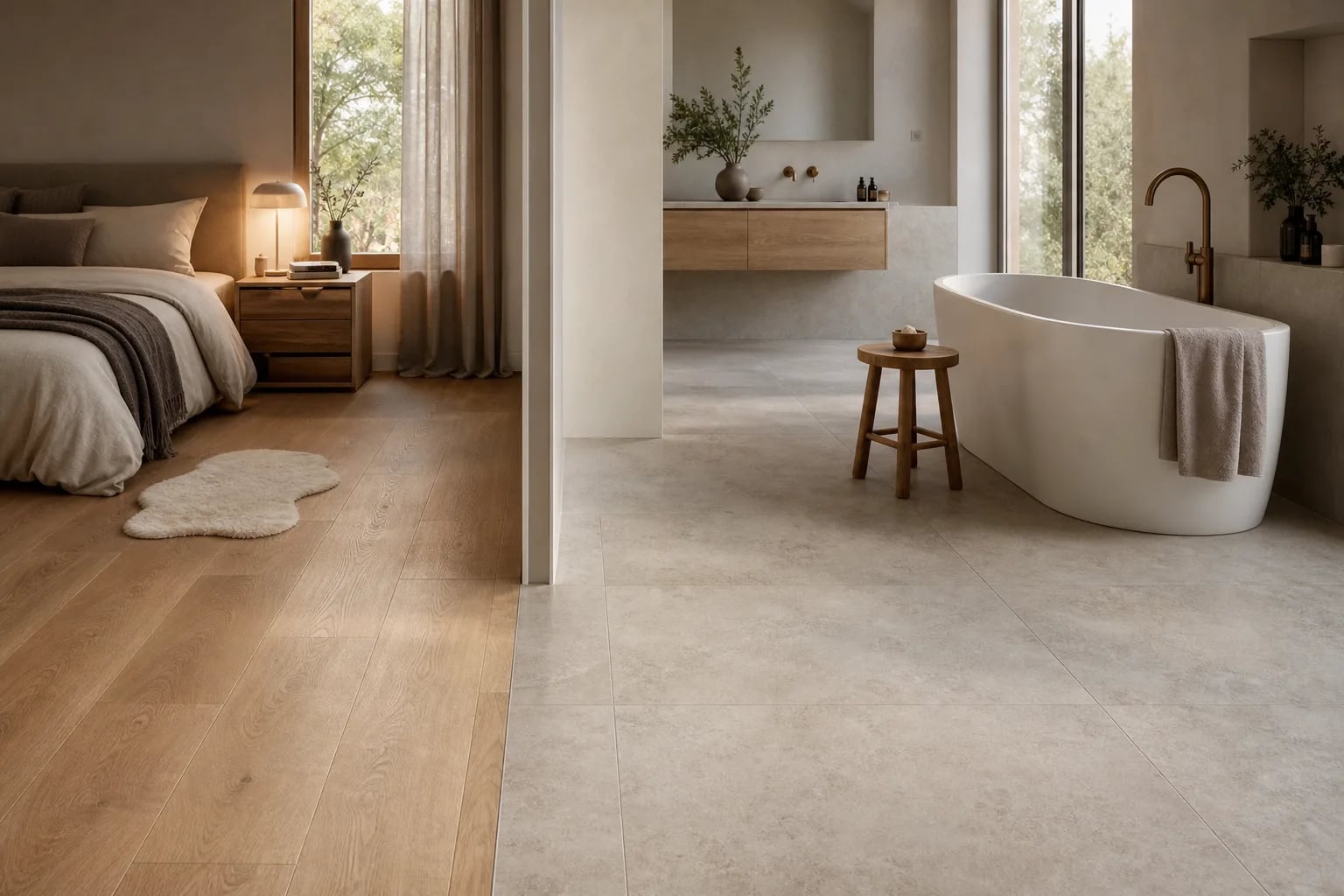
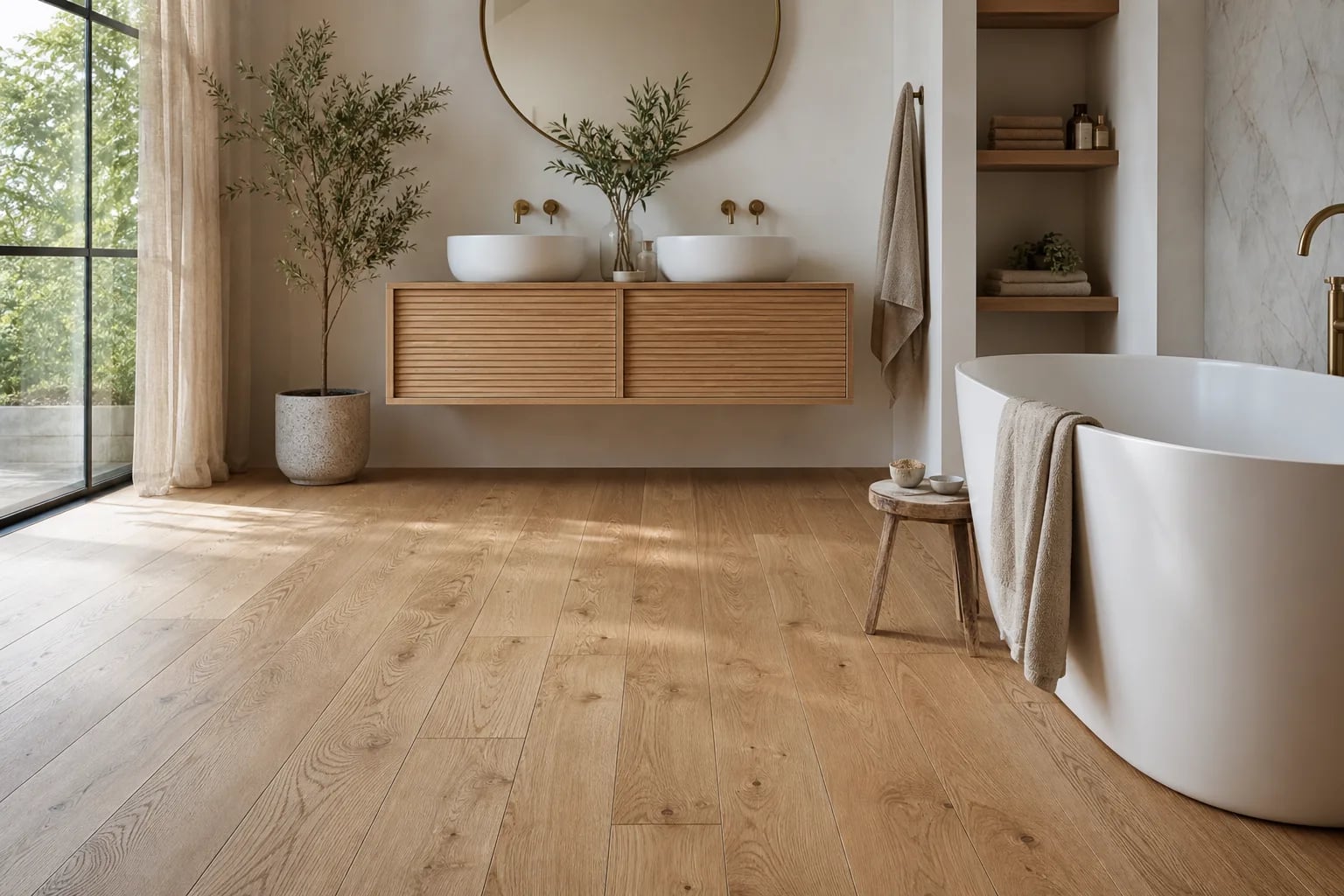
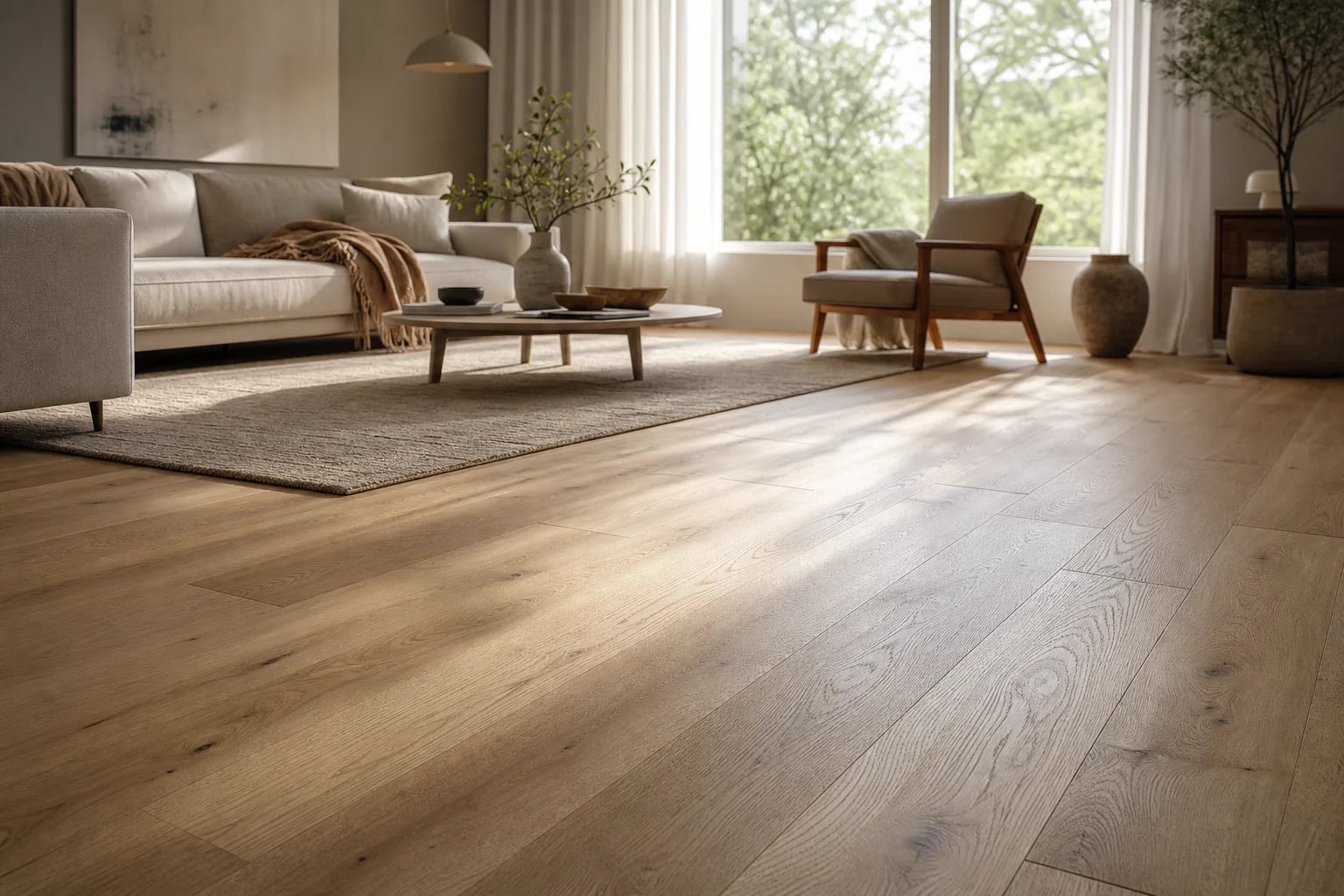
Guide · 9 min
Wide plank oak parquet: does the XL format suit your home?
1 September 2026
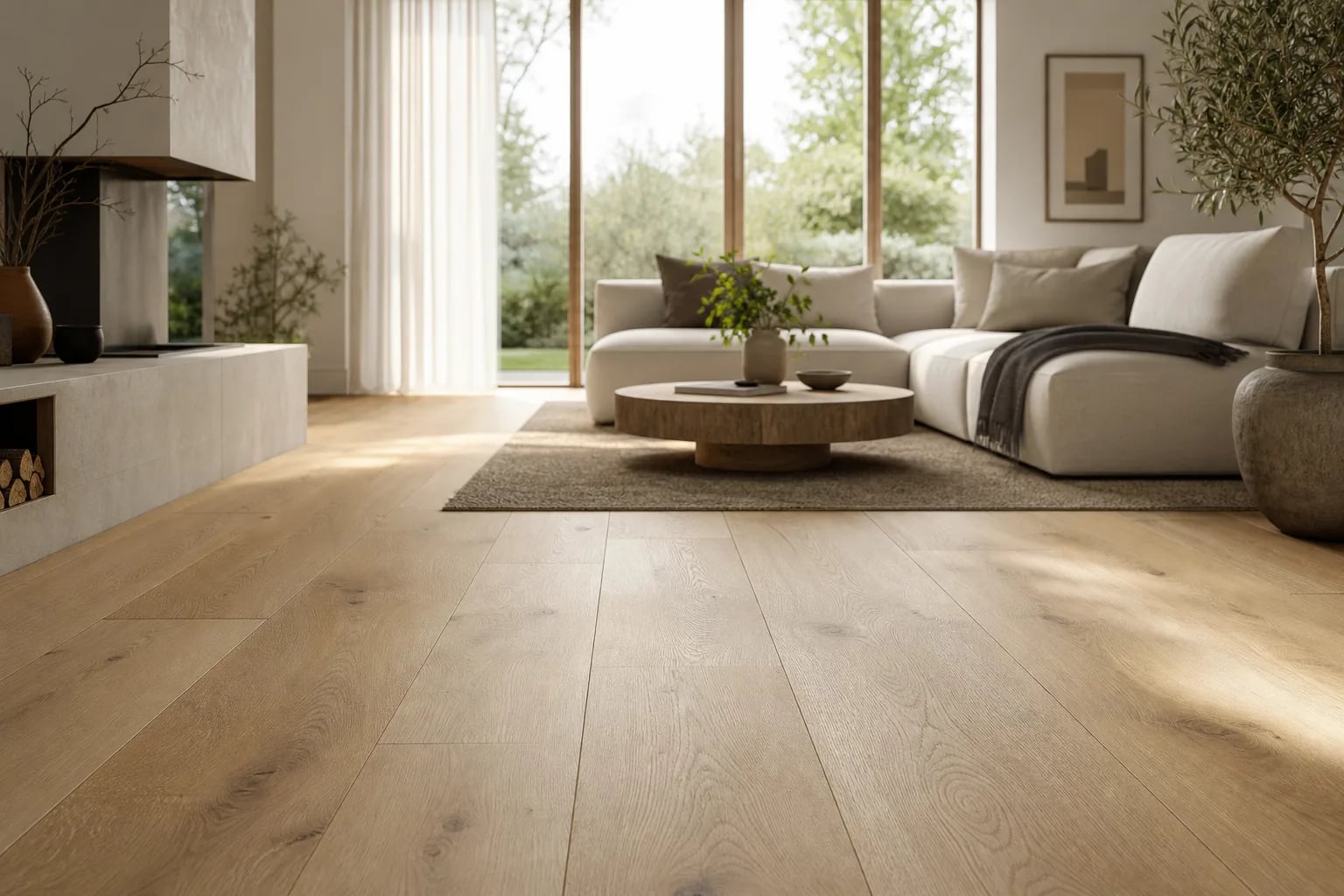
Over the past decade the parquet world has taken a quiet but very visible turn: boards have grown thicker and, above all, wider. Twenty years ago a 140 mm strip counted as a substantial board; today the interiors press is full of 260, 300 and even 400 mm planks. This is more than a passing fashion — a wide format genuinely changes how a room reads. As with any design decision, though, it pays to understand when the width works in your favour and when it simply overwhelms the space.
What counts as a wide plank?
There is no official cut-off, but the market has settled on a fairly consistent scale. Narrow strips of up to roughly 140 mm recall classic, traditional parquet — the kind you still find in period apartments and restored interiors. The medium or standard width sits at around 180–195 mm, by far the most common format today and a safe choice for almost any room. Anything past 240 mm is confidently described as wide, or XL.
In our range the wide plank category is represented by 400 mm collections such as Oak Vienna and Oak Innsbruck. A board of that width is more than twice the size of a conventional plank, so each one carries a far larger section of the timber pattern, complete with heartwood, growth rings and natural shifts in colour.
| Width | Visual effect | Best suited to |
|---|---|---|
| Up to ~140 mm (narrow) | Classic, many joints, a fine-grained pattern with a lively rhythm | Traditional interiors, herringbone, period apartments |
| 180–195 mm (standard) | Versatile, calm, neutral | Almost any room — the safe choice |
| 260–300 mm (wide) | Modern, spacious, fewer joints | Living rooms, open-plan spaces, new-build homes |
| 350–400 mm (XL) | Seamless, luxurious, gallery-like | Large, bright rooms, premium interiors |
Why a wide format looks different
The main advantage of a wide board is simple: fewer joints. The wider the plank, the less often the seam lines repeat across the floor, so the eye reads the surface as one continuous plane rather than a series of strips. The room feels calmer and visually larger, because there is no constant striped rhythm breaking the picture up. That is precisely why designers reach for the XL format in minimalist and Scandinavian interiors.
The second point is the character of the wood itself. A wider board holds a larger fragment of the pattern, so the growth rings, heartwood and natural colour variation of the oak come through at full strength. Choose a livelier grade with knots and contrast and a wide board becomes something close to a piece of art. We look at how the Select, Natur and Rustic grades differ in our guide to parquet grading — that choice directly determines how much visual noise you will see across a wide surface.
Finally there is the sense of quality. A wide board is instinctively associated with better timber, and with good reason: the format demands a larger, more uniform log to begin with. That is the main reason XL parquet usually sits in a higher price bracket.
Where wide plank flooring works
A stubborn myth says that wide boards only suit large houses. The truth is more nuanced. Yes, the XL format is at its best in spacious, well-lit rooms, where an unbroken surface emphasises the floor area and delivers that gallery-like, premium impression. An open-plan living room and kitchen, with the floor running through without partitions, could have been designed for a wide plank.
But a wide format can also earn its place in a smaller room, on one condition: choose a light shade. A pale, continuous surface visually widens the space, and fewer joints mean less fragmentation, so the room reads as calmer and larger than it would with densely laid narrow strips. The mistake is putting a dark, heavy XL board into a small room, where the floor can end up closing the space in. If you are weighing up tones, our guide to oak parquet colours is a good starting point.
Wide boards look particularly good in modern, minimalist interiors with clean lines. They are a weaker fit for classic, ornamented schemes and for herringbone, where a narrower strip suits the historic aesthetic far better. We cover the character of oak parquet and how to combine it in our overview of oak flooring.
Stability: why a wide board needs a three-layer construction
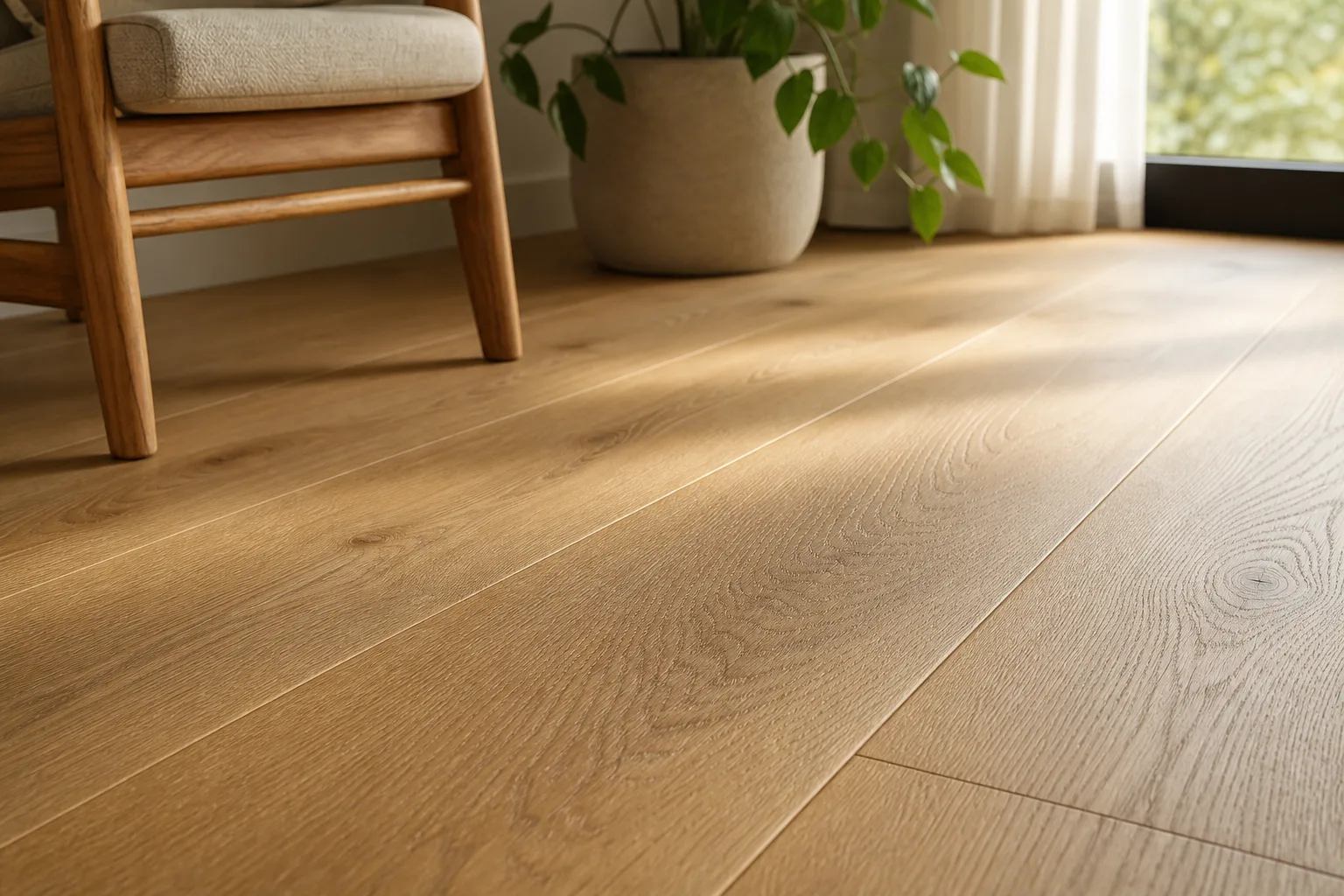
This is the technical heart of the wide format. The wider the board, the greater the stresses acting on it as humidity and temperature change — the wood works, expanding and contracting across its full width. A solid, single-layer wide board in those conditions would be inclined to cup or open up gaps. That is why every serious XL parquet is built in three layers.
A three-layer construction acts as cross-bracing. The oak wear layer on top provides the natural look and the durability, while beneath it the core layers, glued at right angles and usually made of pine or HDF, restrain the movement of the timber and hold the board straight. It is this build that makes 400 mm boards possible — boards that stay stable for decades and are suitable even for underfloor heating. If you want to understand what an engineered board is made of layer by layer, we take one apart in our article on parquet construction.
The practical conclusion is straightforward: when you buy a wide board, never take the cheapest option with an unspecified construction. Our XL collections, Vienna and Innsbruck, are three-layer boards supplied direct from German and Austrian mills, with a 15-year warranty.
The price question
A wider board is almost always dearer than a standard one, and logically so. The larger format calls for better, more uniform raw timber, more demanding production and stricter quality control, since defects cannot be hidden in a wide board. That is why XL parquet generally belongs to the premium segment.
Our engineered oak parquet starts at €37.95/m² incl. VAT, and the wide-format collections sit above that. It is worth taking the long view, though: three-layer oak lasts for decades, it can be renewed by sanding, and an uninterrupted surface does not date. Professional fitting, if you need it, is normally arranged with a local installer — rates differ considerably from one country to the next, so treat any figure per m² you read online as indicative rather than fixed. To work out exactly how many square metres you need, use our flooring calculator, and get in touch if you would like advice on what to specify.
We ship on pallets across the EU; the cost and the delivery time are shown at checkout or quoted on request. We have been supplying floors since 2014, so if you are hesitating over the format, you can always order three free samples and see how a wide oak board actually looks in your own light.
Frequently asked questions
What width counts as a wide plank?+
A standard board is around 180–195 mm wide. Anything above 240 mm is generally described as wide or XL. Our wide collections, Vienna and Innsbruck, are 400 mm — more than twice the width of an ordinary board.
Does wide plank flooring work in small rooms?+
Yes, provided you choose a light colour. A continuous light surface with fewer joints makes a small room look wider and calmer. Dark, heavy XL boards do the opposite and can make a small space feel closed in.
Why does a wide board need a three-layer construction?+
The wider the board, the more it moves as humidity changes. A three-layer build with cross-bonded core layers restrains that movement and keeps the board flat. That is why 400 mm boards are only ever made as three-layer parquet, and why they work over underfloor heating.
Is wide plank parquet more expensive than standard widths?+
Usually, yes. The XL format needs more uniform, higher-grade timber and stricter quality control, which puts it in the premium segment. Our engineered oak parquet starts at €37.95/m² incl. VAT, and the wide collections sit above that.
How do I make sure the wide format suits my interior?+
The only reliable test is to see a board in your own light. Order three free samples, lay them in the room you are flooring and look at them in daylight and in the evening — you will see the true colour, grain and width before you commit.