Comparison
Waterproof flooring: which covering should you choose?
1 September 2026
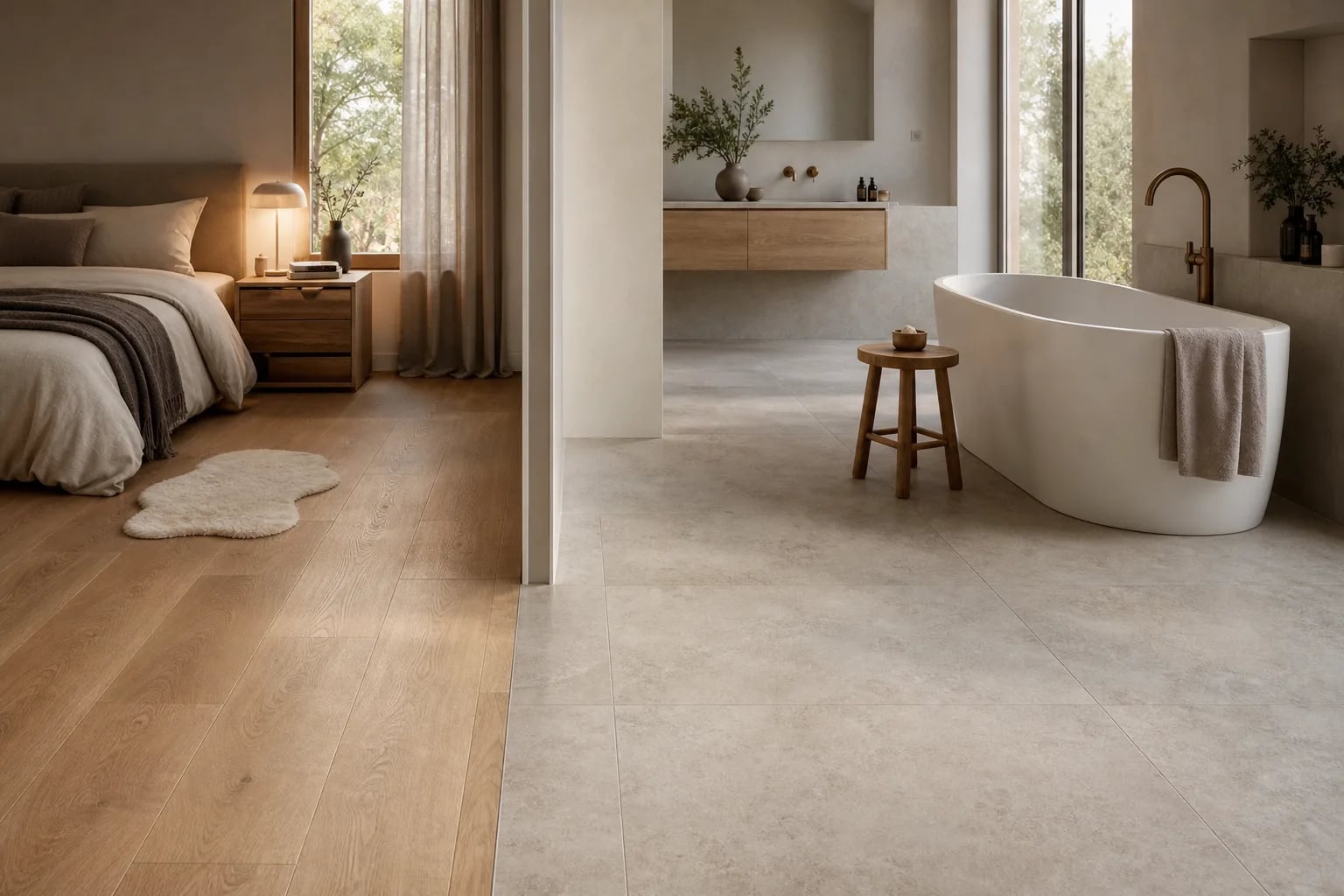
A glass of water knocked over in the kitchen, steam in the bathroom, snow melting off boots in the hall — moisture is the most common cause of floor failure in European homes. The good news is that a waterproof floor is no longer a compromise between practicality and looks. SPC vinyl imitates timber convincingly, porcelain tiles do the same for marble, and engineered oak parquet, given sensible care, is perfectly happy even in a kitchen. This guide compares every covering by how it handles water and shows which one belongs in which room.
Why water resistance is the first question to settle
Before you think about colour, pattern or plank width, answer one simple question: how much water will this room see day to day? Some coverings shrug off moisture for decades, others fail after their first serious flood — and the difference lies not in the surface but in the core the board or tile is built on.
It helps to sort rooms into three groups. Wet areas — bathroom, shower, utility room — take water directly and regularly, so the covering has to be fully waterproof. Damp areas — kitchen, hallway, entrance lobby — see moisture only now and then: a spilled cup, wet boots, steam from the hob. And dry living spaces, where the risk is minimal and the floor can be chosen on looks and feel underfoot alone. Each group calls for something different, so let us work through the options from the most resistant to the most sensitive.
What happens to laminate when it gets wet
Start with the covering you will not find on this list. Classic laminate is built on a pressed high-density fibreboard (HDF) core that soaks up water like a sponge. Moisture that finds its way through the joints makes the board swell: plank edges lift, the surface turns wavy, the locking joints no longer hold. Most importantly, the process is irreversible. Swollen laminate cannot be dried out or repaired — the damaged area has to be lifted and replaced. That is why we do not offer laminate for damp rooms at all: for much the same outlay you can have vinyl flooring, which simply is not troubled by water.
SPC vinyl — 100% waterproof
SPC (Stone Polymer Composite) vinyl flooring is the most practical answer to the moisture question. Its core is a rigid composite of stone powder and polymers that absorbs no water whatsoever: the floor can stand under water for a time and neither its dimensions nor its shape will change. We looked at whether SPC flooring is worth the money in a separate article — the short answer is that for damp areas it offers the best balance of price and practicality on the market.
It is worth knowing the difference between the two vinyl types. SPC has a rigid core and is laid floating with a click system (from 25,95 €/m²), and stays stable even where temperatures swing. Glue-down LVT is more flexible, a mere 2–2.5 mm thick and bonded over the full floor area, so water has no route beneath the covering at all (from 16,95 €/m²). Both types are 100% waterproof — what differs is the installation method, the thickness and the feel underfoot. There is a full comparison in SPC or LVT vinyl. The wear layer in both cases measures 0,5–0,55 mm, which is commercial-grade and suits even the busiest areas of a home.
Vinyl performs well in a bathroom provided the joints and the perimeter are detailed properly — we set out every point in our guide to vinyl flooring in a bathroom. The vinyl range holds both wood and stone decors, with prices from 16,95 €/m² incl. VAT.
Porcelain tiles — resistance without reservation
If SPC vinyl is waterproof to the letter, porcelain tiles add a further level: they are unmoved not only by water but by heat, household chemicals and impact from sharp objects. The tiles in our range are 9 mm thick with rectified edges and are made in Italy. Their water absorption is close to zero, so they take constant direct water in their stride — from the shower zone to the utility room.
One rule matters in wet areas: choose a matt surface, which is considerably less slippery when wet than a polished one. There is more on that in our article on non-slip tiles. The range currently runs to 16 matt and 36 polished models — all 9 mm, rectified and Italian — so there is enough choice for a bathroom and a living room alike. Porcelain tile prices start at 35,95 €/m² incl. VAT, and the marble-look collections at 39,95 €/m². For a full guide to the wettest room in the house, see which flooring suits a bathroom.
Engineered oak parquet — natural wood and moisture
Three-layer engineered oak parquet (14–15 mm thick, with a 3–4 mm oak wear layer) is the only natural covering on this list, so the rules here are different. Wood takes up moisture and gives it back, which makes it important to separate two things: swings in air humidity, which the cross-bonded three-layer construction handles very well, and direct water, which can leave a mark if it is left standing on the surface for any length of time.
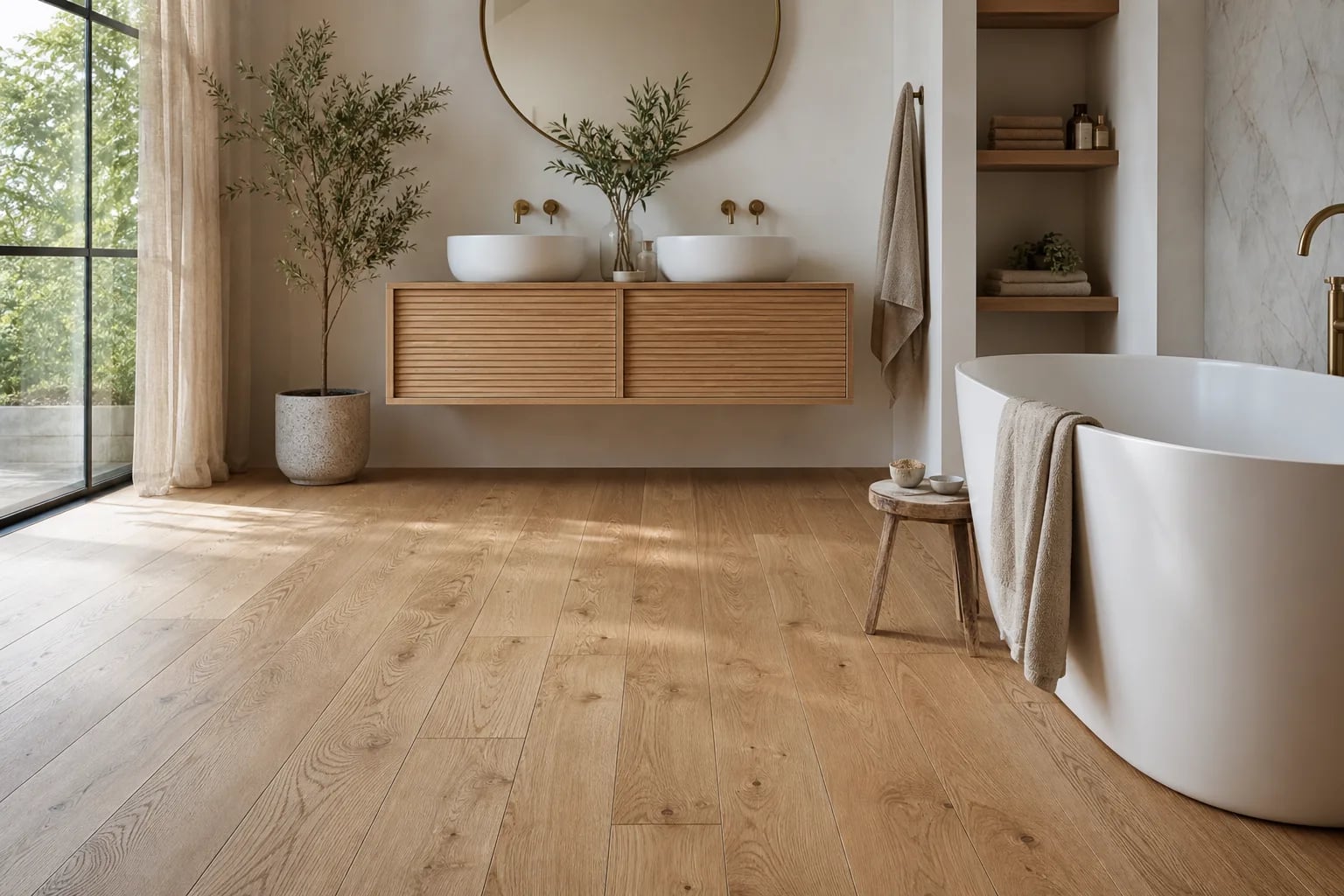
The practical conclusion is straightforward. In a kitchen, engineered oak parquet works: a spill wiped up within a few minutes does no damage, and a warm natural floor turns the kitchen into the most welcoming room in the house — we gathered the arguments on both sides in which flooring suits a kitchen. In bathrooms with direct water, though, we do not recommend parquet: constant contact with water and steam is too great a test for natural wood.
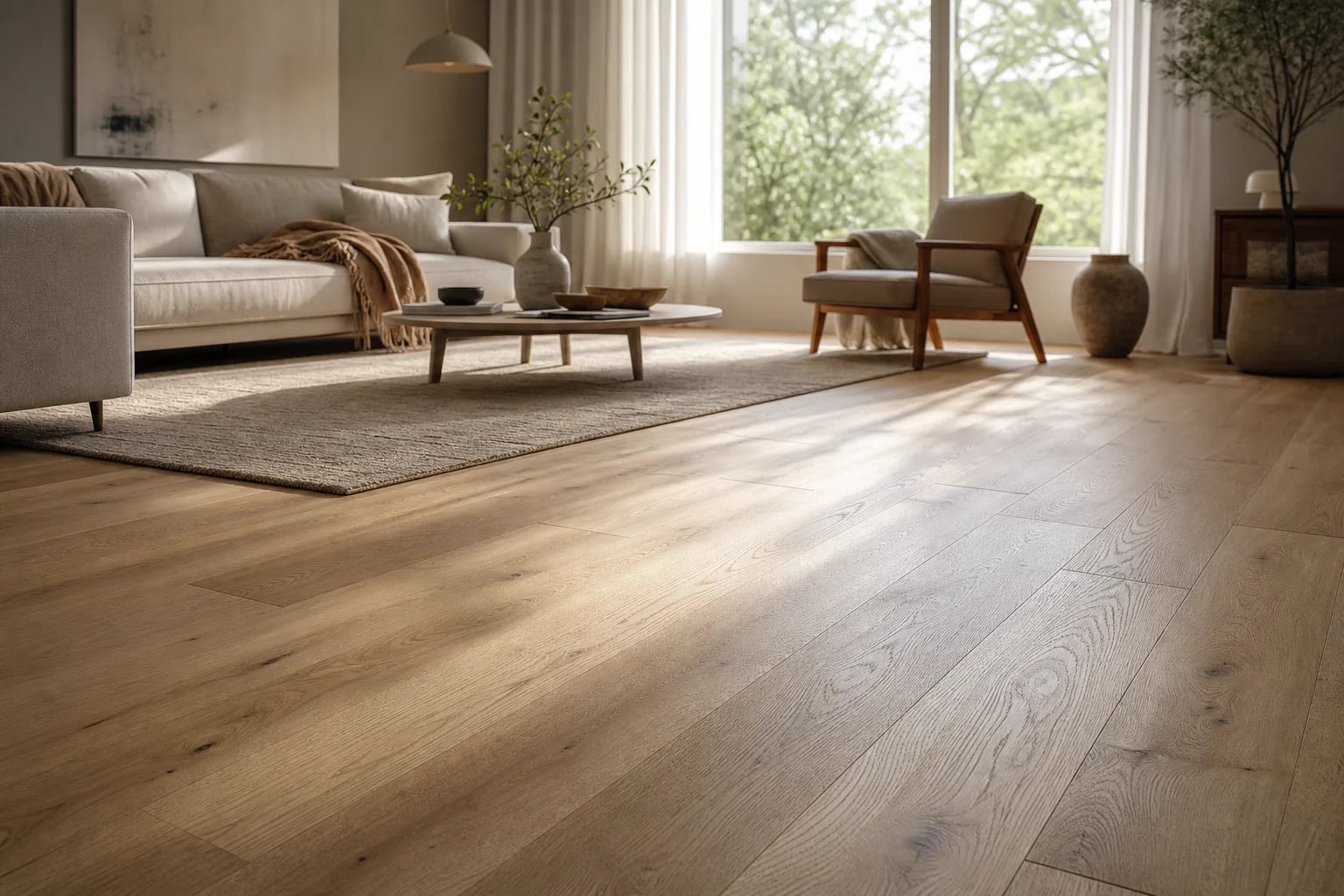
In damper rooms an oiled surface is the sensible choice: a local stain or a roughened patch can be dealt with in place — sand and re-oil the damaged spot alone, leaving the rest of the floor untouched. A lacquered floor does not allow that, as repair means re-coating the whole area. We compared the two finishes in oiled or lacquered parquet. Prices in the engineered oak parquet category start at 37,95 €/m² incl. VAT.
Which covering to choose for each room
| Room | Best choice | Alternative | What to avoid |
|---|---|---|---|
| Bathroom, shower | Porcelain tiles (matt) | Glue-down LVT vinyl | Laminate, engineered parquet |
| Kitchen | SPC vinyl or porcelain tiles | Engineered oak parquet (wiping up spills at once) | Laminate |
| Hallway, entrance lobby | Porcelain tiles | SPC vinyl | Laminate |
| Utility room | Porcelain tiles | Glue-down LVT vinyl | Laminate, engineered parquet |
| Living room, bedroom | Engineered oak parquet | SPC vinyl | — |
Vinyl or tiles — how to decide in a wet area
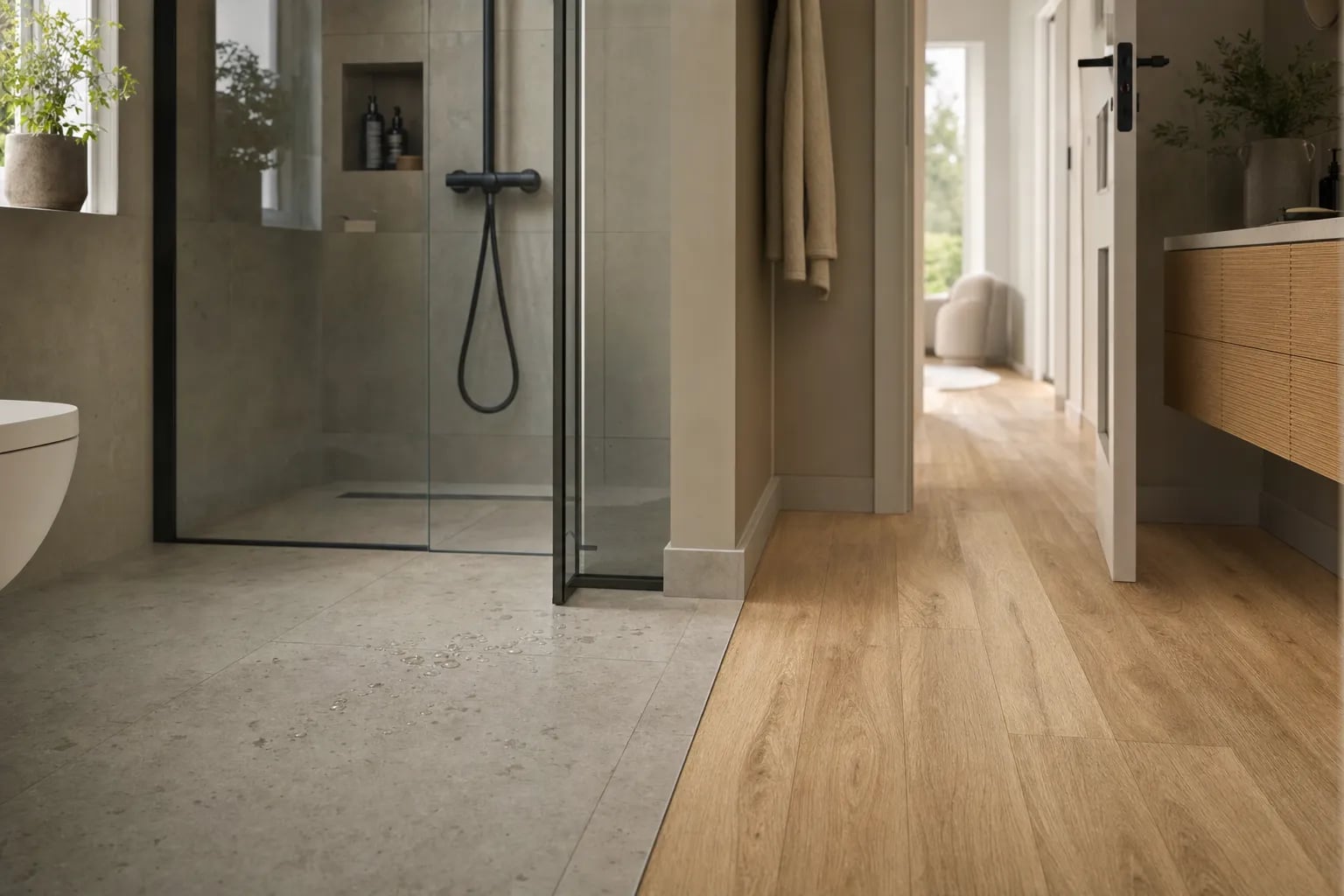
When the conversation turns to a bathroom or a utility room, the choice usually comes down to the same two favourites, and both are right answers — only the priorities differ. Porcelain tiles win on longevity and on sheer indifference to heat, chemicals and scratching: this is a floor for decades, untroubled by hair dye or a dropped bottle of perfume. Vinyl answers with warmth and comfort — its surface is kinder to bare feet even without underfloor heating, the floor is quieter, and a dropped object is unlikely to shatter. The budgets differ as well: glue-down LVT starts at 16,95 €/m² and porcelain tiles at 35,95 €/m², with fitting on top. Tiling is priced locally and varies widely from one European country to the next, so treat figures in the region of 15–25 €/m² as an indicative market rate rather than our price, and ask two or three local fitters for a firm quote. A practical compromise many of our customers settle on: tiles in the bathroom and entrance lobby, SPC vinyl in the kitchen and hallway. The wettest zones get maximum protection, and the living areas get one continuous, warm floor with no thresholds.
Joints and edges — where the real risk lies
Even a fully waterproof covering protects only as far as its joints and perimeter are sealed. Water that gets underneath the floor may damage not the covering but the subfloor: damp concrete, mould, a stale smell. In wet areas, then, the quality of the installation matters just as much as the type of covering.
Click-jointed SPC is a floating floor, so in wet areas its perimeter against the walls must be sealed with silicone — water is then left with no route in, either through the joints or around the edges. Glue-down LVT is simpler still in this respect: bonded over the full area, it leaves no voids beneath the floor in the first place. With tiles, the seal comes from the grout, and rectified edges allow joints only a few millimetres wide — neat to look at and easy to keep clean. We explained why precise edges change the whole result of a tiling job in our article on rectified tiles.
Underfloor heating in damp rooms
In a damp room, underfloor heating brings a double benefit: a warm floor dries faster and collects less condensation, and in a bathroom it is simply pleasant underfoot. All of our porcelain tiles and the whole SPC vinyl range work with underfloor heating without reservation. Engineered oak parquet is suitable too, with one condition — it must be bonded to the subfloor so that heat is transferred efficiently and evenly. Detailed temperature and installation guidance is in our guide to flooring for underfloor heating.
What does waterproof flooring cost?
The budget range is wide but manageable for any project: glue-down LVT vinyl from 16,95 €/m², click SPC from 25,95 €/m², porcelain tiles from 35,95 €/m², marble-look tiles from 39,95 €/m² and three-layer engineered oak parquet from 37,95 €/m², all incl. VAT. Browse the tile category and the vinyl flooring range, and note that parquet and vinyl models can be handled at home first — order up to 3 free samples (we do not send tile samples). If you are torn between several coverings, tell us about the room and we will shortlist the models that fit your space and budget. Pallet delivery is available across the EU; the cost and the lead time are shown at checkout or quoted on request.
Frequently asked questions
Which flooring is the most waterproof?
Two coverings are genuinely waterproof: porcelain tiles and vinyl flooring (SPC and LVT). The water absorption of porcelain is close to zero, so it suits even the wettest areas, while the stone-polymer core of vinyl takes up no water at all — the floor does not change even under standing water.
Can you lay engineered oak parquet in a bathroom?
We would not recommend it. A bathroom with direct water and constant steam puts natural wood under too much strain. Engineered oak parquet is a good fit for a kitchen, provided spills are wiped up straight away; for wet areas choose porcelain tiles or vinyl.
What is the difference between SPC and LVT vinyl?
SPC has a rigid core of stone powder and polymers and is laid floating with a click system, while glue-down LVT is more flexible, 2–2.5 mm thick and bonded over the full floor area. Both types are 100% waterproof — they differ in installation, thickness and feel underfoot.
Why is laminate unsuitable for damp rooms?
Laminate is built on a high-density fibreboard (HDF) core that absorbs water and swells: the edges lift and the surface goes wavy. The process is irreversible and the damaged area has to be replaced, which is why we do not recommend laminate for damp rooms.
Does waterproof flooring work with underfloor heating?
Yes. All of our porcelain tiles and the whole SPC vinyl range work with underfloor heating without reservation. Engineered oak parquet is suitable too, but it must be bonded to the subfloor so that the heat is transferred evenly.